

Kirjailija
Stuart Henry
Kirjat ja teokset yhdessä paikassa: 22 kirjaa, julkaisuja vuosilta 1992-2025, suosituimpien joukossa Villa Elsa. Vertaile teosten hintoja ja tarkista saatavuus suomalaisista kirjakaupoista.
22 kirjaa
Kirjojen julkaisuhaarukka 1992-2025.

Villa Elsa: A Story of German Family Life
Stuart Henry
Createspace Independent Publishing Platform
2014
nidottu

This book considers the social and economic arrangements that would be necessary for rational mechanisms of exchange and distribution to emerge, function, and remain viable if extreme conditions produced an absence or the severe destruction of an institutional infrastructure and of resource endowments. Written by an economist, a sociologist, and an anthropologist, the study confronts such radical circumstances from an interdisciplinary perspective, thereby rethinking and revising some cherished conventional economic and social assumptions.At one level, the book discusses the kinds of market structures that would be viable under different socioeconomic conditions. At another level, the analysis questions monolithic approaches to applied economic analysis and policy based on what works under existing conditions. To illustrate the applicability of theoretical modeling, the authors consider two policy areas: economic recovery from a major societal disaster and economic development. The book will be of particular interest to students of applied economics, but it will also be of interest to those concerned with social ecology, economy and society, economic history, economic anthropology, applied sociology, and developmental studies. It will be especially valuable to scholars in Eastern European and socialist economic systems that are currently seeking to establish market economies.
This significantly expanded edition of Essential Criminology covers the broadest range of criminological theories—the essential criminological theories—from longstanding ones such as classical theory and strain theory to recently introduced ones such as ultra-realism and green cultural criminology. Whether all are “essential” depends on one’s theoretical stance. The value of this text is its carefully designed comparative analysis, which helps readers consider their relative contribution to the field. Originally designed as an alternative to lengthy and expensive introductory texts, Essential Criminology provides a concise, yet comprehensive overview of the field. The book offers a clear, structured, student-friendly, critical analytical examination of the nature of crime, theories of crime causation, and their criminal justice policy implications. Causal theories covered range from micro-level classical and rational choice to biological psychological, social learning, social control, and interactionist perspectives, to macro-level social ecology, anomie/strain, conflict, Marxist, feminist, and postmodernist theories. Over its 26-year history the book has added new theoretical perspectives as these have gained prominence. New to this edition are chapters on critical and ultra-realism, and critical green criminology and discussions of zemiology, critical race theory, and quantum holographic criminology. The authors have also expanded some theoretical frameworks that had previously been underdeveloped such as opportunity theory, subcultural theory, and social constructionism.Essential Criminology contextualizes criminology in the globally interdependent 21st century, addressing the crimes of terrorism, global pandemics, and climate change. With its cutting-edge updates, illustrative real-world examples, and student-friendly study tools, including analytically comparable summary charts exposing each theory's ontological assumptions, this text was designed primarily for undergraduate criminology courses, but has also been adopted by community colleges and graduate programs in criminology, sociology, and political science.

This significantly expanded edition of Essential Criminology covers the broadest range of criminological theories—the essential criminological theories—from longstanding ones such as classical theory and strain theory to recently introduced ones such as ultra-realism and green cultural criminology. Whether all are “essential” depends on one’s theoretical stance. The value of this text is its carefully designed comparative analysis, which helps readers consider their relative contribution to the field. Originally designed as an alternative to lengthy and expensive introductory texts, Essential Criminology provides a concise, yet comprehensive overview of the field. The book offers a clear, structured, student-friendly, critical analytical examination of the nature of crime, theories of crime causation, and their criminal justice policy implications. Causal theories covered range from micro-level classical and rational choice to biological psychological, social learning, social control, and interactionist perspectives, to macro-level social ecology, anomie/strain, conflict, Marxist, feminist, and postmodernist theories. Over its 26-year history the book has added new theoretical perspectives as these have gained prominence. New to this edition are chapters on critical and ultra-realism, and critical green criminology and discussions of zemiology, critical race theory, and quantum holographic criminology. The authors have also expanded some theoretical frameworks that had previously been underdeveloped such as opportunity theory, subcultural theory, and social constructionism.Essential Criminology contextualizes criminology in the globally interdependent 21st century, addressing the crimes of terrorism, global pandemics, and climate change. With its cutting-edge updates, illustrative real-world examples, and student-friendly study tools, including analytically comparable summary charts exposing each theory's ontological assumptions, this text was designed primarily for undergraduate criminology courses, but has also been adopted by community colleges and graduate programs in criminology, sociology, and political science.

Introduction to International Studies provides students with scholarly essays and articles to familiarize them with the field of international studies and prepare them to conduct undergraduate research while abroad. Students learn how to successfully navigate another culture and how to conduct meaningful cross-cultural comparative research.Part I of the anthology introduces readers to the area of international studies, along with the concepts of a global society, culture, and intercultural communication. In Part II, students read about various social science research methods, including qualitative research, quantitative research, and the literature review process. Part III is focused on issues related to cross-cultural research practices. Students learn about ethical principles, cultural adaptation, and best practices to ensure a successful study abroad experience.Introduction to International Studies is designed to support students enrolled in courses that afford them the opportunity to conduct exploratory social science research in another country while studying abroad.
Initially designed to accompany Mark Lanier and Stuart Henry's best-selling Essential Criminology textbook, this new reader is an up-to-date companion text perfect for all students of introductory criminology and criminological theory courses. The Essential Criminology Reader contains 30 original articles on current developments in criminological theory. Commissioned specifically for The Reader, these short essays were written by leading scholars in the field. Each chapter complements one of 13 different theoretical perspectives covered in Lanier and Henry's Essential Criminology text and contains between two and three articles from leading theorists on each perspective. Each chapter of The Reader features: a brief summary of the main ideas of the theory the ways the author's theory has been misinterpreted/distorted criticisms by others of the theory and how the author has responded a summary of the balance of the empirical findings the latest developments in their theoretical position policy implications/practice of their theory.
In the fourth edition of Essential Criminology, authors Mark M. Lanier, Stuart Henry, and Desire .M. Anastasia build upon this best-selling critical review of criminology, which has become essential reading for students of criminology in the 21st century.Designed as an alternative to overly comprehensive, lengthy, and expensive introductory texts, Essential Criminology is, as its title implies, a concise overview of the field. The book guides students through the various definitions of crime and the different ways crime is measured. It then covers the major theories of crime, from individual-level, classical, and rational choice to biological, psychological, social learning, social control, and interactionist perspectives. In this latest edition, the authors explore the kind of criminology that is needed for the globally interdependent twenty-first century. With cutting-edge updates, illustrative real-world examples, and new study tools for students, this text is a necessity for both undergraduate and graduate courses in criminology.

The new edition of this popular introduction explores the meaning of social deviance in contemporary society. It traces the path by which we create deviance: how we single out behavior, ideas, and appearances that differ from the “norm,” label them as either offensive or acceptable, and then condemn or celebrate them. The book explains what kinds of behavior are banned and who bans them, exposing the important political influences underlying these processes. Refreshed with a new engaging, accessible style, the second edition features expanded treatment of the theories of deviance, new material on positive deviance, and updated references and contemporary examples throughout. At its core, Social Deviance looks at who becomes deviant and why. It delves into the multiple motives that cause rule-breakers to behave badly in the eyes of those they offend or creatively in the eyes of those they please, and it reveals the way deviants think about their actions, their moral identity, and their fellow moral outcasts.
The new edition of this popular introduction explores the meaning of social deviance in contemporary society. It traces the path by which we create deviance: how we single out behavior, ideas, and appearances that differ from the “norm,” label them as either offensive or acceptable, and then condemn or celebrate them. The book explains what kinds of behavior are banned and who bans them, exposing the important political influences underlying these processes. Refreshed with a new engaging, accessible style, the second edition features expanded treatment of the theories of deviance, new material on positive deviance, and updated references and contemporary examples throughout. At its core, Social Deviance looks at who becomes deviant and why. It delves into the multiple motives that cause rule-breakers to behave badly in the eyes of those they offend or creatively in the eyes of those they please, and it reveals the way deviants think about their actions, their moral identity, and their fellow moral outcasts.
This book, first published in 1983, looks at discipline in industry and shows how private justice is integrally bound up with formal law. It is a timely examination of the forms of social control that exist ostensibly outside the formal legal system but on which it crucially depends. Private Justice: Towards Integrated Theorising in the Sociology of Law will be of interest to students of law, sociology, and criminology. Dr. Stuart Henry is currently Professor and Director of the School of Public Affairs at San Diego State University where he has been since 2006. Since leaving Trent Polytechnic (now Nottingham Trent University) in 1983 he has held positions in the United States at Eastern Michigan University, Wayne State University, and the University of Texas at Arlington. He is the author or editor of 30 books and over 100 articles on crime, deviance and social control.

"The anthology Law in Society explores how law shapes and is shaped by societies. The selections stem from a view of law as an integral part of the wider socio-political economy and one of its central institutions. The introduction familiarizes students with definitions and explanations of criminal law, explores the functions of law, and provides an overview of the theories of law covered in the rest of the book. The first section of the text examines sources of law, natural law theory, and the concept of positive or formal law. The second section considers the origins of law in social structures and provides an overview of sociology of law. The third section is devoted to sources of law and social control such as custom, social norms, and group processes. The final section introduces critical theories of law and considers recent developments in alternative dispute resolution and restorative justice. Through reading Law in Society students come to recognize that as a society changes, so too do its laws and legal system. The book is well suited to courses in criminal justice and sociology, as well as those in social or cultural anthropology. Stuart Henry earned his Ph.D. at the University of Kent, United Kingdom. He is director of the School of Public Affairs at San Diego State University and former co-editor of Western Criminology Review. Alan Mobley received his Ph.D. at the University of California, Irvine and is an associate professor of public affairs and criminal justice at San Diego State University. Paul Kaplan holds a Ph.D. in criminology, law, and society from the University of California, Irvine. He is an associate professor of criminal justice at San Diego State University."

This book, first published in 1983, looks at discipline in industry and shows how private justice is integrally bound up with formal law. It is a timely examination of the forms of social control that exist ostensibly outside the formal legal system but on which it crucially depends. Private Justice: Towards Integrated Theorising in the Sociology of Law will be of interest to students of law, sociology, and criminology. Dr. Stuart Henry is currently Professor and Director of the School of Public Affairs at San Diego State University where he has been since 2006. Since leaving Trent Polytechnic (now Nottingham Trent University) in 1983 he has held positions in the United States at Eastern Michigan University, Wayne State University, and the University of Texas at Arlington. He is the author or editor of 30 books and over 100 articles on crime, deviance and social control.

Essential Criminology, 4th Edition
Desire' Anastasia; Mark Lanier; Stuart Henry
Westview Press Inc
2014
pokkari
In the fourth edition of Essential Criminology , authors Mark M. Lanier, Stuart Henry, and Desiré J.M. Anastasia build upon this best-selling critical review of criminology, which has become essential reading for students of criminology in the 21st century.Designed as an alternative to overly comprehensive, lengthy, and expensive introductory texts, Essential Criminology is, as its title implies, a concise overview of the field. The book guides students through the various definitions of crime and the different ways crime is measured. It then covers the major theories of crime, from individual-level, classical, and rational choice to biological, psychological, social learning, social control, and interactionist perspectives. In this latest edition, the authors explore the kind of criminology that is needed for the globally interdependent twenty-first century. With cutting-edge updates, illustrative real-world examples, and new study tools for students, this text is a necessity for both undergraduate and graduate courses in criminology.

Paris Days and Evenings ... with ... Illustrations.
Stuart Henry
British Library, Historical Print Editions
2011
pokkari
Criminological Theory is an examination of the major theoretical perspectives in criminology today. Werner J. Einstadter and Stuart Henry lay bare various theorists' ideas about human nature, social structure, social order, concepts of law, crime and criminals, the logic of crime causation, and the policies and practices that follow from these premises. Material is presented and organized around these analytic and critical dimensions throughout the text. Criminological Theory provides students with a clear overview of the subject that enables informed comparisons among diverse concepts. Abstract concepts are explained clearly to maximize the significance of each theoretical framework. The authors cover the major literature in an engaging, comprehensive, and accessible way, allowing students to develop a critical understanding of foundational and contemporary ideas in Criminology.
Criminological Theory is an examination of the major theoretical perspectives in criminology today. Werner J. Einstadter and Stuart Henry lay bare various theorists' ideas about human nature, social structure, social order, concepts of law, crime and criminals, the logic of crime causation, and the policies and practices that follow from these premises. Material is presented and organized around these analytic and critical dimensions throughout the text. Criminological Theory provides students with a clear overview of the subject that enables informed comparisons among diverse concepts. Abstract concepts are explained clearly to maximize the significance of each theoretical framework. The authors cover the major literature in an engaging, comprehensive, and accessible way, allowing students to develop a critical understanding of foundational and contemporary ideas in Criminology.
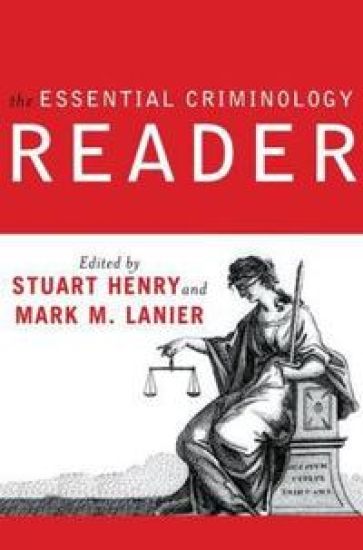
Initially designed to accompany Mark Lanier and Stuart Henry's best-selling Essential Criminology textbook, this new reader is an up-to-date companion text perfect for all students of introductory criminology and criminological theory courses. The Essential Criminology Reader contains 30 original articles on current developments in criminological theory. Commissioned specifically for The Reader , these short essays were written by leading scholars in the field. Each chapter complements one of 13 different theoretical perspectives covered in Lanier and Henry's Essential Criminology text and contains between two and three articles from leading theorists on each perspective. Each chapter of The Reader features: a brief summary of the main ideas of the theory the ways the author's theory has been misinterpreted istorted criticisms by others of the theory and how the author has responded a summary of the balance of the empirical findings the latest developments in their theoretical position policy implications/practice of their theory
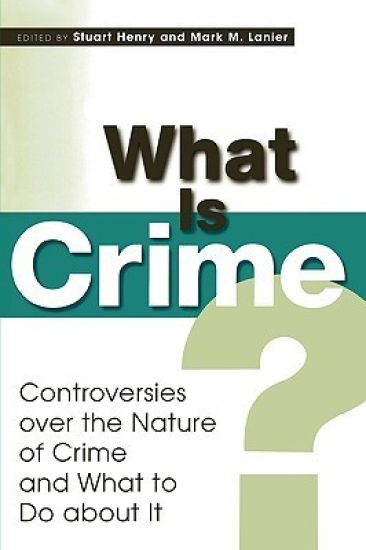
For decades, scholars have disagreed about what kinds of behavior count as crime. Is it simply a violation of the criminal law? Is it behavior that causes serious harm? Is the seriousness affected by how many people are harmed and does it make a difference who those people are? Are crimes less criminal if the victims are black, lower class, or foreigners? When corporations victimize workers is that a crime? What about when governments violate basic human rights of their citizens, and who then polices governments? In What Is Crime? the first book-length treatment of the topic, contributors debate the content of crime from diverse perspectives: consensus/moral, cultural/relative, conflict/power, anarchist/critical, feminist, racial/ethnic, postmodernist, and integrational. Henry and Lanier synthesize these perspectives and explore what each means for crime control policy.