Kirjojen hintavertailu. Mukana 12 532 238 kirjaa ja 12 kauppaa.

Kirjailija

Stuart S. Nagel

Kirjat ja teokset yhdessä paikassa: 31 kirjaa, julkaisuja vuosilta 1977-2021, suosituimpien joukossa Public Policy. Vertaile teosten hintoja ja tarkista saatavuus suomalaisista kirjakaupoista.

Mukana myös kirjoitusasut: Stuart S Nagel

31 kirjaa

Kirjojen julkaisuhaarukka 1977-2021.

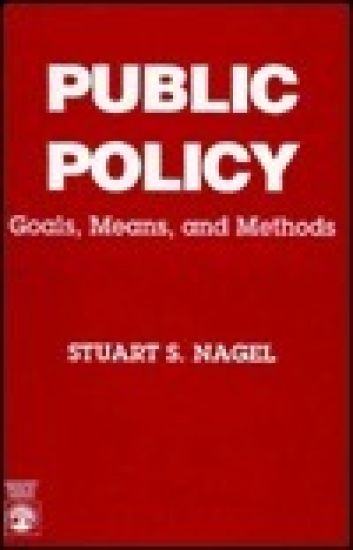
Public Policy

Public Policy

Stuart S. Nagel

University Press of America
1991
nidottu
The author details the basic concepts and principles of systematic public policy evaluation which involves processing goals to be achieved, the means available for achieving these goals and methods of determining relations and drawing conclusions on the best policies or combinations of policies. Filled with examples, visual aids, questions, references, indexes and glossaries, as well as other useful features. Originally published in 1984 by St. Martin's Press, this edition contains a new preface by the author.
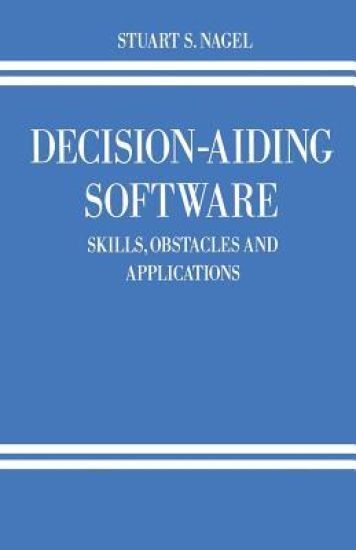
Decision-Aiding Software

Decision-Aiding Software

Stuart S. Nagel

Palgrave Macmillan
1991
nidottu
The aim of this book is to clarify what is involved in using decision-aiding software in evaluative decision-making at a non-technical level. Topics covered include the skills that software enhances, the obstacles that it helps overcome, and the applications to diverse fields.
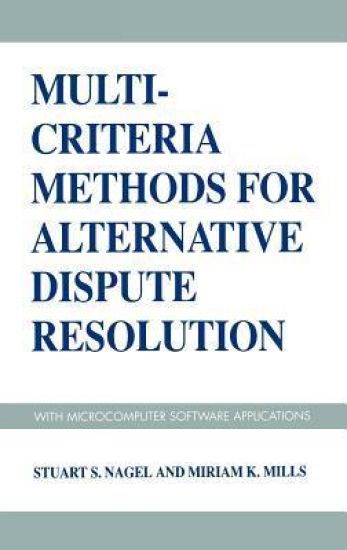
Multi-Criteria Methods for Alternative Dispute Resolution

Multi-Criteria Methods for Alternative Dispute Resolution

Stuart S. Nagel; Miriam K. Mills

Praeger Publishers Inc
1990
sidottu
This work examines the topic of dispute resolution, specifically the multi-criteria approach that seeks to arrive at a conclusion that is mutually beneficial to both sides. Through the use of decision-aiding software, the multi-criteria approach can allow each side to give on various criteria that are not important to it, but are important to the other side. In this way, a super-optimum solution may even be met, in which both sides receive something significantly better than they had expected. Such a result is very difficult, if not impossible, to achieve, Stuart Nagel points out, in traditional single-dimension dispute resolution.Nagel and Mills describe the nature of multi-criteria dispute resolution utilizing decision-aiding software. The first part of the book clarifies the general character of computer-aided negotiation, computer-aided mediation, and super-optimizing dispute resolution. Part two guides the reader through the use of Policy/Goal Percentaging (P/G%) decision-aiding software, centering on general decision-making, negotiation, mediation, and prediction of outcomes. Multi-criteria resolution in the context of rule-making and legal policy disputes is the focus of part three, where such matters as determining initial alternatives and criteria, resolving deadlocks, and arriving at super-optimum solutions are discussed. Part four emphasizes dispute resolution in the context of rule-applying and litigation disputes, as well as mediation at the international level and between lawyers and clients. The final part deals with future applications, such as computer-aided mediation and group decision-making with phone modems. The book's combination of decision-aiding software, arbitration-mediation, and super-optimum expansionist decision-making brings a truly innovative approach to the topic of dispute resolution. This volume should be a welcome addition to academic, legal, and public libraries, and a valuable reference work for lawyers, law students, and legal professors and researchers.
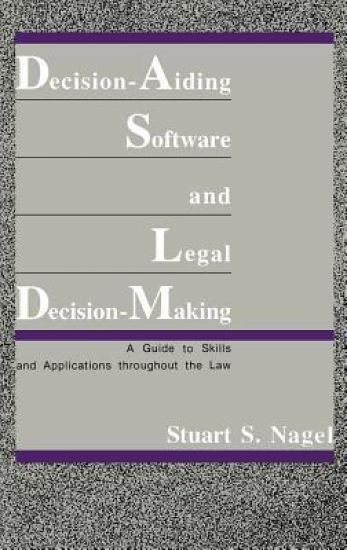
Decision-Aiding Software and Legal Decision-Making

Decision-Aiding Software and Legal Decision-Making

Stuart S. Nagel

Praeger Publishers Inc
1989
sidottu
The use of microcomputers as decision aids in law practice is increasing rapidly. Nagel here shows how developments in software over the last few years are making microcomputers practically indispensable to lawyers as decision aids. This is in contrast to his earlier book on Microcomputers as Decision Aids in Law Practice. It dealt speculatively with ways in which decision-aiding software could be used by lawyers for judicial prediction, litigation strategy, allocating scarce resources, and negotiation-mediation.The book is divided into three parts covering general developments, specific lawyer skills, and application to all fields of law. The first part previews various uses of decision-aiding software by practicing lawyers, including a general discussion of the potential and actual benefits of such software. How decision-aiding software enhances specific lawyer skills comprises the second and largest part of the work. Among the topics discussed are computer-aided counseling, computer-aided mediation, legal policy evaluation and computer-aided advocacy, law prediction, and legal administration. In the third part, Nagel assesses applications of decision-aiding software to all fields of law, with an emphasis on contracts, property, torts, family law, criminal law, constitutional law, economic regulation, international law, civil procedure, and criminal procedure. In a provocative concluding chapter, he deals with the thorny issues of individual ethics and professional responsibility in the context of microcomputers. Because decision-aiding software encourages decision makers to be much more explicit about their goals than they otherwise would be, its use raises questions as to whose goals should be pursued and to what degree. This is a nuts-and-bolts guidebook that will be a valuable tool for practicing attorneys with some knowledge of microcomputers and is recommended reading for legal scholars and law students.
Policy Studies

Policy Studies

Stuart S. Nagel

Praeger Publishers Inc
1989
nidottu
As the field's principal organizer and leading promoter, one is indebted to Nagel for his energy, enthusiasm, and resourcefulness. This volume is imbued with such qualities. It covers vast territory, insistently counters the skeptics, and develops original schema for evaluating the work of the field. Furthermore, as vintage Nagel, the book is highly structured, with many definitions, lists, and prenamed series of ideas. . . . Nagel is unswervingly convinced of the correctness of the rationalist perspective, and anchors himself firmly in behavioralist political science while accepting the contributions from other social sciences. ChoiceThe purpose of this work is twofold. First, it attempts to integrate the basic ideas that relate to policy studies. These include the definition of concepts, the establishment of criteria for judging policy studies researh, and the clarification of policy goals. Second, the volume proposes to evaluate the methods of policy evaluation themselves, and to assess the field as a whole. Designed to serve as a definitive analysis of policy studies, this volume covers basic concepts, research criteria, societal goals, and policy altenatives. It also examines analytic methods, optimizing, statistics, quasi-experimentation, behaviorism, multicriteria decison making, evaluation, research, legal analysis, and conflicting critiques of the field.
Policy Studies

Policy Studies

Stuart S. Nagel

Praeger Publishers Inc
1988
sidottu
Less fragmented than the author's earlier work, this book synthesizes Nagel's perspective on the field of policy analysis. As the field's principal organizer and leading promoter, one is indebted to Nagel for his energy, enthusiasm and resourcefulness. This volume is itself imbued with such qualities. It covers vast territory, insistently counters the skeptics, and develops original schema for evaluating the work of the field. Furthermore, as vintage Nagel, the book is highly structured, with many definitions, lists, and prenamed series of ideas. The author provides numerous hypothetical examples of his points, worked out in succinct formulas and terse explanations. Nagel is unswervingly convinced of the correctness of the rationalist perspective, and anchors himself firmly in behavioralist political science while accepting the contributions from other social sciences. Not one to qualify a statement or beat around the bush, the author enunciates many guiding principles and values, such as effectiveness, efficiency and equity. Nagel discusses software options for those interested in conducting analysis with microcomputers. He also gives advice on teaching with computers. Important for graduate students and university libraries. ChoiceThe purpose of this work is twofold. First, it attempts to integrate the basic ideas that relate to policy studies. These include the definition of concepts, the establishment of criteria for judging policy studies research, and the clarification of policy goals. Second, the volume proposes to evaluate the methods of policy evaluation themselves, and to assess the field as a whole.Designed to serve as a definitive analysis of policy studies, this volume covers basic concepts, research criteria, societal goals, and policy alternatives. It also examines analytic methods, optimizing, statistics, quasi-experimentation, behavioralism, multicriteria decision making, evaluation, research, legal analysis, and conflicting critiques of the field. It was written for researchers and instructors of public policy studies, and will also assist public policy specialists and others interested in the application of social science and other fields of knowledge to important public policy issues.
Microcomputers as Decision Aids in Law Practice

Microcomputers as Decision Aids in Law Practice

Stuart S. Nagel

Praeger Publishers Inc
1987
sidottu
This book demonstrates the use of the personal computer as an integral component of legal decision making. Nagel begins with an overview of the use of microcomputers as a tool in the legal decision-making process. He reviews in detail the currently available decision-aiding software. Several important areas of decision-making are covered, including predicting the outcome of future cases in light of previous relevant cases and present facts; litigation choices such as whether to go to trial or to settle; allocating attorney resources; and negotiating and mediating. The book can help one's law practice more profitable, less time-consuming, and more competitive.
Law, Policy, and Optimizing Analysis

Law, Policy, and Optimizing Analysis

Stuart S. Nagel

Praeger Publishers Inc
1986
sidottu
This book can improve the effectiveness of those working within the legal process and in legal policy. It seeks to clarify how the examination of risk levels, time allocation, and other legal policy situations can lead to optimum choices. The principles discussed are amplified by illustrative examples covering such important subjects as right to counsel, plea bargaining, client selection, pretrial release, jury size, crime prevention, delay reduction, and many other controversial and problematic issues of concern to the practicing attorney, the legal scholar, and the legal policymaker. Nagel offers the reader realistic applications of the theories provided, and is unique in his hands-on direct relation of those theories to the decision-making process.
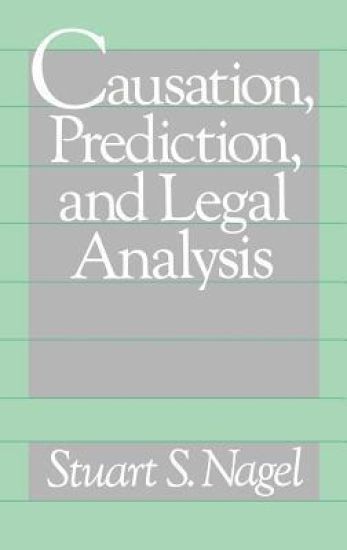
Causation, Prediction, and Legal Analysis

Causation, Prediction, and Legal Analysis

Stuart S. Nagel

Praeger Publishers Inc
1986
sidottu
Nagel draws on his experience as a practicing attorney and legal scholar to present a clear and concise discussion of the analytical methods in law which deal with causation and prediction. Within the legal arena, causal analysis explains the factors involved that cause legal policies/decisions to be adopted and the impact a legal policy is likely to have, and why. Predictive analysis is an attempt to forecast the outcome of a legal action and is especially useful for those involved in courtroom procedures. Causation, Prediction, and Legal Analysis is the only book available on this broadly focused subject, encompassing a thorough exposition of both the theory and application of causation and prediction.
Policy Analysis in Social Science Research

Policy Analysis in Social Science Research

Stuart S. Nagel; Marian Neef

University Press of America
1985
nidottu
An invaluable guide for policy-makers, researchers and advanced students, this volume focuses on the more interesting aspects of leading methodological problems that bridge both social science and policy analysis. The authors discuss statistical inference, statistical prediction and causal analysis in the context of public policy evaluation. Originally published in 1979 by Sage Publications.
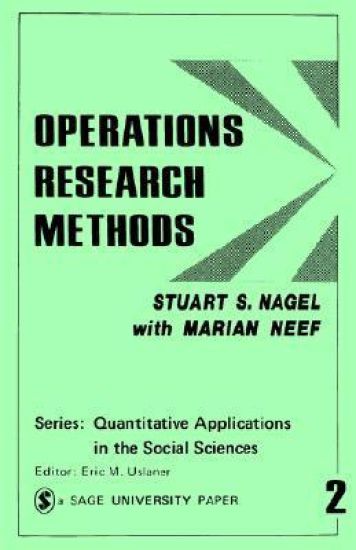
Operations Research Methods

Operations Research Methods

Stuart S. Nagel; Marian Neef

SAGE Publications Inc
1977
nidottu
A discussion of basic concepts and methods associated with the application of operations research toward arriving at an optimum mix, level or choice. Three techniques are explored: linear programming, inventory modeling, and decision theory.