Kirjojen hintavertailu. Mukana 12 633 540 kirjaa ja 12 kauppaa.

Kirjailija

Stuart Sutherland

Kirjat ja teokset yhdessä paikassa: 18 kirjaa, julkaisuja vuosilta 1995-2017, suosituimpien joukossa Irrationality. Vertaile teosten hintoja ja tarkista saatavuus suomalaisista kirjakaupoista.

18 kirjaa

Kirjojen julkaisuhaarukka 1995-2017.

Irrationality

Irrationality

Stuart Sutherland; Ben Goldacre

Pinter Martin Ltd.
2013
nidottu
New, 21st anniversary edition, with a new foreword by Ben Goldacre, author of Bad Science and Bad Pharma, and an afterword by James Ball, covering developments in our understanding of irrationality over the last two decades. Why do doctors, army generals, high-ranking government officials and other people in positions of power make bad decisions that cause harm to others? Why do prizes serve no useful function? Why are punishments so ineffective? Why is interviewing such an unsatisfactory method of selection? Irrationality is a challenging and thought-provoking book that draws on statistical concepts, probability theory and a mass of intriguing research to expose the failings of human reasoning, judgement and intuition. The author explores the inconsistencies of human behaviour, and discovers why even the experts find it so hard to make rational and unbiased decisions. Written with clarity and occasional flashes of wry humour, this classic volume is just as relevant today as when it was first written twenty-one years ago.
RTL Modeling with SystemVerilog for Simulation and Synthesis: Using SystemVerilog for ASIC and FPGA Design
This book is both a tutorial and a reference for engineers who use the SystemVerilog Hardware Description Language (HDL) to design ASICs and FPGAs. The book shows how to write SystemVerilog models at the Register Transfer Level (RTL) that simulate and synthesize correctly, with a focus on proper coding styles and best practices.SystemVerilog is the latest generation of the original Verilog language, and adds many important capabilities to efficiently and more accurately model increasingly complex designs. This book reflects the SystemVerilog-2012/2017 standards. This book is for engineers who already know, or who are learning, digital design engineering. The book does not present digital design theory; it shows how to apply that theory to write RTL models that simulate and synthesize correctly. The creator of the original Verilog Language, Phil Moorby says about this book (an excerpt from the book's Foreword): "Many published textbooks on the design side of SystemVerilog assume that the reader is familiar with Verilog, and simply explain the new extensions. It is time to leave behind the stepping-stones and to teach a single consistent and concise language in a single book, and maybe not even refer to the old ways at all If you are a designer of digital systems, or a verification engineer searching for bugs in these designs, then SystemVerilog will provide you with significant benefits, and this book is a great place to learn the design aspects of SystemVerilog."
A Bibliography of the Seven Weeks' War of 1866

A Bibliography of the Seven Weeks' War of 1866

Stuart Sutherland

Helion Company
2013
sidottu
Stuart Sutherland’s work is the first modern bibliography in English of the Seven Weeks’ War of 1866. It includes books in English, French, German and Italian and is subdivided into sections on general histories particular campaigns and battles (Hanoverian Bohemian-Moravian Italian southern German and naval), biographies, journals, reminiscences by participants and state organizational and regimental histories-the last divided by arm of service. Many rare works are covered and there are editorial comments in the sections covering general histories and campaign/battle accounts. This is an indispensable work for beginning serious study of the conflict. This comprehensive reference lists in excess of 1200 titles and will prove invaluable to historians, researchers, collectors and librarians.
The Organization of the German State Forces in 1866
The so-called Seven Weeks' War of 1866 between Prussia and Italy and Austria was notable not only for its effect on future German history but also because it was the last time the armies of the smaller German states fought as independent contingents. Forces from 30 smaller states were involved and they were either of some strength or barely able to guard their rulers' palaces. They have largely been ignored in standard histories and this book attempts to begin to redress that imbalance by presenting for the first time in English detailed information about the organization of the armies of the smaller states. States covered: Anhalt, Baden, Bavaria, Bremen, Brunswick, Frankfurt am Main, Hamburg, Hanover, Electoral Hesse, Grand Ducal Hesse, Landgravial Hesse, Liechtenstein, Limburg, Lippe-Detmold, Lübeck, Luxembourg, The Mecklenburgs, Nassau, Oldenburg, The Reusses, Saxe-Altenburg, Saxe-Coburg-Gotha, Saxe-Meiningen, Saxe-Weimar-Eisenach, Saxony, Schaumburg-Lippe, Schwarzburg-Rudolstadt, Schwarzburg-Sondershausen, Waldeck, Württemberg. An introduction places this information in context and appendices give selected orders of battle and a chronology of the preliminaries and main events of the war in Germany.
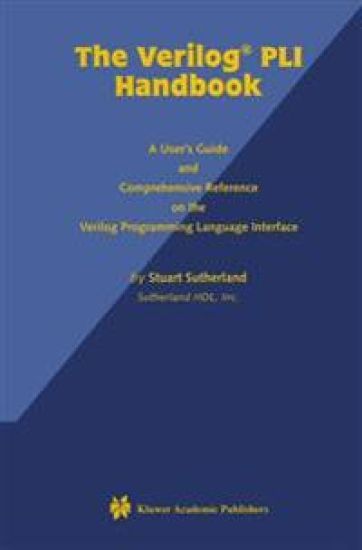
The Verilog PLI Handbook

The Verilog PLI Handbook

Stuart Sutherland

Springer-Verlag New York Inc.
2013
nidottu
by Maq Mannan President and CEO, DSM Technologies Chairman of the IEEE 1364 Verilog Standards Group Past Chairman of Open Verilog International One of the major strengths of the Verilog language is the Programming Language Interface (PLI), which allows users and Verilog application developers to infinitely extend the capabilities of the Verilog language and the Verilog simulator. In fact, the overwhelming success of the Verilog language can be partly attributed to the exi- ence of its PLI. Using the PLI, add-on products, such as graphical waveform displays or pre and post simulation analysis tools, can be easily developed. These products can then be used with any Verilog simulator that supports the Verilog PLI. This ability to create thi- party add-on products for Verilog simulators has created new markets and provided the Verilog user base with multiple sources of software tools. Hardware design engineers can, and should, use the Verilog PLI to customize their Verilog simulation environment. A Company that designs graphics chips, for ex- ple, may wish to see the simulation results of a new design in some custom graphical display. The Verilog PLI makes it possible, and even trivial, to integrate custom so- ware, such as a graphical display program, into a Verilog simulator. The simulation results can then dynamically be displayed in the custom format during simulation. And, if the company uses Verilog simulators from multiple simulator vendors, this integrated graphical display will work with all the simulators.
The Verilog PLI Handbook

The Verilog PLI Handbook

Stuart Sutherland

Springer-Verlag New York Inc.
2012
nidottu
The Verilog Programming Language Interface, commonly called the Verilog PU, is one of the more powerful features of Verilog. The PU provides a means for both hardware designers and software engineers to interface their own programs to commercial Verilog simulators. Through this interface, a Verilog simulator can be customized to perform virtually any engineering task desired. Just a few of the common uses of the PU include interfacing Veri log simulations to C language models, adding custom graphical tools to a simulator, reading and writing proprietary file formats from within a simulation, performing test coverage analysis during simulation, and so forth. The applications possible with the Verilog PLI are endless. Intended audience: this book is written for digital design engineers with a background in the Verilog Hardware Description Language and a fundamental knowledge of the C programming language. It is expected that thereader: Has a basic knowledge of hardware engineering, specifically digital design of ASIC and FPGA technologies.Is familiar with the Verilog Hardware Description Language (HDL), and can write models of hardware circuits in Verilog, can write simulation test fixtures in Verilog, and can run at least one Verilog logic simulator.Knows basic C-language programming, including the use of functions, pointers, structures and file I/O. Explanations of the concepts and terminology of digital
Verilog — 2001

Verilog — 2001

Stuart Sutherland

Springer-Verlag New York Inc.
2012
nidottu
by Phil Moorby The Verilog Hardware Description Language has had an amazing impact on the mod­ em electronics industry, considering that the essential composition of the language was developed in a surprisingly short period of time, early in 1984. Since its introduc­ tion, Verilog has changed very little. Over time, users have requested many improve­ ments to meet new methodology needs. But, it is a complex and time consuming process to add features to a language without ambiguity, and maintaining consistency. A group of Verilog enthusiasts, the IEEE 1364 Verilog committee, have broken the Verilog feature doldrums. These individuals should be applauded. They invested the time and energy, often their personal time, to understand and resolve an extensive wish-list of language enhancements. They took on the task of choosing a feature set that would stand up to the scrutiny of the standardization process. I would like to per­ sonally thank this group. They have shown that it is possible to evolve Verilog, rather than having to completely start over with some revolutionary new language. The Verilog 1364-2001 standard provides many of the advanced building blocks that users have requested. The enhancements include key components for verification, abstract design, and other new methodology capabilities. As designers tackle advanced issues such as automated verification, system partitioning, etc., the Verilog standard will rise to meet the continuing challenge of electronics design.
A Bibliography of the Seven Weeks' War of 1866

A Bibliography of the Seven Weeks' War of 1866

Stuart Sutherland

Helion Company
2011
nidottu
The first modern bibliography in English of the Seven Weeks' War of 1866, it includes books in English, French, German and Italian, subdivided into sections on general histories, particular campaigns and battles (Hanoverian, Bohemian-Moravian, Italian, southern German and naval), biographies, journals and reminiscences by participants, and state organisational and regimental histories, the last divided by arm of service. Many rare works are covered, and there are editorial comments in the general histories and campaign/battle accounts. An indispensable work for beginning serious study of the conflict. This comprehensive reference lists in excess of 1,200 titles, and will prove invaluable to historians, researchers, collectors and librarians.
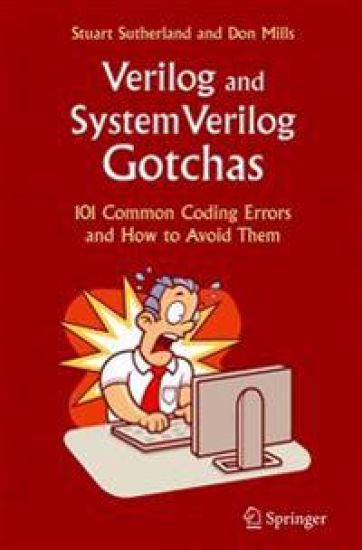
Verilog and SystemVerilog Gotchas

Verilog and SystemVerilog Gotchas

Stuart Sutherland; Don Mills

Springer-Verlag New York Inc.
2010
nidottu
In programming, “Gotcha” is a well known term. A gotcha is a language feature, which, if misused, causes unexpected - and, in hardware design, potentially disastrous - behavior. The purpose of this book is to enable engineers to write better Verilog/SystemVerilog design and verification code, and to deliver digital designs to market more quickly. This book shows over 100 common coding mistakes that can be made with the Verilog and SystemVerilog languages. Each example explains in detail the symptoms of the error, the languages rules that cover the error, and the correct coding style to avoid the error. The book helps digital design and verification engineers to recognize these common coding mistakes, and know how to avoid them. Many of these errors are very subtle, and can potentially cost hours or days of lost engineering time trying to find and debug the errors. This book is unique because while there are many books that teach the language, and a few that try to teach coding style, no other book addresses how to recognize and avoid coding errors with these languages.
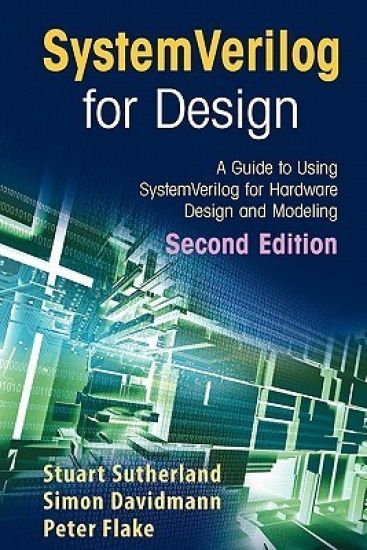
SystemVerilog for Design Second Edition

SystemVerilog for Design Second Edition

Stuart Sutherland; P. Moorby; Simon Davidmann; Peter Flake

Springer-Verlag New York Inc.
2010
nidottu
SystemVerilog is a rich set of extensions to the IEEE 1364-2001 Verilog Hardware Description Language (Verilog HDL). These extensions address two major aspects of HDL-based design. First, modeling very large designs with concise, accurate, and intuitive code. Second, writing high-level test programs to efficiently and effectively verify these large designs. The first edition of this book addressed the first aspect of the SystemVerilog extensions to Verilog. Important modeling features were presented, such as two-state data types, enumerated types, user-degined types, structures, unions, and interfaces. Emphasis was placed on the proper usage of these enhancements for simulation and synthesis. SystemVerilog for Design, Second Edition has been extensively revised on a chapter by chapter basis to include the many text and example updates needed to reflect changes that were made between the first edition of this book was written and the finalization of the new standard. It is important that the book reflect these syntax and semantic changes to the SystemVerilog language. In addition, the second edition features a new chapter that explanis the SystemVerilog "packages", a new appendix that summarizes the synthesis guidelines presented throughout the book, and all of the code examples have been updated to the final syntax and rerun using the latest version of the Synopsys, Mentor, and Cadance tools.
Breakdown

Breakdown

Stuart Sutherland

YogaWords
2010
nidottu
This acclaimed account by author of the bestselling author of Irrationailty of his own manic depression remains unique in its honesty and perception. As an eminent psychologist who suffered a severe mental breaskdown. Stuart Sutherland was ideally placed to provide an original and insightful description of his illness and often bizarre consequences. In the second part of Breakdown, Sutherland describes and assesses the various forms of therapy and drug treatments available to sufferers of manic depression and analyses the origins of mental illness. Essentail reading for anyone affected by or interested in mental illness.
The Organization of the German State Forces in 1866
The so-called Seven Weeks' War of 1866 between Prussia and Italy and Austria was notable not only for its effect on future German history but also because it was the last time the armies of the smaller German states fought as independent contingents. Forces from 30 smaller states were involved, and they were either of some strength or barely able to guard their rulers' palaces. They have largely been ignored in standard histories, and this book attempts to begin to redress that imbalance by presenting for the first time in English detailed information about the organisation of the armies of the smaller states. States covered include: Anhalt, Baden, Bavaria, Bremen, Brunswick, Frankfurt am Main, Hamburg, Hanover, Electoral Hesse, Grand Ducal Hesse, Landgravial Hesse, Liechtenstein, Limburg, Lippe-Detmold, Lübeck, Luxembourg, The Mecklenburgs, Nassau, Oldenburg, The Reusses, Saxe-Altenburg, Saxe-Coburg-Gotha, Saxe-Meiningen, Saxe-Weimar-Eisenach, Saxony, Schaumburg-Lippe, Schwarzburg-Rudolstadt, Schwarzburg-Sondershausen, Waldeck, Württemberg. An introduction places this information in context, and appendices give selected orders of battle and a chronology of the preliminaries and main events of the war in Germany.
Verilog and SystemVerilog Gotchas

Verilog and SystemVerilog Gotchas

Stuart Sutherland; Don Mills

Springer-Verlag New York Inc.
2007
sidottu
In programming, “Gotcha” is a well known term. A gotcha is a language feature, which, if misused, causes unexpected - and, in hardware design, potentially disastrous - behavior. The purpose of this book is to enable engineers to write better Verilog/SystemVerilog design and verification code, and to deliver digital designs to market more quickly. This book shows over 100 common coding mistakes that can be made with the Verilog and SystemVerilog languages. Each example explains in detail the symptoms of the error, the languages rules that cover the error, and the correct coding style to avoid the error. The book helps digital design and verification engineers to recognize these common coding mistakes, and know how to avoid them. Many of these errors are very subtle, and can potentially cost hours or days of lost engineering time trying to find and debug the errors. This book is unique because while there are many books that teach the language, and a few that try to teach coding style, no other book addresses how to recognize and avoid coding errors with these languages.
SystemVerilog for Design Second Edition

SystemVerilog for Design Second Edition

Stuart Sutherland; P. Moorby; Simon Davidmann; Peter Flake

Springer-Verlag New York Inc.
2006
sidottu
SystemVerilog is a rich set of extensions to the IEEE 1364-2001 Verilog Hardware Description Language (Verilog HDL). These extensions address two major aspects of HDL-based design. First, modeling very large designs with concise, accurate, and intuitive code. Second, writing high-level test programs to efficiently and effectively verify these large designs. The first edition of this book addressed the first aspect of the SystemVerilog extensions to Verilog. Important modeling features were presented, such as two-state data types, enumerated types, user-degined types, structures, unions, and interfaces. Emphasis was placed on the proper usage of these enhancements for simulation and synthesis. SystemVerilog for Design, Second Edition has been extensively revised on a chapter by chapter basis to include the many text and example updates needed to reflect changes that were made between the first edition of this book was written and the finalization of the new standard. It is important that the book reflect these syntax and semantic changes to the SystemVerilog language. In addition, the second edition features a new chapter that explanis the SystemVerilog "packages", a new appendix that summarizes the synthesis guidelines presented throughout the book, and all of the code examples have been updated to the final syntax and rerun using the latest version of the Synopsys, Mentor, and Cadance tools.
The Verilog PLI Handbook

The Verilog PLI Handbook

Stuart Sutherland

Springer
2002
muu
by Maq Mannan President and CEO, DSM Technologies Chairman of the IEEE 1364 Verilog Standards Group Past Chairman of Open Verilog International One of the major strengths of the Verilog language is the Programming Language Interface (PLI), which allows users and Verilog application developers to infinitely extend the capabilities of the Verilog language and the Verilog simulator. In fact, the overwhelming success of the Verilog language can be partly attributed to the exi- ence of its PLI. Using the PLI, add-on products, such as graphical waveform displays or pre and post simulation analysis tools, can be easily developed. These products can then be used with any Verilog simulator that supports the Verilog PLI. This ability to create thi- party add-on products for Verilog simulators has created new markets and provided the Verilog user base with multiple sources of software tools. Hardware design engineers can, and should, use the Verilog PLI to customize their Verilog simulation environment. A Company that designs graphics chips, for ex- ple, may wish to see the simulation results of a new design in some custom graphical display. The Verilog PLI makes it possible, and even trivial, to integrate custom so- ware, such as a graphical display program, into a Verilog simulator. The simulation results can then dynamically be displayed in the custom format during simulation. And, if the company uses Verilog simulators from multiple simulator vendors, this integrated graphical display will work with all the simulators.
Verilog — 2001

Verilog — 2001

Stuart Sutherland

Springer
2001
sidottu
by Phil Moorby The Verilog Hardware Description Language has had an amazing impact on the mod­ em electronics industry, considering that the essential composition of the language was developed in a surprisingly short period of time, early in 1984. Since its introduc­ tion, Verilog has changed very little. Over time, users have requested many improve­ ments to meet new methodology needs. But, it is a complex and time consuming process to add features to a language without ambiguity, and maintaining consistency. A group of Verilog enthusiasts, the IEEE 1364 Verilog committee, have broken the Verilog feature doldrums. These individuals should be applauded. They invested the time and energy, often their personal time, to understand and resolve an extensive wish-list of language enhancements. They took on the task of choosing a feature set that would stand up to the scrutiny of the standardization process. I would like to per­ sonally thank this group. They have shown that it is possible to evolve Verilog, rather than having to completely start over with some revolutionary new language. The Verilog 1364-2001 standard provides many of the advanced building blocks that users have requested. The enhancements include key components for verification, abstract design, and other new methodology capabilities. As designers tackle advanced issues such as automated verification, system partitioning, etc., the Verilog standard will rise to meet the continuing challenge of electronics design.
Oxford University Computing Services Guide to Digital Resources for the Humanities

Oxford University Computing Services Guide to Digital Resources for the Humanities

Frances Condron; Michael Fraser; Stuart Sutherland

West Virginia University Press
2001
nidottu
A comprehensive reference tool in humanities computing. Essays in nine disciplines describe resources and introduce the state of humanities computing. Platform, price, system requirements, and means of acquisition are noted with substantial descriptions of each project plus review citations.
The Macmillan Dictionary of Psychology

The Macmillan Dictionary of Psychology

Stuart Sutherland

Red Globe Press
1995
nidottu
This completely revised edition incorporates over a 1000 new terms that have come into usage since the first edition was published in 1987. In addition, the definitions of many of the original terms have been revised and many new usages added. The dictionary includes as many terms as possible from other related disciplines - including psychiatry, artificial intelligence, linguistics, statistics, neurology, neurophysiology, brain chemistry, genetics etc.