

Kirjailija
Sue Grand
Kirjat ja teokset yhdessä paikassa: 6 kirjaa, julkaisuja vuosilta 2002-2025, suosituimpien joukossa Transgenerational Trauma. Vertaile teosten hintoja ja tarkista saatavuus suomalaisista kirjakaupoista.
6 kirjaa
Kirjojen julkaisuhaarukka 2002-2025.
In this book, Jill Salberg and Sue Grand offer an overview of the psychoanalytic work on transgenerational trauma, rooting their perspective in attachment theory, and the social-ethical turn of Relational psychoanalysis.Transgenerational Trauma: A Contemporary Introduction is a cutting-edge study of trauma transmission across generations. Salberg and Grand consider how our forebears' trauma can leave a scar on our lives, our bodies, and on our world. They posit that, too often, we re-cycle the social violence that we were subjected to. Their unique approach embraces diverse psychoanalytic and psychodynamic theories, as they look at attachment, legacies of violence, and the role of witnessing in healing. Clinical and personal stories are interwoven with theory to elucidate the socio-historical positions that we inherit and live out. Social justice concerns are addressed throughout, in a mission to heal both individual and collective wounds.Transgenerational Trauma: A Contemporary Introduction offers a nuanced and comprehensive approach to this vital topic, and will be of interest to psychoanalysts, psychologists and other mental health professionals, as well as students and scholars of trauma studies, race and gender studies, sociology, conflict resolution, and others.
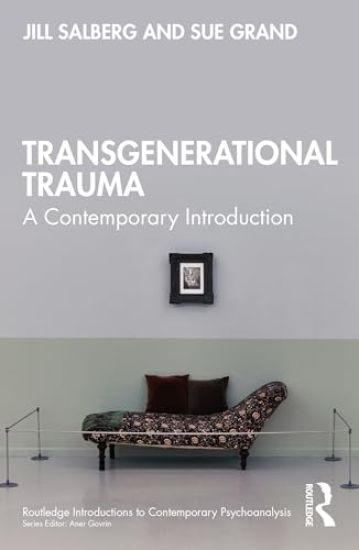
In this book, Jill Salberg and Sue Grand offer an overview of the psychoanalytic work on transgenerational trauma, rooting their perspective in attachment theory, and the social-ethical turn of Relational psychoanalysis.Transgenerational Trauma: A Contemporary Introduction is a cutting-edge study of trauma transmission across generations. Salberg and Grand consider how our forebears' trauma can leave a scar on our lives, our bodies, and on our world. They posit that, too often, we re-cycle the social violence that we were subjected to. Their unique approach embraces diverse psychoanalytic and psychodynamic theories, as they look at attachment, legacies of violence, and the role of witnessing in healing. Clinical and personal stories are interwoven with theory to elucidate the socio-historical positions that we inherit and live out. Social justice concerns are addressed throughout, in a mission to heal both individual and collective wounds.Transgenerational Trauma: A Contemporary Introduction offers a nuanced and comprehensive approach to this vital topic, and will be of interest to psychoanalysts, psychologists and other mental health professionals, as well as students and scholars of trauma studies, race and gender studies, sociology, conflict resolution, and others.

Why is it that victims of abuse so often become perpetrators, and what can psychoanalysis offer to these survivor-perpetrators, whose criminal conduct seems to transcend the possibilities of empathic psychoanalytic inquiry. In The Reproduction of Evil, Sue Grand engages these deeply troublesome issues in the belief that psychoanalysts can and should reclaim the study of what lies beyond ordinary human empathy. Her goal is to elucidate the link between traumatic memory and the perpetration of evil. To this end, she presents an interdisciplinary analysis, at once scholarly and passionate, of the ways in which families and cultures transform victims of malignant trauma into perpetrators of these very traumas on others. Through intensive case studies, Grand draws the reader into the world of the survivor-perpetrators who commit acts of child abuse, of incest, of racial persecution, even of homicide and genocide. By infusing psychoanalytic inquiry with cultural analysis and by supplementing clinical vignettes with well-chosen literary illustrations, Grand is able to convey the survivor-perpetrator's immediacy of experience in a manner that readers may find unsettling, even uncanny. By interweaving psychoanalytic, sociohistorical, and literary perspectives, Grand fills a critical lacuna in the literature about trauma and its intergenerational transmission. Her analysis of the psychodynamic processes and cultural tensions that bind perpetrators, victims, and bystanders provides trenchant insights into the violence and fragmentation that beset our society. Essential reading for a wide clinical audience, The Reproduction of Evil will also be powerfully informative for academic and lay readers interested in the intrapsychic, interpersonal, and cultural factors that account for the perpetuation of evil from generation to generation.

In times of stress, trauma and crisis—whether on a personal or global scale—it can be all too easy for us to externalize a larger-than-life figure who can assuage our suffering, a Hero who comes to the fore even as we recede into the background. In taking on our collective burden, however, such an omnipotent Hero can actually undermine us, representing as it does the very same characteristics we fail to note in one another. By granting the Hero to power to set things right, we seem to deny it to ourselves, leaving us temporarily lightened but ultimately helpless.In response, Sue Grand deconstructs the myth of the Heroic and argues for the "ordinary hero," a more realistic figure with the same limitations, concerns and fears as the rest of us, but who nonetheless stands up for the greater good in the face of danger, despair and villainy. From the foundation of relational psychoanalysis, Grand incorporates cultural and ethical considerations in her examination of what this ordinary hero might look like, a trip that takes us from the consulting room to right outside our front doors, from the heart of a "civilized" nation to the myriad war-torn regions dappling the globe, both past and present. Along the way we meet individuals whose encounters with adversity range from the mundane to the catastrophic, and learn how they struggle against the dubious concept of the Hero looming large in their lives. Recounting this journey in finely-tuned yet imminently accessible and enjoyable prose, Grand demonstrates that the best place to ultimately find the ordinary hero is within each other: The hero is us.

Why is it that victims of abuse so often become perpetrators, and what can psychoanalysis offer to these survivor-perpetrators, whose criminal conduct seems to transcend the possibilities of empathic psychoanalytic inquiry. In The Reproduction of Evil, Sue Grand engages these deeply troublesome issues in the belief that psychoanalysts can and should reclaim the study of what lies beyond ordinary human empathy. Her goal is to elucidate the link between traumatic memory and the perpetration of evil. To this end, she presents an interdisciplinary analysis, at once scholarly and passionate, of the ways in which families and cultures transform victims of malignant trauma into perpetrators of these very traumas on others. Through intensive case studies, Grand draws the reader into the world of the survivor-perpetrators who commit acts of child abuse, of incest, of racial persecution, even of homicide and genocide. By infusing psychoanalytic inquiry with cultural analysis and by supplementing clinical vignettes with well-chosen literary illustrations, Grand is able to convey the survivor-perpetrator's immediacy of experience in a manner that readers may find unsettling, even uncanny. By interweaving psychoanalytic, sociohistorical, and literary perspectives, Grand fills a critical lacuna in the literature about trauma and its intergenerational transmission. Her analysis of the psychodynamic processes and cultural tensions that bind perpetrators, victims, and bystanders provides trenchant insights into the violence and fragmentation that beset our society. Essential reading for a wide clinical audience, The Reproduction of Evil will also be powerfully informative for academic and lay readers interested in the intrapsychic, interpersonal, and cultural factors that account for the perpetuation of evil from generation to generation.