Kirjojen hintavertailu. Mukana 12 390 323 kirjaa ja 12 kauppaa.

Kirjailija

Sue Jackson

Kirjat ja teokset yhdessä paikassa: 7 kirjaa, julkaisuja vuosilta 2004-2020, suosituimpien joukossa Reconceptualising Lifelong Learning. Vertaile teosten hintoja ja tarkista saatavuus suomalaisista kirjakaupoista.

7 kirjaa

Kirjojen julkaisuhaarukka 2004-2020.

The Spaces in Between

The Spaces in Between

Sue Jackson

Fuzzy Flamingo
2020
nidottu
One in five of us will experience depression in our lifetime. But what is it like when depression becomes your lived reality, rather than a statistic?How does it feel to struggle from day to day, from hour to hour?The Spaces in Between is a moving, thought-provoking and intensely personal account of one woman's journey through depression.Structured around the festivals of the Jewish calendar, this book weaves together stories, poetry and memoirs into a brave and beautifully written whole. Ultimately, it is a story of hope and of love.
Planning in Indigenous Australia

Planning in Indigenous Australia

Sue Jackson; Libby Porter; Louise C. Johnson

Routledge
2017
nidottu
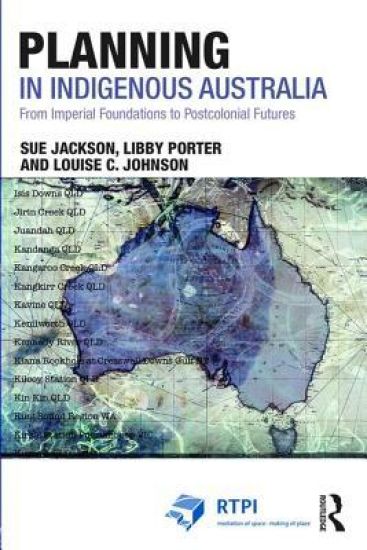
Planning in settler-colonial countries is always taking place on the lands of Indigenous peoples. While Indigenous rights, identity and cultural values are increasingly being discussed within planning, its mainstream accounts virtually ignore the colonial roots and legacies of the discipline’s assumptions, techniques and methods. This ground-breaking book exposes the imperial origins of the planning canon, profession and practice in the settler-colonial country of Australia.By documenting the role of planning in the history of Australia’s relations with Indigenous peoples, the book maps the enduring effects of colonisation. It provides a new historical account of colonial planning practices and rewrites the urban planning histories of major Australian cities. Contemporary land rights, native title and cultural heritage frameworks are analysed in light of their critical importance to planning practice today, with detailed case illustrations. In reframing Australian planning from a postcolonial perspective, the book shatters orthodox accounts, revising the story that planning has told itself for over 100 years. New ways to think and practise planning in Indigenous Australia are advanced.Planning in Indigenous Australia makes a major contribution towards the decolonisation of planning. It is essential reading for students and teachers in tertiary planning programmes, as well as those in geography, development studies, postcolonial studies, anthropology and environmental management. It is also vital reading for professional planners in the public, private and community sectors.
Planning in Indigenous Australia

Planning in Indigenous Australia

Sue Jackson; Libby Porter; Louise C. Johnson

Routledge
2017
sidottu
Planning in settler-colonial countries is always taking place on the lands of Indigenous peoples. While Indigenous rights, identity and cultural values are increasingly being discussed within planning, its mainstream accounts virtually ignore the colonial roots and legacies of the discipline’s assumptions, techniques and methods. This ground-breaking book exposes the imperial origins of the planning canon, profession and practice in the settler-colonial country of Australia.By documenting the role of planning in the history of Australia’s relations with Indigenous peoples, the book maps the enduring effects of colonisation. It provides a new historical account of colonial planning practices and rewrites the urban planning histories of major Australian cities. Contemporary land rights, native title and cultural heritage frameworks are analysed in light of their critical importance to planning practice today, with detailed case illustrations. In reframing Australian planning from a postcolonial perspective, the book shatters orthodox accounts, revising the story that planning has told itself for over 100 years. New ways to think and practise planning in Indigenous Australia are advanced.Planning in Indigenous Australia makes a major contribution towards the decolonisation of planning. It is essential reading for students and teachers in tertiary planning programmes, as well as those in geography, development studies, postcolonial studies, anthropology and environmental management. It is also vital reading for professional planners in the public, private and community sectors.
Differently Academic?

Differently Academic?

Sue Jackson

Springer
2010
nidottu
Lifelong learning is a key feature of society today, and is apparently embraced by a wide range of educators and trainers, as well as by governments and employers. In this wide-ranging book, Sue Jackson shows that universities have been slow to embrace a lifelong learning agenda, and argues that the lifelong learning experiences of women – and especially of working-class students – are seldom welcomed in the academy. In its unique considerations of the experiences of women students and academics, this book expounds an innovative and critical analysis of women in higher education. It will give a clear indication of alternative strategies for learners, teachers and policy makers. This book will be of key interest to anyone working in the fields of lifelong learning or continuing education who is interested in making learning accessible and meaningful for disadvantaged groups. It will also appeal to students of education, women's studies, gender studies and sociology; and to those interested in issues of gender, social class, feminist theory and feminist research.
Reconceptualising Lifelong Learning

Reconceptualising Lifelong Learning

Sue Jackson; Penny Jane Burke

Routledge
2007
nidottu
Arising from work by the Gender and Lifelong Learning Group of the Gender and Education Association, this book presents reconceptualisations of lifelong learning. It argues that the current field of lifelong learning is based on certain hidden values and assumptions and examines the mechanisms by which exclusionary discourses and practices are reproduced and maintained.The book opens up ways of conceptualising learning that takes into account multiple and shifting formations of learners from different social contexts. The authors broaden what counts as learning and who counts as a learner, offering different understandings of lifelong learning that are able to include currently marginalised values and principles.Organised in four sections the book looks at:reclaiming - it draws on feminist and post-structural conceptual frameworks to create a critical analysis of the current 'field' of lifelong learningretelling - it tells the tales of different multi-positions in lifelong learning revisioning - it moves from narrative to analysis and the authors present their revisioning of learning which provide the tools to reconceptualise the field of lifelong learningreconstructing - it furthers the discussion to outline new approaches to and practices in lifelong learning.
Reconceptualising Lifelong Learning

Reconceptualising Lifelong Learning

Sue Jackson; Penny Jane Burke

Routledge
2007
sidottu
Arising from work by the Gender and Lifelong Learning Group of the Gender and Education Association, this book presents reconceptualisations of lifelong learning. It argues that the current field of lifelong learning is based on certain hidden values and assumptions and examines the mechanisms by which exclusionary discourses and practices are reproduced and maintained.The book opens up ways of conceptualising learning that takes into account multiple and shifting formations of learners from different social contexts. The authors broaden what counts as learning and who counts as a learner, offering different understandings of lifelong learning that are able to include currently marginalised values and principles.Organised in four sections the book looks at:reclaiming - it draws on feminist and post-structural conceptual frameworks to create a critical analysis of the current 'field' of lifelong learningretelling - it tells the tales of different multi-positions in lifelong learning revisioning - it moves from narrative to analysis and the authors present their revisioning of learning which provide the tools to reconceptualise the field of lifelong learningreconstructing - it furthers the discussion to outline new approaches to and practices in lifelong learning.
Differently Academic?

Differently Academic?

Sue Jackson

Springer-Verlag New York Inc.
2004
sidottu
Lifelong learning is a key feature of society today, and is apparently embraced by a wide range of educators and trainers, as well as by governments and employers. In this wide-ranging book, Sue Jackson shows that universities have been slow to embrace a lifelong learning agenda, and argues that the lifelong learning experiences of women – and especially of working-class students – are seldom welcomed in the academy. In its unique considerations of the experiences of women students and academics, this book expounds an innovative and critical analysis of women in higher education. It will give a clear indication of alternative strategies for learners, teachers and policy makers. This book will be of key interest to anyone working in the fields of lifelong learning or continuing education who is interested in making learning accessible and meaningful for disadvantaged groups. It will also appeal to students of education, women's studies, gender studies and sociology; and to those interested in issues of gender, social class, feminist theory and feminist research.