Kirjojen hintavertailu. Mukana 12 595 353 kirjaa ja 12 kauppaa.

Kirjailija

Sue Lowndes

Kirjat ja teokset yhdessä paikassa: 11 kirjaa, julkaisuja vuosilta 2003-2017, suosituimpien joukossa Using and Applying Mathematics at Key Stage 1. Vertaile teosten hintoja ja tarkista saatavuus suomalaisista kirjakaupoista.

11 kirjaa

Kirjojen julkaisuhaarukka 2003-2017.

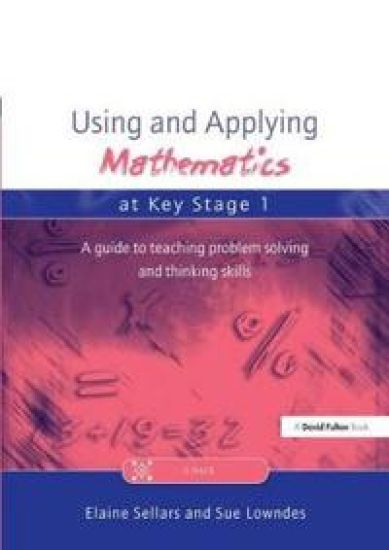
Using and Applying Mathematics at Key Stage 1

Using and Applying Mathematics at Key Stage 1

Elaine Sellers; Sue Lowndes

CRC Press
2017
sidottu
All pupils - able children included - need to be taught strategies to enable their thinking skills to progress. They also need help with developing different approaches to problem solving. A sustained piece of work that requires perseverance, logical strategies, and refinement of method and extension of the original task is not the same as a straightforward quick-fix type problem. Both types of problem solving need to be taught. This book presents a series of activities that can be used with whole classes to provide a curriculum for the teaching of problem solving and the development of thinking skills. Each tried and tested investigation is clearly explained with ideas on how to introduce the task to a class, full solutions and resource sheets. Activities include making 10p: a task to encourage systematic listing; tables and chairs: working systematically and spotting patterns; polygons and polyhedra: investigating diagonals, triangles, faces, edges and vertices; hidden faces: investigating different shapes and sizes of dice; and pond borders: investigating area and perimeter.
Using and Applying Mathematics at Key Stage 2

Using and Applying Mathematics at Key Stage 2

Elaine Sellars; Sue Lowndes

CRC Press
2016
sidottu
All pupils - able children included - need to be taught strategies to enable their thinking skills to progress. They also need help with developing different approaches to problem solving. A sustained piece of work that requires perseverance, logical strategies, and refinement of method and extension of the original task is not the same as a straightforward quick-fix type problem. Both types of problem solving need to be taught. This book presents a series of activities that can be used with whole classes to provide a curriculum for the teaching of problem solving and the development of thinking skills. Each tried and tested investigation is clearly explained with ideas on how to introduce the task to a class, full solutions and resource sheets. Activities include prisoners: a fun way of generating square numbers; handshakes: exploring arithmetic progressions; T-shape: an activity to lead pupils from numerical calculations to algebraic generalizations; frogs: encouraging systematic working and listing; and opposite corners: an advanced piece of work for independent learners.
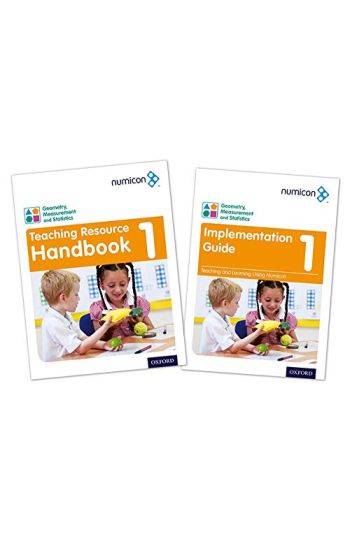
Numicon: Geometry, Measurement and Statistics 1 Teaching Pack

Numicon: Geometry, Measurement and Statistics 1 Teaching Pack

Tony Wing; Sue Lowndes; Simon d'Angelo; Andrew Jeffrey; Elizabeth Gibbs

Oxford University Press
2014
muu
The Numicon Geometry, Measurement and Statistics 1 Teaching Pack comprises a Teaching Resource Handbook and an Implementation Guide, providing the core materials you need to start teaching children aged 5 to 6. The Teaching Resource Handbook provides step-by-step activities for developing children's understanding of geometry, measurement and statistics. With a great emphasis on problem-solving through real-world contexts and practical planning and assessment guidance, the Teaching Resource Handbook will support you with developing children's mathematical understanding using Numicon. Photocopiable activities for home, linked to classroom activities, give children the opportunity to practise and discuss maths in a fun, engaging way. Accompanied with editable planning and printable photocopy masters, you can personalise to suit the needs of your children. The Implementation Guide offers guidance on what Numicon is, gives advice on how best to implement Numicon in your school and describes the Key Mathematical Ideas that underpin work within this year. With information on the theory behind Numicon, this guide will inspire you in building a secure future in mathematics for all children.
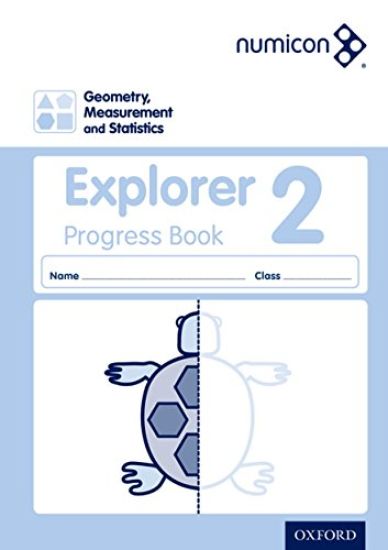
Numicon: Geometry, Measurement and Statistics 2 Explorer Progress Book

Numicon: Geometry, Measurement and Statistics 2 Explorer Progress Book

Sue Lowndes; Simon d'Angelo; Andrew Jeffrey; Elizabeth Gibbs

Oxford University Press
2014
nidottu
Numicon builds a deep understanding of maths through a multi-sensory approach, developing children's fluency, reasoning and problem-solving. The Numicon Geometry, Measurement and Statistics 2 Explorer Progress Book supports the activities in the Numicon Geometry, Measurement and Statistics 2 Teaching Resource Handbook and is a great assessment tool, allowing teachers to gather evidence of children's achievements. The book contains fun and engaging activities for children to complete. Each activity links to a topic from the Teaching Resource Handbook, offering you opportunities to assess individual children's understanding and monitor progress in geometry, measurement and statistics. Children have the freedom to record their answers in their own way, allowing you to see their thinking, and the use of real-life contexts allows you to assess children's ability to use and apply their maths learning.
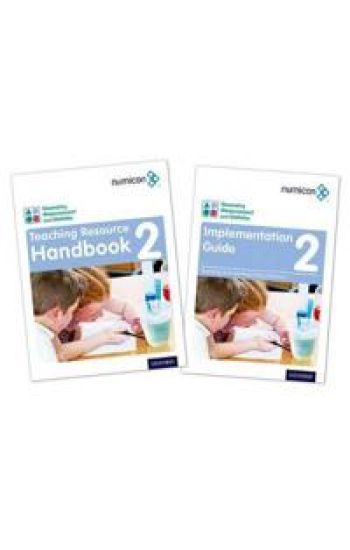
Numicon: Geometry, Measurement and Statistics 2 Teaching Pack

Numicon: Geometry, Measurement and Statistics 2 Teaching Pack

Tony Wing; Sue Lowndes; Simon d'Angelo; Andrew Jeffrey; Elizabeth Gibbs

Oxford University Press
2014
muu
The Numicon Geometry, Measurement and Statistics 2 Teaching Pack comprises a Teaching Resource Handbook and an Implementation Guide, providing the core materials you need to start teaching children aged 6 to 7. The Teaching Resource Handbook provides step-by-step activities for developing children's understanding of geometry, measurement and statistics. With a great emphasis on problem-solving through real-world contexts and practical planning and assessment guidance, the Teaching Resource Handbook will support you with developing children's mathematical understanding using Numicon. Photocopiable activities for home, linked to classroom activities, give children the opportunity to practise and discuss maths in a fun, engaging way. Accompanied with editable planning and printable photocopy masters, you can personalise to suit the needs of your children. The Implementation Guide offers guidance on what Numicon is, gives advice on how best to implement Numicon in your school and describes the Key Mathematical Ideas that underpin work within this year. With information on the theory behind Numicon, this guide will inspire you in building a secure future in mathematics for all children.
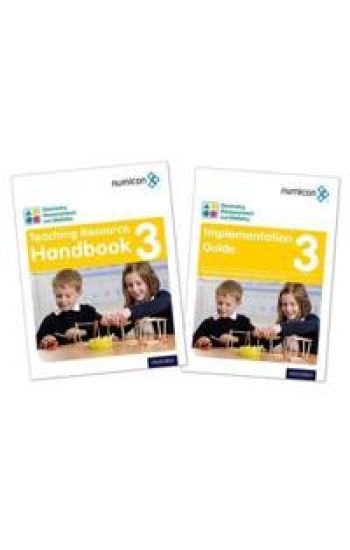
Numicon: Geometry, Measurement and Statistics 3 Teaching Pack

Numicon: Geometry, Measurement and Statistics 3 Teaching Pack

Tony Wing; Sue Lowndes; Simon d'Angelo; Andrew Jeffrey; Elizabeth Gibbs

Oxford University Press
2014
muu
The Numicon Geometry, Measurement and Statistics 3 Teaching Pack comprises a Teaching Resource Handbook and an Implementation Guide, providing the core materials you need to start teaching children aged 7 to 8. The Teaching Resource Handbook provides step-by-step activities for developing children's understanding of geometry, measurement and statistics. With a great emphasis on problem-solving through real-world contexts and practical planning and assessment guidance, the Teaching Resource Handbook will support you with developing children's mathematical understanding using Numicon. Photocopiable activities for home, linked to classroom activities, give children the opportunity to practise and discuss maths in a fun, engaging way. Accompanied with editable planning and printable photocopy masters, you can personalise to suit the needs of your children. The Implementation Guide offers guidance on what Numicon is, gives advice on how best to implement Numicon in your school and describes the Key Mathematical Ideas that underpin work within this year. With information on the theory behind Numicon, this guide will inspire you in building a secure future in mathematics for all children.
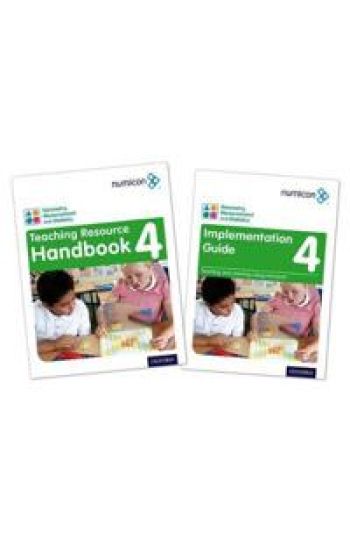
Numicon: Geometry, Measurement and Statistics 4 Teaching Pack

Numicon: Geometry, Measurement and Statistics 4 Teaching Pack

Tony Wing; Sue Lowndes; Simon d'Angelo; Andrew Jeffrey; Elizabeth Gibbs

Oxford University Press
2014
muu
The Numicon Geometry, Measurement and Statistics 4 Teaching Pack comprises a Teaching Resource Handbook and an Implementation Guide, providing the core materials you need to start teaching children aged 8 to 9. The Teaching Resource Handbook provides step-by-step activities for developing children's understanding of geometry, measurement and statistics. With a great emphasis on problem-solving through real-world contexts and practical planning and assessment guidance, the Teaching Resource Handbook will support you with developing children's mathematical understanding using Numicon. Photocopiable activities for home, linked to classroom activities, give children the opportunity to practise and discuss maths in a fun, engaging way. Accompanied with editable planning and printable photocopy masters, you can personalise to suit the needs of your children. The Implementation Guide offers guidance on what Numicon is, gives advice on how best to implement Numicon in your school and describes the Key Mathematical Ideas that underpin work within this year. With information on the theory behind Numicon, this guide will inspire you in building a secure future in mathematics for all children.
Numicon: Geometry, Measurement and Statistics 3 Explorer Progress Book

Numicon: Geometry, Measurement and Statistics 3 Explorer Progress Book

Sue Lowndes; Simon d'Angelo; Andrew Jeffrey; Elizabeth Gibbs

Oxford University Press
2014
nidottu
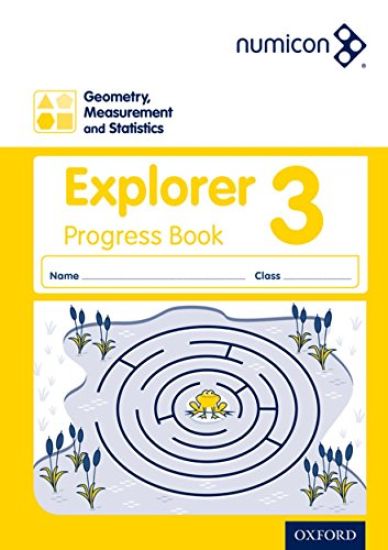
Numicon builds a deep understanding of maths through a multi-sensory approach, developing children's fluency, reasoning and problem-solving. The Numicon Geometry, Measurement and Statistics 3 Explorer Progress Book supports the activities in the Numicon Geometry, Measurement and Statistics 3 Teaching Resource Handbook and is a great assessment tool, allowing teachers to gather evidence of children's achievements. The book contains fun and engaging activities for children to complete. Each activity links to a topic from the Teaching Resource Handbook, offering you opportunities to assess individual children's understanding and monitor progress in geometry, measurement and statistics. Children have the freedom to record their answers in their own way, allowing you to see their thinking, and the use of real-life contexts allows you to assess children's ability to use and apply their maths learning.
Numicon: Geometry, Measurement and Statistics 4 Explorer Progress Book

Numicon: Geometry, Measurement and Statistics 4 Explorer Progress Book

Sue Lowndes; Simon d'Angelo; Andrew Jeffrey; Elizabeth Gibbs

Oxford University Press
2014
nidottu
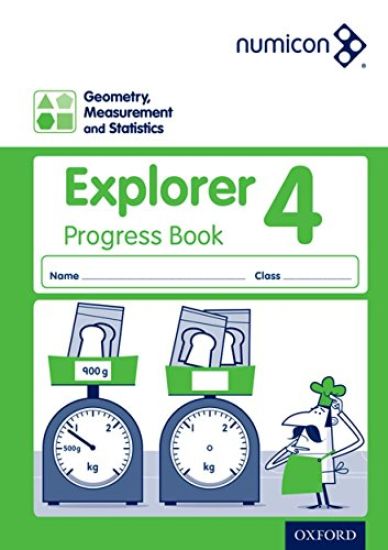
Numicon builds a deep understanding of maths through a multi-sensory approach, developing children's fluency, reasoning and problem-solving. The Numicon Geometry, Measurement and Statistics 4 Explorer Progress Book supports the activities in the Numicon Geometry, Measurement and Statistics 4 Teaching Resource Handbook and is a great assessment tool, allowing teachers to gather evidence of children's achievements. The book contains fun and engaging activities for children to complete. Each activity links to a topic from the Teaching Resource Handbook, offering you opportunities to assess individual children's understanding and monitor progress in geometry, measurement and statistics. Children have the freedom to record their answers in their own way, allowing you to see their thinking, and the use of real-life contexts allows you to assess children's ability to use and apply their maths learning.
Using and Applying Mathematics at Key Stage 1

Using and Applying Mathematics at Key Stage 1

Elaine Sellers; Sue Lowndes

David Fulton Publishers Ltd
2003
nidottu
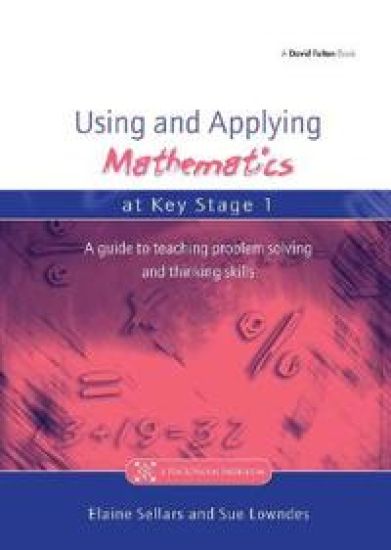
All pupils - able children included - need to be taught strategies to enable their thinking skills to progress. They also need help with developing different approaches to problem solving. A sustained piece of work that requires perseverance, logical strategies, and refinement of method and extension of the original task is not the same as a straightforward quick-fix type problem. Both types of problem solving need to be taught. This book presents a series of activities that can be used with whole classes to provide a curriculum for the teaching of problem solving and the development of thinking skills. Each tried and tested investigation is clearly explained with ideas on how to introduce the task to a class, full solutions and resource sheets. Activities include making 10p: a task to encourage systematic listing; tables and chairs: working systematically and spotting patterns; polygons and polyhedra: investigating diagonals, triangles, faces, edges and vertices; hidden faces: investigating different shapes and sizes of dice; and pond borders: investigating area and perimeter.
Using and Applying Mathematics at Key Stage 2

Using and Applying Mathematics at Key Stage 2

Elaine Sellars; Sue Lowndes

David Fulton Publishers Ltd
2003
nidottu
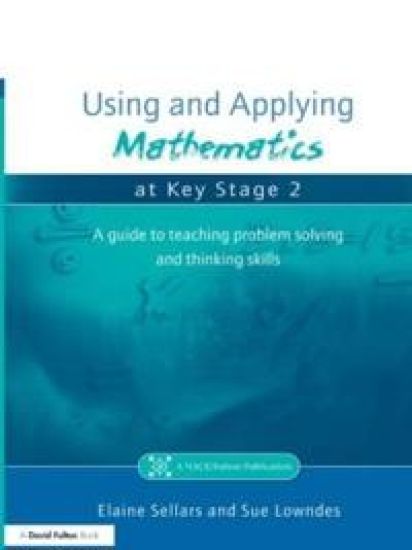
All pupils - able children included - need to be taught strategies to enable their thinking skills to progress. They also need help with developing different approaches to problem solving. A sustained piece of work that requires perseverance, logical strategies, and refinement of method and extension of the original task is not the same as a straightforward quick-fix type problem. Both types of problem solving need to be taught. This book presents a series of activities that can be used with whole classes to provide a curriculum for the teaching of problem solving and the development of thinking skills. Each tried and tested investigation is clearly explained with ideas on how to introduce the task to a class, full solutions and resource sheets. Activities include prisoners: a fun way of generating square numbers; handshakes: exploring arithmetic progressions; T-shape: an activity to lead pupils from numerical calculations to algebraic generalizations; frogs: encouraging systematic working and listing; and opposite corners: an advanced piece of work for independent learners.