Kirjojen hintavertailu. Mukana 12 371 151 kirjaa ja 12 kauppaa.

Kirjailija

Sunil Nautiyal

Kirjat ja teokset yhdessä paikassa: 13 kirjaa, julkaisuja vuosilta 2011-2025, suosituimpien joukossa Development of Rural and Peri-Urban Landscapes. Vertaile teosten hintoja ja tarkista saatavuus suomalaisista kirjakaupoista.

13 kirjaa

Kirjojen julkaisuhaarukka 2011-2025.

Climate Change, Shifting Cultivation and Livelihood Vulnerabilities in India

Climate Change, Shifting Cultivation and Livelihood Vulnerabilities in India

Niranjan Roy; Avijit Debnath; Sunil Nautiyal

Springer International Publishing AG
2025
nidottu
?This book explores how climate change affects households that rely on shifting cultivation and how to assess their vulnerability. This study looks at micro and macro levels in Indian states with indigenous communities practicing shifting cultivation. The micro-level study has been conducted in 52 villages, with 1469 households covering 7067 population in seven states of India in the Northeastern region. The book covers different topics related to climate change, such as its patterns, impact on households and agriculture, forest management, and the role of indigenous knowledge in mitigation. This research is associated with different sectors like shifting agriculture, forestry sector, climate change and rural development etc. and integrated with large respondents and stakeholders through both direct and focus group discussions. Research scholars, climate activists, institutional and non-institutional organisations, people interested in environmental science, social science and policymakers will find this book very relevant.
Determinants and Stratification of Household Carbon Footprint

Determinants and Stratification of Household Carbon Footprint

Sunil Nautiyal; Mrinalini Goswami; A Premkumar

Springer Nature Switzerland AG
2025
sidottu
This book provides comprehensive insights into the socioeconomic systems, carbon accounting, and consumption-expenditure frameworks influencing household carbon footprints (HCF) in a developing economy. It offers a unique perspective on the link between socioeconomic classes, agro-ecological zones, and carbon emissions, specifically in the Indian context. Household consumption patterns play a critical role in determining greenhouse gas emissions and are increasingly recognized as vital for shaping effective climate policies. Various socio-economic, demographic, and lifestyle factors—such as household size, income, food habits, mobility choices, waste management practices, home appliances, and education—significantly impact HCF. While the IPCC mitigation framework focuses extensively on direct emissions from energy and product production, this book emphasizes indirect emissions driven by lifestyle choices and end-use consumption. The book is based on a PAN-India study across 13 diverse locations within nine agro-ecological regions, examining the socioeconomic and geo-climatic determinants of household carbon emissions. It explores the income-consumption relationship, providing strategies to leverage these insights for targeted decarbonization and sustainable development. Additionally, the book addresses the behavioral aspects of carbon footprints and offers policy recommendations to promote a "carbon handprint"—advocating for carbon-friendly behaviors and solutions that are socially acceptable. By segregating emissions from production and consumption, it aims to guide the development of comprehensive emission reduction strategies for various consumables. This volume is an essential resource for students, researchers, and policymakers interested in sustainable consumption, climate mitigation, and the socio-economic dimensions of carbon emissions in developing countries.
Climate Change, Shifting Cultivation and Livelihood Vulnerabilities in India

Climate Change, Shifting Cultivation and Livelihood Vulnerabilities in India

Niranjan Roy; Avijit Debnath; Sunil Nautiyal

Springer International Publishing AG
2024
sidottu
?This book explores how climate change affects households that rely on shifting cultivation and how to assess their vulnerability. This study looks at micro and macro levels in Indian states with indigenous communities practicing shifting cultivation. The micro-level study has been conducted in 52 villages, with 1469 households covering 7067 population in seven states of India in the Northeastern region. The book covers different topics related to climate change, such as its patterns, impact on households and agriculture, forest management, and the role of indigenous knowledge in mitigation. This research is associated with different sectors like shifting agriculture, forestry sector, climate change and rural development etc. and integrated with large respondents and stakeholders through both direct and focus group discussions. Research scholars, climate activists, institutional and non-institutional organisations, people interested in environmental science, social science and policymakers will find this book very relevant.
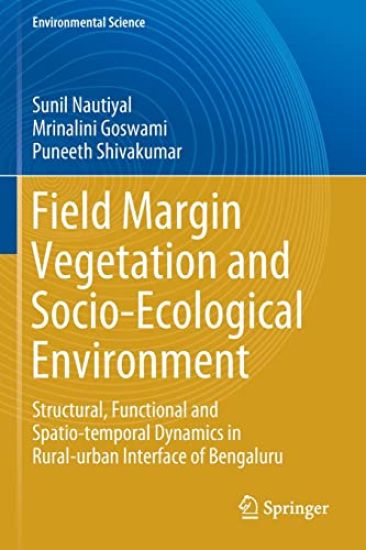
Field Margin Vegetation and Socio-Ecological Environment

Field Margin Vegetation and Socio-Ecological Environment

Sunil Nautiyal; Mrinalini Goswami; Puneeth Shivakumar

Springer Nature Switzerland AG
2022
nidottu
This book has been produced as a part of the project ‘Social-Ecological Systems at the Indian Rural-Urban Interface: Functions, Scales, and Dynamics of Transition’. It addresses transition processes in agriculture and society triggered by urbanization, focusing on Bengaluru as an example of a rapidly growing megacity in India. Adopting a holistic, multidisciplinary approach embedded within a social-ecological systems research framework, it explores how the physical and socio-economic landscapes have led to changes in economic priorities, which have overpowered ecological and traditional priorities with regard to ecosystem governance. Allowing readers to gain a deeper understanding of this unexplored dimension of socio-ecological systems, this book is a valuable resource for international researchers, scholars and master’s students in the field of environmental science, socio-ecology, forestry and agriculture.
Field Margin Vegetation and Socio-Ecological Environment

Field Margin Vegetation and Socio-Ecological Environment

Sunil Nautiyal; Mrinalini Goswami; Puneeth Shivakumar

Springer Nature Switzerland AG
2021
sidottu
This book has been produced as a part of the project ‘Social-Ecological Systems at the Indian Rural-Urban Interface: Functions, Scales, and Dynamics of Transition’. It addresses transition processes in agriculture and society triggered by urbanization, focusing on Bengaluru as an example of a rapidly growing megacity in India. Adopting a holistic, multidisciplinary approach embedded within a social-ecological systems research framework, it explores how the physical and socio-economic landscapes have led to changes in economic priorities, which have overpowered ecological and traditional priorities with regard to ecosystem governance. Allowing readers to gain a deeper understanding of this unexplored dimension of socio-ecological systems, this book is a valuable resource for international researchers, scholars and master’s students in the field of environmental science, socio-ecology, forestry and agriculture.
Biodiversity of Semiarid Landscape

Biodiversity of Semiarid Landscape

Sunil Nautiyal; Katari Bhaskar; Y.D. Imran Khan

Springer International Publishing AG
2016
nidottu
This study presents authentic data compiled from field experiments and investigations, and provides a point of reference for any future changes associated with anthropogenic activity in semiarid ecosystems. Three years of continuous and rigorous empirical research on biodiversity (from phytoplankton to higher plants and from zooplankton to higher animals – all flora and fauna) in India’s semiarid region have culminated in this work. Though there are many studies available on issues related to biodiversity, the majority cover either specific groups of plants or groups of animals; with the exception of this book, studies that include all flora and fauna including the phyto- and zooplanktons in a given ecosystem are not readily available. Further, the book focuses on an extremely important topic, firstly because semiarid landscapes are highly vulnerable to climate change, and secondly because other developmental activities will be undertaken in the region in an effort to meet its energy requirements. As such, the results of the current study will provide a standard protocol for subsequent monitoring and mapping of biodiversity for conservation and management. The book explores, quantifies and surveys plant and animal species from aquatic and terrestrial ecosystems, assessing and quantitatively analyzing the diversity indices of different vegetation strata. Further, it investigates the conservation status of each species (flora and fauna) in keeping with IUCN categories. The study also examines landscape dynamics using RS and GIS for vegetation analysis, and discusses traditional ecological knowledge related to the use, conservation and management of biodiversity. As such, it offers a unique and valuable resource not only for researchers from the environmental/ecological sciences but also for conservationists and policymakers.
Biodiversity of Semiarid Landscape

Biodiversity of Semiarid Landscape

Sunil Nautiyal; Katari Bhaskar; Y.D. Imran Khan

Springer International Publishing AG
2015
sidottu
This study presents authentic data compiled from field experiments and investigations, and provides a point of reference for any future changes associated with anthropogenic activity in semiarid ecosystems. Three years of continuous and rigorous empirical research on biodiversity (from phytoplankton to higher plants and from zooplankton to higher animals – all flora and fauna) in India’s semiarid region have culminated in this work. Though there are many studies available on issues related to biodiversity, the majority cover either specific groups of plants or groups of animals; with the exception of this book, studies that include all flora and fauna including the phyto- and zooplanktons in a given ecosystem are not readily available. Further, the book focuses on an extremely important topic, firstly because semiarid landscapes are highly vulnerable to climate change, and secondly because other developmental activities will be undertaken in the region in an effort to meet its energy requirements. As such, the results of the current study will provide a standard protocol for subsequent monitoring and mapping of biodiversity for conservation and management. The book explores, quantifies and surveys plant and animal species from aquatic and terrestrial ecosystems, assessing and quantitatively analyzing the diversity indices of different vegetation strata. Further, it investigates the conservation status of each species (flora and fauna) in keeping with IUCN categories. The study also examines landscape dynamics using RS and GIS for vegetation analysis, and discusses traditional ecological knowledge related to the use, conservation and management of biodiversity. As such, it offers a unique and valuable resource not only for researchers from the environmental/ecological sciences but also for conservationists and policymakers.
Development of Rural and Peri-Urban Landscapes

Development of Rural and Peri-Urban Landscapes

Sunil Nautiyal

LAP Lambert Academic Publishing
2011
pokkari
Human effects on ecosystems are a big concern all over the world and it is particularly important to understand human influences on the rural and peri- urban landscape which are getting transformed because of the process of rapid urbanization. The current study was undertaken to understand the change process in peri-urban and rural landscapes and analyzed the various driving forces that are leading such changes in land use and land cover. The theoretical approach developed here is based on standard driving forces which influence the farmer's decision and behaviour. The main driving forces which influence farmers' decision are environmental resources, socio-economic resources, policies and national economy. These are widely accepted from a global to a local scale. Yet, knowledge on changes in the spatial patterns of agricultural land use, the driving factors behind these changes, and their implications within the context of sustainable development is limited in rural and peri-urban landscapes.