Kirjojen hintavertailu. Mukana 12 595 353 kirjaa ja 12 kauppaa.

Kirjailija

Surendra S. Yadav

Kirjat ja teokset yhdessä paikassa: 6 kirjaa, julkaisuja vuosilta 2014-2022, suosituimpien joukossa Security Analysis and Portfolio Management. Vertaile teosten hintoja ja tarkista saatavuus suomalaisista kirjakaupoista.

6 kirjaa

Kirjojen julkaisuhaarukka 2014-2022.

Security Analysis and Portfolio Management

Security Analysis and Portfolio Management

Shveta Singh; Surendra S. Yadav

SPRINGER VERLAG, SINGAPORE
2022
nidottu
This book is a simple and concise text on the subject of security analysis and portfolio management. It is targeted towards those who do not have prior background in finance, and hence the text veers away from rather complicated formulations and discussions. The course ‘Security Analysis and Portfolio Management’ is usually taught as an elective for students specialising in financial management, and the authors have an experience of teaching this course for more than two decades. The book contains real empirical evidence and examples in terms of returns, risk and price multiples from the Indian equity markets (over the past two decades) that are a result of the analysis undertaken by the authors themselves. This empirical evidence and analysis help the reader in understanding basic concepts through real data of the Indian stock market. To drive home concepts, each chapter has many illustrations and case-lets citing real-life examples and sections called ‘points to ponder’ to encourageindependent thinking and critical examination. For practice, each chapter has many numericals, questions, and assignments
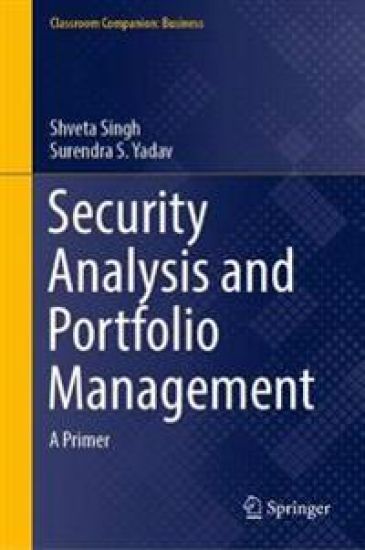
Security Analysis and Portfolio Management

Security Analysis and Portfolio Management

Shveta Singh; Surendra S. Yadav

Springer Verlag, Singapore
2021
sidottu
This book is a simple and concise text on the subject of security analysis and portfolio management. It is targeted towards those who do not have prior background in finance, and hence the text veers away from rather complicated formulations and discussions. The course ‘Security Analysis and Portfolio Management’ is usually taught as an elective for students specialising in financial management, and the authors have an experience of teaching this course for more than two decades. The book contains real empirical evidence and examples in terms of returns, risk and price multiples from the Indian equity markets (over the past two decades) that are a result of the analysis undertaken by the authors themselves. This empirical evidence and analysis help the reader in understanding basic concepts through real data of the Indian stock market. To drive home concepts, each chapter has many illustrations and case-lets citing real-life examples and sections called ‘points to ponder’ to encourageindependent thinking and critical examination. For practice, each chapter has many numericals, questions, and assignments
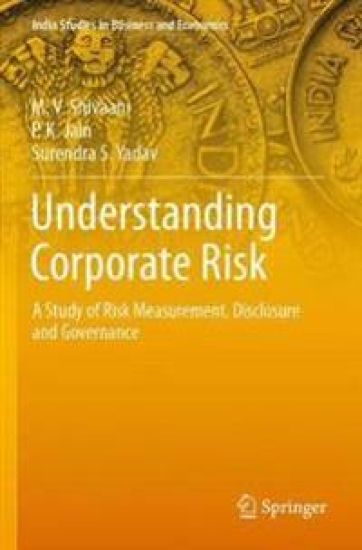
Understanding Corporate Risk

Understanding Corporate Risk

M. V. Shivaani; P. K. Jain; Surendra S. Yadav

Springer Verlag, Singapore
2020
nidottu
This book proposes three normative frameworks pertaining to risk-measurement, disclosure and governance using expert opinion and data from the top 429 non-financial companies (of the NIFTY 500 index) over a 10-year period. The book offers a novel contribution to the global literature on disclosure quality by presenting a composite measure of the quality as well as quantity of risk disclosures. Focusing on the quality of risk disclosures and risk governance structures, and using sophisticated methodology to tackle the issue of endogeneity, the book explores the important yet uncharted confluence of accounting information, risk and corporate governance. It addresses the interplay between three facets of risk, and is corroborated by practitioners’ perspectives as well as case studies. It is an excellent resource for practitioners, professionals and policy-makers, in addition to researchers working on the topic.
Understanding Corporate Risk

Understanding Corporate Risk

M. V. Shivaani; P. K. Jain; Surendra S. Yadav

Springer Verlag, Singapore
2019
sidottu
This book proposes three normative frameworks pertaining to risk-measurement, disclosure and governance using expert opinion and data from the top 429 non-financial companies (of the NIFTY 500 index) over a 10-year period. The book offers a novel contribution to the global literature on disclosure quality by presenting a composite measure of the quality as well as quantity of risk disclosures. Focusing on the quality of risk disclosures and risk governance structures, and using sophisticated methodology to tackle the issue of endogeneity, the book explores the important yet uncharted confluence of accounting information, risk and corporate governance. It addresses the interplay between three facets of risk, and is corroborated by practitioners’ perspectives as well as case studies. It is an excellent resource for practitioners, professionals and policy-makers, in addition to researchers working on the topic.
Public Sector Enterprises in India

Public Sector Enterprises in India

P.K. Jain; Seema Gupta; Surendra S. Yadav

Springer, India, Private Ltd
2016
nidottu
The book examines the various aspects of non-financial central public sector enterprises (PSEs) in India, for a period from 1986-87 to 2010-11. The analysis is based on all the key financial ratios; namely, profitability, efficiency, liquidity, leverage and productivity. Liberalization and globalization have caused competition in India and have lowered the profit margins. At the same time, Indian government has reduced subsidies and budgetary support for PSEs to curtail their own fiscal deficit. Strategic and economic reforms were also introduced in PSEs to make their operations commercially profitable so that they are not dependent on the government to meet their financial requirements on the one hand, and have their own earnings to finance their expansion/modernization requirements as well as their social obligations, on the other. To what extent, the PSEs have succeeded in this objective constitutes one major aspect of the present research work. The other equally important aspect examined is financial performance of the PSEs which have opted for disinvestment and have signed memorandum of understanding (MoU)/ self obligations. The Indian Government has desired the central PSEs to be profitable in their operations in post-liberation era of 1990s. For this purpose, two major instruments, namely, disinvestment and MoUs, were introduced. This book examines, in detail, financial performance of PSEs which had opted for disinvestment and have signed MoU. Based on analysis/ findings and literature on the subject, the book contains some concrete suggestions that would prove extremely helpful to Indian Government to further improve their financial performance. ?
Public Sector Enterprises in India

Public Sector Enterprises in India

P.K. Jain; Seema Gupta; Surendra S. Yadav

Springer, India, Private Ltd
2014
sidottu
The book examines the various aspects of non-financial central public sector enterprises (PSEs) in India, for a period from 1986-87 to 2010-11. The analysis is based on all the key financial ratios; namely, profitability, efficiency, liquidity, leverage and productivity. Liberalization and globalization have caused competition in India and have lowered the profit margins. At the same time, Indian government has reduced subsidies and budgetary support for PSEs to curtail their own fiscal deficit. Strategic and economic reforms were also introduced in PSEs to make their operations commercially profitable so that they are not dependent on the government to meet their financial requirements on the one hand, and have their own earnings to finance their expansion/modernization requirements as well as their social obligations, on the other. To what extent, the PSEs have succeeded in this objective constitutes one major aspect of the present research work. The other equally important aspect examined is financial performance of the PSEs which have opted for disinvestment and have signed memorandum of understanding (MoU)/ self obligations. The Indian Government has desired the central PSEs to be profitable in their operations in post-liberation era of 1990s. For this purpose, two major instruments, namely, disinvestment and MoUs, were introduced. This book examines, in detail, financial performance of PSEs which had opted for disinvestment and have signed MoU. Based on analysis/ findings and literature on the subject, the book contains some concrete suggestions that would prove extremely helpful to Indian Government to further improve their financial performance. ?