Kirjojen hintavertailu. Mukana 12 390 323 kirjaa ja 12 kauppaa.

Kirjailija

Suresh P. Sethi

Kirjat ja teokset yhdessä paikassa: 13 kirjaa, julkaisuja vuosilta 1994-2022, suosituimpien joukossa Hierarchical Decision Making in Stochastic Manufacturing Systems. Vertaile teosten hintoja ja tarkista saatavuus suomalaisista kirjakaupoista.

13 kirjaa

Kirjojen julkaisuhaarukka 1994-2022.

Optimal Control Theory

Optimal Control Theory

Suresh P. Sethi

Springer Nature Switzerland AG
2022
sidottu
This new 4th edition offers an introduction to optimal control theory and its diverse applications in management science and economics. It introduces students to the concept of the maximum principle in continuous (as well as discrete) time by combining dynamic programming and Kuhn-Tucker theory. While some mathematical background is needed, the emphasis of the book is not on mathematical rigor, but on modeling realistic situations encountered in business and economics. It applies optimal control theory to the functional areas of management including finance, production and marketing, as well as the economics of growth and of natural resources. In addition, it features material on stochastic Nash and Stackelberg differential games and an adverse selection model in the principal-agent framework. Exercises are included in each chapter, while the answers to selected exercises help deepen readers’ understanding of the material covered. Also included are appendices of supplementary material on the solution of differential equations, the calculus of variations and its ties to the maximum principle, and special topics including the Kalman filter, certainty equivalence, singular control, a global saddle point theorem, Sethi-Skiba points, and distributed parameter systems. Optimal control methods are used to determine optimal ways to control a dynamic system. The theoretical work in this field serves as the foundation for the book, in which the author applies it to business management problems developed from his own research and classroom instruction. The new edition has been refined and updated, making it a valuable resource for graduate courses on applied optimal control theory, but also for financial and industrial engineers, economists, and operational researchers interested in applying dynamic optimization in their fields.
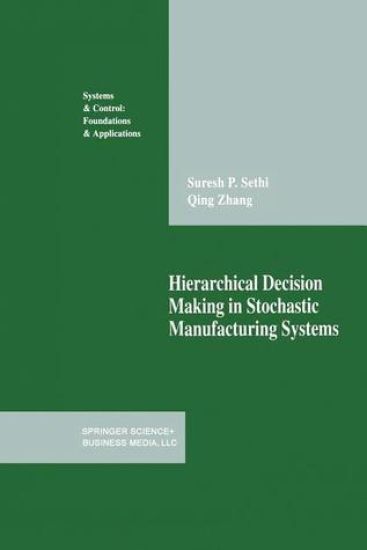
Hierarchical Decision Making in Stochastic Manufacturing Systems

Hierarchical Decision Making in Stochastic Manufacturing Systems

Suresh P. Sethi; Qing Zhang

Springer-Verlag New York Inc.
2012
nidottu
One of the most important methods in dealing with the optimization of large, complex systems is that of hierarchical decomposition. The idea is to reduce the overall complex problem into manageable approximate problems or subproblems, to solve these problems, and to construct a solution of the original problem from the solutions of these simpler prob­ lems. Development of such approaches for large complex systems has been identified as a particularly fruitful area by the Committee on the Next Decade in Operations Research (1988) [42] as well as by the Panel on Future Directions in Control Theory (1988) [65]. Most manufacturing firms are complex systems characterized by sev­ eral decision subsystems, such as finance, personnel, marketing, and op­ erations. They may have several plants and warehouses and a wide variety of machines and equipment devoted to producing a large number of different products. Moreover, they are subject to deterministic as well as stochastic discrete events, such as purchasing new equipment, hiring and layoff of personnel, and machine setups, failures, and repairs.
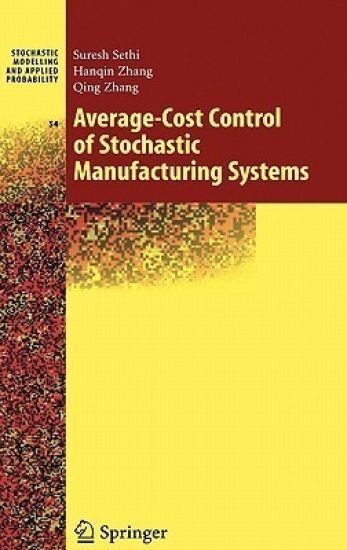
Average-Cost Control of Stochastic Manufacturing Systems

Average-Cost Control of Stochastic Manufacturing Systems

Suresh P. Sethi; Han-Qin Zhang; Qing Zhang

Springer-Verlag New York Inc.
2010
nidottu
Most manufacturing systems are large, complex, and operate in an environment of uncertainty. It is common practice to manage such systems in a hierarchical fashion. This book articulates a new theory that shows that hierarchical decision making can in fact lead to a near optimization of system goals. The material in the book cuts across disciplines. It will appeal to graduate students and researchers in applied mathematics, operations management, operations research, and system and control theory.
Throughput Optimization in Robotic Cells

Throughput Optimization in Robotic Cells

Milind W. Dawande; H. Neil Geismar; Suresh P. Sethi; Chelliah Sriskandarajah

Springer-Verlag New York Inc.
2007
sidottu
Intense global competition in manufacturing has compelled manufacturers to incorporate repetitive processing and automation for improving productivity. Modern manufacturing systems use robotic cells – a particular type of computer-controlled system in cellular manufacturing. Throughput optimization in robotic cells provides practitioners, researchers, and students with up-to-date algorithmic results on sequencing of robot moves and scheduling of parts in robotic cells. It brings together the structural results developed over the last 25 years for the various realistic models of robotic cells. After describing industrial applications of robotic cells and presenting fundamental results about cyclic production, several advanced features, such as dual-grippers, parallel machines, multi-part-type production, and multiple robots, are treated. Important open problems in the area are also identified. This book is an excellent text for use in a graduate course or a research seminar on robotic cells.
Average-Cost Control of Stochastic Manufacturing Systems

Average-Cost Control of Stochastic Manufacturing Systems

Suresh P. Sethi; Han-Qin Zhang; Qing Zhang

Springer-Verlag New York Inc.
2005
sidottu
Most manufacturing systems are large, complex, and operate in an environment of uncertainty. It is common practice to manage such systems in a hierarchical fashion. This book articulates a new theory that shows that hierarchical decision making can in fact lead to a near optimization of system goals. The material in the book cuts across disciplines. It will appeal to graduate students and researchers in applied mathematics, operations management, operations research, and system and control theory.
Optimal Consumption and Investment with Bankruptcy

Optimal Consumption and Investment with Bankruptcy

Suresh P. Sethi

Springer-Verlag New York Inc.
2012
nidottu
This book presents papers on continuous-time consumption­ investment models by Suresh Sethi and various co-authors. Sir Isaac Newton said that he saw so far because he stood on the shoulders of gi­ ants. Giants upon whose shoulders Professor Sethi and colleagues stand are Robert Merton, particularly Merton's (1969, 1971, 1973) seminal papers, and Paul Samuelson, particularly Samuelson (1969). Karatzas, Lehoczky, Sethi and Shreve (1986), henceforth KLSS, re­ produced here as Chapter 2, reexamine the model proposed by Mer­ ton. KLSS use methods of modern mathematical analysis, taking care to prove the existence of integrals, check the existence and (where appro­ priate) the uniqueness of solutions to equations, etc. KLSS find that un­ der some conditions Merton's solution is correct; under others, it is not. In particular, Merton's solution for aHARA utility-of-consumption is correct for some parameter values and not for others. The problem with Merton's solution is that it sometimes violates the constraints against negative wealth and negative consumption stated in Merton (1969) and presumably applicable in Merton (1971 and 1973). This not only affects the solution at the zero-wealth, zero-consumption boundaries, but else­ where as well. Problems with Merton's solution are analyzed in Sethi and Taksar (1992), reproduced here as Chapter 3.
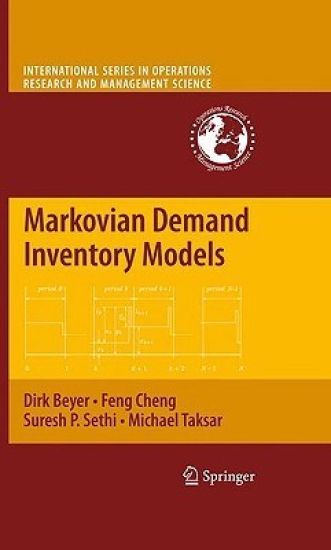
Markovian Demand Inventory Models

Markovian Demand Inventory Models

Dirk Beyer; Feng Cheng; Suresh P. Sethi; Michael Taksar

Springer-Verlag New York Inc.
2012
nidottu
Inventory management is concerned with matching supply with demand and a central problem in Operations Management. The problem is to find the amount to be produced or purchased in order to maximize the total expected profit or minimize the total expected cost. Over the past two decades, several variations of the formula appeared, mostly in trade journals written by and for inventory managers. A critical assumption in the inventory literature is that the demands in different periods are independent and identically distributed. However, in real life, demands may depend on environmental considerations or the events in the world such as the weather, the state of economy, etc. Moreover, these events are represented by stochastic processes - exogenous or controlled. In Markovian Demand Inventory Models, the authors are concerned with inventory models where these world events are modeled by Markov processes. Their research on Markovian demand inventory models was carried out over a period of ten years beginning in the early nineties.
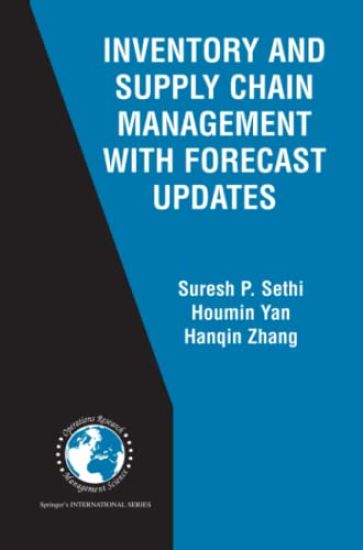
Inventory and Supply Chain Management with Forecast Updates

Inventory and Supply Chain Management with Forecast Updates

Suresh P. Sethi; Houmin Yan; Hanqin Zhang

Springer-Verlag New York Inc.
2010
nidottu
Inventory and Supply Chain Management with Forecast Updates is concerned with the problems of inventory and supply chain decision making with information updating over time. The models considered include inventory decisions with multiple sources and delivery modes, supply-contract design and evaluation, contracts with exercise price, volume-flexible contracts allowing for spot-market purchase decisions, and competitive supply chains. Real problems are formulated into tractable mathematical models, which allow for an analysis of various approaches, and provide insights for better supply chain management. The book provides a unified treatment of these models, presents a critique of the existing results, and points out potential research directions. Attention is focused on solutions – that is, inventory decisions prior and subsequent to information updates and the impact of the quality of information on these decisions.
Throughput Optimization in Robotic Cells

Throughput Optimization in Robotic Cells

Milind W. Dawande; H. Neil Geismar; Suresh P. Sethi; Chelliah Sriskandarajah

Springer-Verlag New York Inc.
2010
nidottu
Intense global competition in manufacturing has compelled manufacturers to incorporate repetitive processing and automation for improving productivity. Modern manufacturing systems use robotic cells – a particular type of computer-controlled system in cellular manufacturing. Throughput optimization in robotic cells provides practitioners, researchers, and students with up-to-date algorithmic results on sequencing of robot moves and scheduling of parts in robotic cells. It brings together the structural results developed over the last 25 years for the various realistic models of robotic cells. After describing industrial applications of robotic cells and presenting fundamental results about cyclic production, several advanced features, such as dual-grippers, parallel machines, multi-part-type production, and multiple robots, are treated. Important open problems in the area are also identified. This book is an excellent text for use in a graduate course or a research seminar on robotic cells.
Markovian Demand Inventory Models

Markovian Demand Inventory Models

Dirk Beyer; Feng Cheng; Suresh P. Sethi; Michael Taksar

Springer-Verlag New York Inc.
2009
sidottu
Inventory management is concerned with matching supply with demand and a central problem in Operations Management. The problem is to find the amount to be produced or purchased in order to maximize the total expected profit or minimize the total expected cost. Over the past two decades, several variations of the formula appeared, mostly in trade journals written by and for inventory managers. A critical assumption in the inventory literature is that the demands in different periods are independent and identically distributed. However, in real life, demands may depend on environmental considerations or the events in the world such as the weather, the state of economy, etc. Moreover, these events are represented by stochastic processes - exogenous or controlled. In Markovian Demand Inventory Models, the authors are concerned with inventory models where these world events are modeled by Markov processes. Their research on Markovian demand inventory models was carried out over a period of ten years beginning in the early nineties.
Inventory and Supply Chain Management with Forecast Updates

Inventory and Supply Chain Management with Forecast Updates

Suresh P. Sethi; Houmin Yan; Hanqin Zhang

Springer-Verlag New York Inc.
2005
sidottu
Inventory and Supply Chain Management with Forecast Updates is concerned with the problems of inventory and supply chain decision making with information updating over time. The models considered include inventory decisions with multiple sources and delivery modes, supply-contract design and evaluation, contracts with exercise price, volume-flexible contracts allowing for spot-market purchase decisions, and competitive supply chains. Real problems are formulated into tractable mathematical models, which allow for an analysis of various approaches, and provide insights for better supply chain management. The book provides a unified treatment of these models, presents a critique of the existing results, and points out potential research directions. Attention is focused on solutions – that is, inventory decisions prior and subsequent to information updates and the impact of the quality of information on these decisions.
Optimal Consumption and Investment with Bankruptcy
This book presents papers on continuous-time consumption­ investment models by Suresh Sethi and various co-authors. Sir Isaac Newton said that he saw so far because he stood on the shoulders of gi­ ants. Giants upon whose shoulders Professor Sethi and colleagues stand are Robert Merton, particularly Merton's (1969, 1971, 1973) seminal papers, and Paul Samuelson, particularly Samuelson (1969). Karatzas, Lehoczky, Sethi and Shreve (1986), henceforth KLSS, re­ produced here as Chapter 2, reexamine the model proposed by Mer­ ton. KLSS use methods of modern mathematical analysis, taking care to prove the existence of integrals, check the existence and (where appro­ priate) the uniqueness of solutions to equations, etc. KLSS find that un­ der some conditions Merton's solution is correct; under others, it is not. In particular, Merton's solution for aHARA utility-of-consumption is correct for some parameter values and not for others. The problem with Merton's solution is that it sometimes violates the constraints against negative wealth and negative consumption stated in Merton (1969) and presumably applicable in Merton (1971 and 1973). This not only affects the solution at the zero-wealth, zero-consumption boundaries, but else­ where as well. Problems with Merton's solution are analyzed in Sethi and Taksar (1992), reproduced here as Chapter 3.
Hierarchical Decision Making in Stochastic Manufacturing Systems

Hierarchical Decision Making in Stochastic Manufacturing Systems

Suresh P. Sethi; Qing Zhang

Birkhauser Boston Inc
1994
sidottu
One of the most important methods in dealing with the optimization of large, complex systems is that of hierarchical decomposition. The idea is to reduce the overall complex problem into manageable approximate problems or subproblems, to solve these problems, and to construct a solution of the original problem from the solutions of these simpler prob­ lems. Development of such approaches for large complex systems has been identified as a particularly fruitful area by the Committee on the Next Decade in Operations Research (1988) [42] as well as by the Panel on Future Directions in Control Theory (1988) [65]. Most manufacturing firms are complex systems characterized by sev­ eral decision subsystems, such as finance, personnel, marketing, and op­ erations. They may have several plants and warehouses and a wide variety of machines and equipment devoted to producing a large number of different products. Moreover, they are subject to deterministic as well as stochastic discrete events, such as purchasing new equipment, hiring and layoff of personnel, and machine setups, failures, and repairs.