Kirjojen hintavertailu. Mukana 12 595 353 kirjaa ja 12 kauppaa.

Kirjailija

Susan Buck-Morss

Kirjat ja teokset yhdessä paikassa: 12 kirjaa, julkaisuja vuosilta 1979-2024, suosituimpien joukossa Att läsa Hegel. Vertaile teosten hintoja ja tarkista saatavuus suomalaisista kirjakaupoista.

12 kirjaa

Kirjojen julkaisuhaarukka 1979-2024.

Seeing  Making: Room for Thought

Seeing Making: Room for Thought

Susan Buck-Morss; Kevin McCaughey; Adam Michaels

Inventory Press LLC
2024
nidottu
Renowned philosopher Susan Buck-Morss collaborates with Boot Boyz Biz's Kevin McCaughey and Inventory Press' Adam Michaels on this experimental image-text update of McLuhan and Benjamin Renowned philosopher Susan Buck-Morss collaborates with Kevin McCaughey of Boot Boyz Biz and Adam Michaels of Inventory Press on this experimental image-text renewal of McLuhan, Berger and Benjamin. Seeing Making: Room for Thought both studies and presents the creative process of constructing ideas with images. By activating the techniques of montage and analogy, the book reveals a wide field of view and a space to engage new critical connections between a multiplicity of objects from the past and present. Realized through an intergenerational collaboration of three cultural producers committed to making theory visible, a transformative anthology of critical essays by Susan Buck-Morss anchors this kaleidoscopic project. Images and ideas sync with Buck-Morss’ perceptive texts on visual culture, history, politics and aesthetics, fusing criticism with visual play and linking collective imagination and social action. In both design and content, Seeing Making: Room for Thought builds upon the dynamic sensorium of Marshall McLuhan and Quentin Fiore's book The Medium Is the Massage, Walter Benjamin's Arcades Project and John Berger's Ways of Seeing. This innovative volume brings Buck-Morss’ more experimental, visually engaged work to the fore in a way that has not been available in the usual contexts within which her writing has appeared.
YEAR 1

YEAR 1

Susan Buck-Morss

MIT PRESS LTD
2024
nidottu
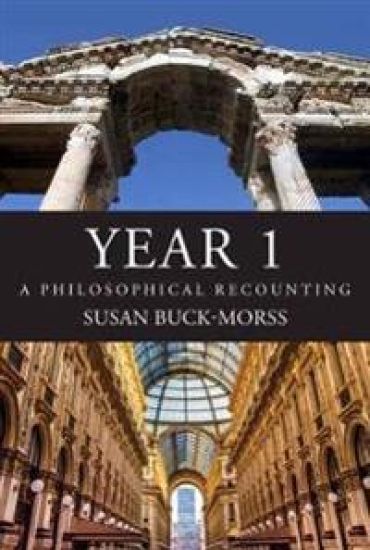
Reclaiming the first century as common ground rather than the origin of deeply entrenched differences: liberating the past to speak to us in another way.Conventional readings of antiquity cast Athens against Jerusalem, with Athens standing in for “reason” and Jerusalem for “faith.” And yet, Susan Buck-Morss reminds us, recent scholarship has overturned this separation. Naming the first century as a zero point—“year one”—that divides time into before and after is equally arbirtrary, nothing more than a convenience that is empirically meaningless. In YEAR 1, Buck-Morss liberates the first century so it can speak to us in another way, reclaiming it as common ground rather than the origin of deeply entrenched differences.Buck-Morss aims to topple various conceptual givens that have shaped modernity as an episteme and led us into some unhelpful postmodern impasses. She approaches the first century through the writings of three thinkers often marginalized in current discourse: Flavius Josephus, historian of the Judaean War; the neo-Platonic philosopher Philo of Alexandria; and John of Patmos, author of Revelation, the last book of the Christian Bible. Also making appearances are Antigone and John Coltrane, Plato and Bulwer-Lytton, al-Farabi and Jean Anouilh, Nicholas of Cusa and Zora Neale Hurston—not to mention Descartes, Kant, Hegel, Kristeva, and Derrida.Buck-Morss shows that we need no longer partition history as if it were a homeless child in need of the protective wisdom of Solomon. Those inhabiting the first century belong together in time, and therefore not to us.
Year 1

Year 1

Susan Buck-Morss

MIT Press
2021
sidottu
Reclaiming the first century as common ground rather than the origin of deeply entrenched differences- liberating the past to speak to us in another way.Conventional readings of antiquity cast Athens against Jerusalem, with Athens standing in for "reason" and Jerusalem for "faith." And yet, Susan Buck-Morss reminds us, recent scholarship has overturned this separation. Naming the first century--"year one"--as a zero point that divides time into before and after is merely a retroactive numbering plan, nothing more than a convenience that is empirically meaningless. In YEAR 1, Buck-Morss liberates the past so it can speak to us in another way, reclaiming the first century as common ground rather than the origin of deeply entrenched differences.
Revolution Today

Revolution Today

Susan Buck-Morss

Haymarket Books
2019
pokkari
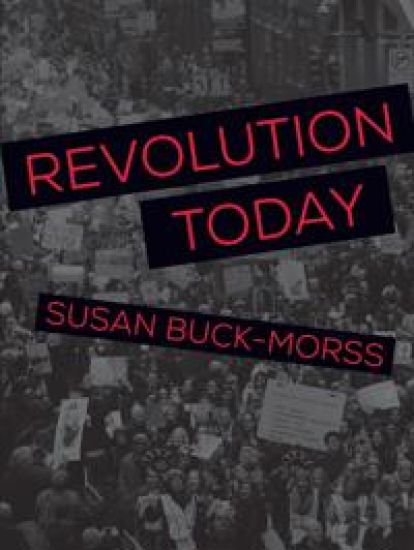
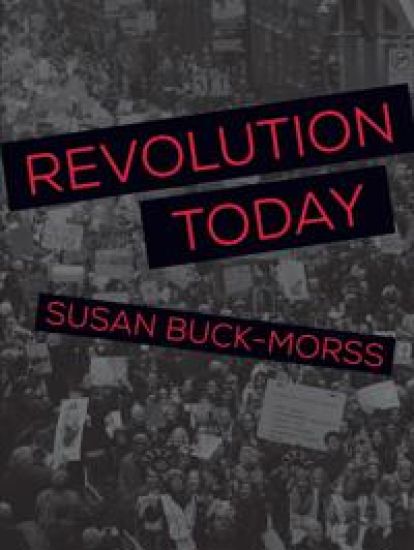
Susan Buck-Morss asks: What does revolution look like today? How will the idea of revolution survive the inadequacy of the formula, “progress = modernization through industrialization,” to which it has owed its political life? Socialism plus computer technology, citizen resistance plus a global agenda of concerns, revolutionary commitment to practices that are socially experimental and inclusive of difference—these are new forces being mobilized to make another future possible. In a moving account that includes over 100 photos and images, many in color,, Revolution Today celebrates the new political subjects that are organizing thousands of grassroots movements to fight racial and gender violence, state-led terrorism, and capitalist exploitation of people and the planet worldwide. The twenty-first century has already witnessed unprecedented popular mobilizations. Unencumbered by old dogmas, mobilizations of opposition are not only happening, they are gaining support and developing a global consciousness in the process. They are themselves a chain of signifiers, creating solidarity across language, religion, ethnicity, gender, and every other difference. Trans-local solidarities exist. They came first. The right-wing authoritarianism and anti-immigrant upsurge that has followed is a reaction against the amazing visual power of millions of citizens occupying public space in defiance of state power. We cannot know how to act politically without seeing others act. This book provides photographic evidence of that fact, while making us aware of how much of the new revolutionary vernacular we already share.
Revolution Today

Revolution Today

Susan Buck-Morss

Haymarket Books
2019
sidottu
Susan Buck-Morss asks: What does revolution look like today? How will the idea of revolution survive the inadequacy of the formula, “progress = modernization through industrialization,” to which it has owed its political life? Socialism plus computer technology, citizen resistance plus a global agenda of concerns, revolutionary commitment to practices that are socially experimental and inclusive of difference—these are new forces being mobilized to make another future possible. Revolution Today celebrates the new political subjects that are organizing thousands of grass roots movements to fight racial and gender violence, state-led terrorism, and capitalist exploitation of people and the planet worldwide. The twenty-first century has already witnessed unprecedented popular mobilizations. Unencumbered by old dogmas, mobilizations of opposition are not only happening, they are gaining support and developing a global consciousness in the process. They are themselves a chain of signifiers, creating solidarity across language, religion, ethnicity, gender, and every other difference. Trans-local solidarities exist. They came first. The right-wing authoritarianism and anti-immigrant upsurge that has followed is a reaction against the amazing visual power of millions of citizens occupying public space in defiance of state power. We cannot know how to act politically without seeing others act. This book provides photographic evidence of that fact, while making us aware of how much of the new revolutionary vernacular we already share. Susan Buck-Morss is distinguished professor of political philosophy at the CUNY Graduate Center, NYC. Her work crosses disciplines, including art history, architecture, comparative literature, cultural studies, German studies, philosophy, history, and visual culture.
Att läsa Hegel

Att läsa Hegel

Judith Butler; Slavoj Zizek; Fredric Jameson; Susan Buck-Morss; Jacques Derrida; Jurgen Habermas

Tankekraft Förlag
2012
kartonkisidos
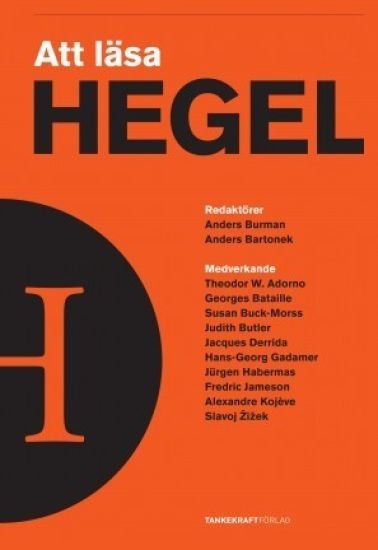
Georg Wilhelm Friedrich Hegel utgör på många sätt portalfiguren för de senaste två århundradenas filosofi och politiska teori. Såväl marxismen som existentialismen, fenomenologin och den kritiska teorin, ja även den moderna analytiska filosofin, uppstod till stor del som reaktioner på hans tänkande och den hegelianism som utvecklades efter hans död. Föreliggande antologi samlar tio tongivande läsningar av Hegel, skrivna av några av den så kallade kontinentalfilosofiska traditionens mest betydelsefulla företrädare. På olika sätt fokuserar samtliga texter på Hegels politiska tänkande. Särskilt uppmärksammas den berömda utläggningen i Andens fenomenologi om begäret, kampen om erkännandet och den dialektiska relationen mellan herren och slaven, men även Hegels idé om det borgerliga samhället och hans syn på staten diskuteras i flera av bidragen. Sammantaget visar texterna att det finns goda skäl att betrakta Hegel som den förste moderne filosofen. Bokens redaktörer, idéhistorikern Anders Burman och filosofen Anders Bartonek, är verksamma vid Södertörns högskola.
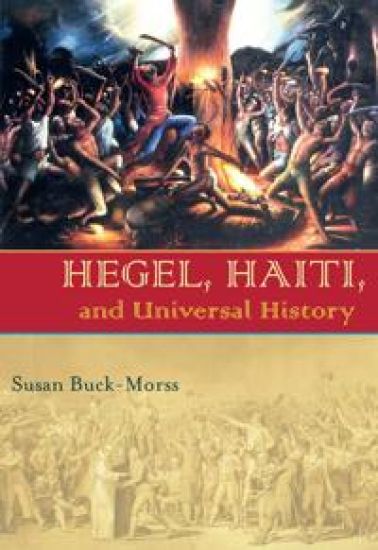
Hegel, Haiti, and Universal History

Hegel, Haiti, and Universal History

Susan Buck-Morss

University of Pittsburgh Press
2009
nidottu
In this path-breaking work, Susan Buck-Morss draws new connections between history, inequality, social conflict, and human emancipation. Hegel, Haiti, and Universal History offers a fundamental reinterpretation of Hegel's master-slave dialectic and points to a way forward to free critical theoretical practice from the prison-house of its own debates.Historicizing the thought of Georg Wilhelm Friedrich Hegel and the actions taken in the Haitian Revolution, Buck-Morss examines the startling connections between the two and challenges us to widen the boundaries of our historical imagination. She finds that it is in the discontinuities of historical flow, the edges of human experience, and the unexpected linkages between cultures that the possibility to transcend limits is discovered. It is these flashes of clarity that open the potential for understanding in spite of cultural differences. What Buck-Morss proposes amounts to a \u201cnew humanism,\u201d one that goes beyond the usual ideological implications of such a phrase to embrace a radical neutrality that insists on the permeability of the space between opposing sides and as it reaches for a common humanity.
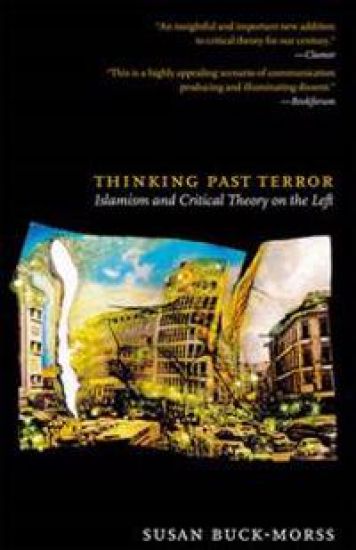
Thinking Past Terror

Thinking Past Terror

Susan Buck-Morss

Verso Books
2006
nidottu
Renowned critical theorist Susan Buck-Morss argues convincingly that a global public needs to think past the twin insanities of terrorism and counter-terrorism in order to dismantle regressive intellectual barriers. Surveying the widespread literature on the relationship of Islam to modernity, she reveals that there is surprising overlap where scholars commonly and simplistically see antithesis. Thinking Past Terror situates this engagement with the study of Islam among critical contemporary discourses-feminism, post-colonialism and the critique of determinism.In a new preface to this paperback edition, Susan Buck-Morss reflects on the events that have marked the world since the book was first published.
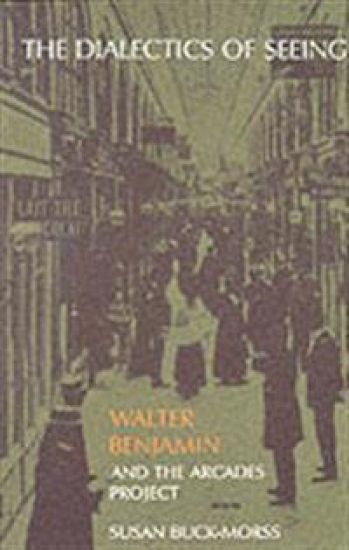
The Dialectics of Seeing

The Dialectics of Seeing

Susan Buck-Morss

MIT Press
1991
pokkari
Walter Benjamin's magnum opus was a book he did not live to write. In The Dialectics of Seeing, Susan Buck-Morss offers an inventive reconstruction of the Passagen Werk, or Arcades Project, as it might have taken form. Working with Benjamin's vast files of citations and commentary which contain a myriad of historical details from the dawn of consumer culture, Buck-Morss makes visible the conceptual structure that gives these fragments philosophical coherence. She uses images throughout the book to demonstrate that Benjamin took the debris of mass culture seriously as the source of philosophical truth. The Paris Arcades that so fascinated Benjamin (as they did the Surrealists whose "materialist metaphysics" he admired) were the prototype, the 19th century "ur-form" of the modern shopping mall. Benjamin's dialectics of seeing demonstrate how to read these consumer dream houses and so many other material objects of the time-from air balloons to women's fashions, from Baudelaire's poetry to Grandville's cartoons-as anticipations of social utopia and, simultaneously, as clues for a radical political critique. Buck-Morss plots Benjamin's intellectual orientation on axes running east and west, north and south-Moscow Paris, Berlin-Naples-and shows how such thinking in coordinates can explain his understanding of "dialectics at a standstill." She argues for the continuing relevance of Benjamin's insights but then allows a set of "afterimages" to have the last word.
Origin of Negative Dialectics

Origin of Negative Dialectics

Susan Buck-Morss

The Free Press
1979
pokkari
Susan Buck-Morss examines and stresses the significance of Critical Theory for young West Germ intellectuals after World War II.Looking at the differences between German and American situations during this time period, Origin of Negative Dialectics convincingly sketches the learning process that ended in antagonism. “[The Origin of Negative Dialectics] is by far the best introduction for the American reader to the complex, esoteric, and illusive structure of thought of one of the most seminal Marxian thinkers of the twentieth century. It belongs on the same shelf as Martin Jay’s history of the Frankfurt School, The Dialectical Imagination.” – Lewis A. Coser, State University of New York, Stony Brook