Kirjojen hintavertailu. Mukana 12 595 353 kirjaa ja 12 kauppaa.

Kirjailija

Susan E. Embretson

Kirjat ja teokset yhdessä paikassa: 4 kirjaa, julkaisuja vuosilta 2000-2025, suosituimpien joukossa Measuring Psychological Constructs. Vertaile teosten hintoja ja tarkista saatavuus suomalaisista kirjakaupoista.

4 kirjaa

Kirjojen julkaisuhaarukka 2000-2025.

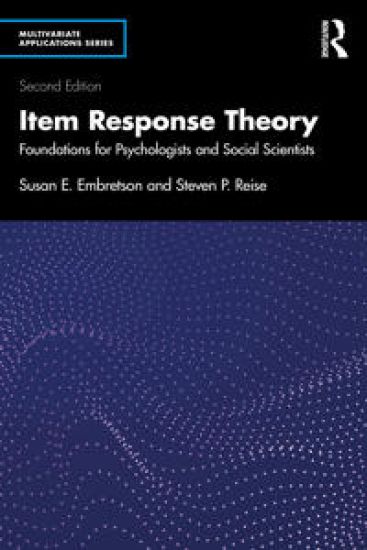
Item Response Theory

Item Response Theory

Susan E. Embretson; Steven P. Reise

Routledge Member of the Taylor and Francis Group
2025
sidottu
This book provides an intuitive and accessible introduction to item response theory (IRT), making complex psychometric concepts easier to grasp through graphical displays and familiar analogies. It bridges theory and application, helping readers interpret and implement IRT models effectively to improve measurement quality in psychology and the social sciences. Covering both foundational and advanced topics, it offers a clear path for understanding contemporary IRT methods and their relevance in research and practice.With a strong focus on applications, the book explains contemporary IRT models and estimation methods, placing special emphasis on polytomous IRT models, which are widely used in psychological assessments and rating scales. Applications in various research areas are explored in detail, alongside a dedicated chapter on available software to support implementation. The final section delves into advanced IRT topics, including multidimensional models and explanatory approaches for hypothesis testing, making it a valuable resource for those looking to deepen their understanding of psychometric analysis.An essential for graduate students, researchers, and practitioners in psychology, education, and the social sciences, the book is useful for researchers who are implementing or developing person assessments, as well as for professionals in clinical, industrial, counselling, and behavioural medicine fields who need a strong grasp of contemporary psychometric foundations. Professors teaching measurement courses will find it an ideal core textbook, offering a structured and engaging introduction to IRT and its applications in test development and analysis.
Item Response Theory

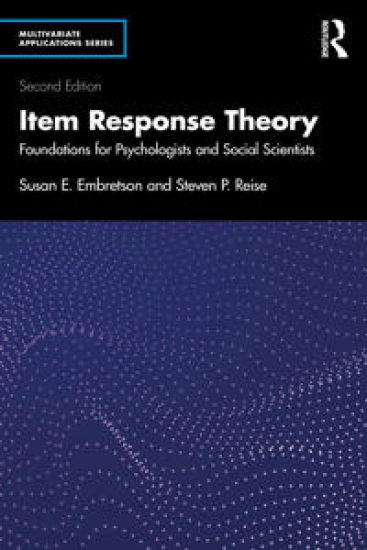
Item Response Theory

Susan E. Embretson; Steven P. Reise

Routledge Academic
2025
nidottu
This book provides an intuitive and accessible introduction to item response theory (IRT), making complex psychometric concepts easier to grasp through graphical displays and familiar analogies. It bridges theory and application, helping readers interpret and implement IRT models effectively to improve measurement quality in psychology and the social sciences. Covering both foundational and advanced topics, it offers a clear path for understanding contemporary IRT methods and their relevance in research and practice.With a strong focus on applications, the book explains contemporary IRT models and estimation methods, placing special emphasis on polytomous IRT models, which are widely used in psychological assessments and rating scales. Applications in various research areas are explored in detail, alongside a dedicated chapter on available software to support implementation. The final section delves into advanced IRT topics, including multidimensional models and explanatory approaches for hypothesis testing, making it a valuable resource for those looking to deepen their understanding of psychometric analysis.An essential for graduate students, researchers, and practitioners in psychology, education, and the social sciences, the book is useful for researchers who are implementing or developing person assessments, as well as for professionals in clinical, industrial, counselling, and behavioural medicine fields who need a strong grasp of contemporary psychometric foundations. Professors teaching measurement courses will find it an ideal core textbook, offering a structured and engaging introduction to IRT and its applications in test development and analysis.
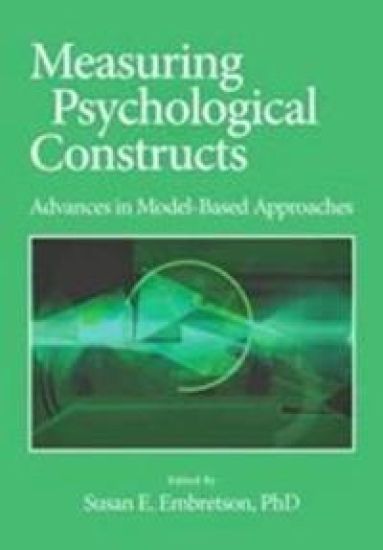
Measuring Psychological Constructs

Measuring Psychological Constructs

Susan E. Embretson

American Psychological Association
2010
sidottu
More than a half-century has passed since Cronbach's distinction between the correlational and experimental approaches in psychology. Yet measurement today is not much better integrated with psychological theory than it was in the late 1950s, and many argue that the traditional psychometric model itself may have introduced constraints that have limited the integration of measurement and theory. ""Measuring Psychological Constructs"" seeks to break through these constraints by offering conceptual alternatives to traditional item-response theory's fixed-content/multiple-choice models. This edited volume's contributors present groundbreaking explanatory approaches to model-based measurement that provide various psychological constructs with more 'authentic' measures such as constructed-response tasks and performance assessment. These new explanatory approaches not only extend rigorous psychometric methods to a variety of major psychological constructs, but also have the potential to change fundamentally the nature of the constructs that are being measured. Grounded in psychometrics and quantitative assessment, and in the history and major theoretical approaches of psychology, ""Measuring Psychological Constructs"" is aimed at students, teachers, researchers, and practitioners alike, in variety of psychology subdisciplines that include developmental and geriatric, industrial/organizational, clinical and counseling, educational, social and personality, experimental, neuropsychology, health and rehabilitation, and quantitative psychology.
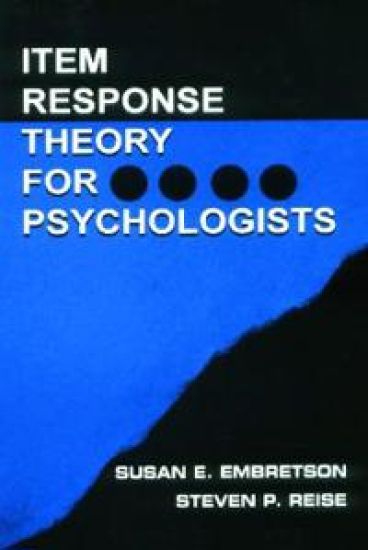
Item Response Theory for Psychologists

Item Response Theory for Psychologists

Susan E. Embretson; Steven P. Reise

Psychology Press
2000
nidottu
This book develops an intuitive understanding of IRT principles through the use of graphical displays and analogies to familiar psychological principles. It surveys contemporary IRT models, estimation methods, and computer programs. Polytomous IRT models are given central coverage since many psychological tests use rating scales.Ideal for clinical, industrial, counseling, educational, and behavioral medicine professionals and students familiar with classical testing principles, exposure to material covered in first-year graduate statistics courses is helpful. All symbols and equations are thoroughly explained verbally and graphically.