Kirjojen hintavertailu. Mukana 12 182 185 kirjaa ja 12 kauppaa.

Kirjailija

Susan G Straus

Kirjat ja teokset yhdessä paikassa: 16 kirjaa, julkaisuja vuosilta 2009-2025, suosituimpien joukossa Alert and Ready. Vertaile teosten hintoja ja tarkista saatavuus suomalaisista kirjakaupoista.

Mukana myös kirjoitusasut: Susan G. Straus

16 kirjaa

Kirjojen julkaisuhaarukka 2009-2025.

Assessing Competencies and Proficiency of Army Intelligence Analysts Across the Career Life Cycle
U.S. Army military intelligence analysts work in increasingly complex and dynamic operational environments requiring intangible competencies, such as critical thinking and adaptability. This report describes the development and implementation of a process to assess key analytic competencies and proficiency of the U.S. Army's analysts in the 35F military occupational specialty and the design of a protocol for ongoing evaluation.
Mentorship Efforts Within the Federal Emergency Management Agency's Incident Workforce

Mentorship Efforts Within the Federal Emergency Management Agency's Incident Workforce

Leslie Adrienne Payne; Susan G. Straus; Lea Sabbag

RAND Corporation
2025
nidottu
The Federal Emergency Management Agency's (FEMA's) ability to successfully mitigate disaster situations depends on having a well-trained and skilled incident workforce (IW), and mentorship can play an important role in helping to develop, support, and sustain IW staff. The authors examine mentorship efforts across the IW and provide recommendations for addressing requirements, gaps, and challenges.
Nontechnical Attribute Training and Development for United States Air Force Special Warfare

Nontechnical Attribute Training and Development for United States Air Force Special Warfare

Sean Robson; Tracy C Krueger; Maria C Lytell; Susan G Straus; Lewis Schneider

RAND Corporation
2024
pokkari
Initial skills training is designed to teach warfighters the technical knowledge and skills needed to perform an occupational specialty. However, a focus on training technical skills alone may miss opportunities to develop valuable nontechnical skills that are important to prepare for current and future missions. This report offers a roadmap for systematically integrating nontechnical attribute development into early and initial skills training.
Identifying Gaps and Areas for Improvement in the FEMA Qualification System for Incident Workforce Positions
The Federal Emergency Management Agency's (FEMA's) Qualification System (FQS) is a credentialing process that focuses on standardizing personnel abilities through training and applied experience. FEMA's Integration Branch asked the authors of this report to identify existing gaps and areas for improvement and examine ways to measure and monitor the effectiveness of FQS in the future.
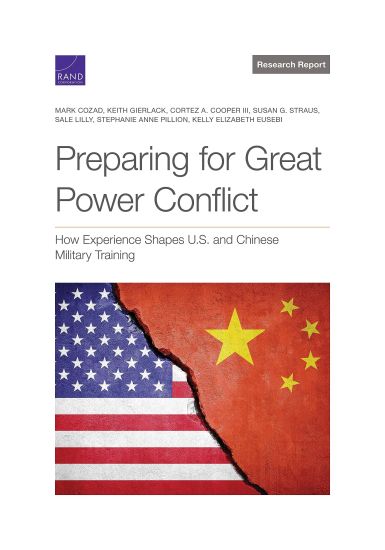
Preparing for Great Power Conflict

Preparing for Great Power Conflict

Mark Cozad; Keith Gierlack; Cortez A Cooper; Susan G Straus; Sale Lilly; Stephanie Anne Pillion; Kelly Elizabeth Eusebi

RAND Corporation
2023
pokkari
The authors examine how direct combat experience has shaped the way the U.S. military approaches training and how indirect experience outside combat has shaped the approach of the People's Liberation Army (PLA). The authors then consider the extent to which training and operational model adaptations in both militaries have kept pace with an evolving global context and prepared the U.S. military and PLA for great power conflict.
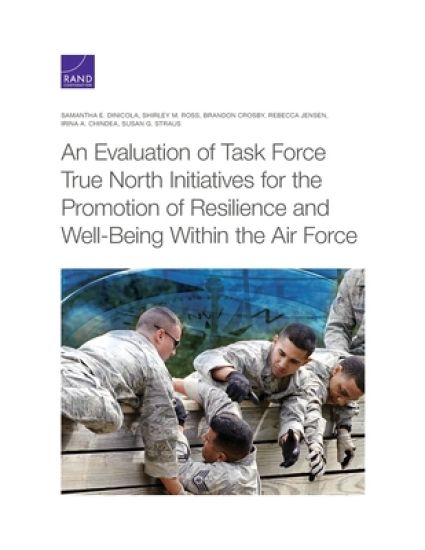
An Evaluation of Task Force True North Initiatives for the Promotion of Resilience and Well-Being Within the Air Force

An Evaluation of Task Force True North Initiatives for the Promotion of Resilience and Well-Being Within the Air Force

Samantha E Dinicola; Shirley M Ross; Brandon Crosby; Rebecca Jensen; Irina a Chindea; Susan G Straus

RAND
2020
nidottu
Researchers conducted interviews and focus groups with key stakeholders of the U.S. Air Force's Task Force True North (TFTN) initiatives. Thematic analysis of the data collected allowed the team to identify key findings related to each initiative and to TFTN as a whole. The authors offer recommendations designed to help each of the initiatives reach its full potential to improve airmen resilience and well-being.
Malleability and Measurement of Army Leader Attributes

Malleability and Measurement of Army Leader Attributes

Susan G Straus; Tracy C McCausland; Geoffrey Grimm

RAND
2018
nidottu
This study identifies psychological constructs associated with intellect, presence, and character attributes specified in the Army Leader Requirements Model. The report reviews research evidence for the extent to which key constructs can be developed through training and education, or reflect more stable characteristics. It also identifies established measures of these constructs to support the Army's leader development and training efforts.
Developing Army Leaders

Developing Army Leaders

Susan G. Straus; Michael G Shanley; James C. Crowley; Douglas Yeung; Sarah H. Bana; Kristin J. Leuschner

RAND
2014
pokkari
The authors evaluated the effectiveness of the Common Core the first phase of the U.S. Army's system for developing critical thinking skills in its officer corps and the extent of differences among course venues: distributed, resident, and mixed delivery. Future evaluation should focus on whether the best possible outcomes within venues, rather than equivalent outcomes across venues, are achieved."
Enhancing Critical Thinking Skills for Army Leaders Using Blended-Learning Methods

Enhancing Critical Thinking Skills for Army Leaders Using Blended-Learning Methods

Susan G. Straus; Michael G Shanley; Maria C. Lytell; James C. Crowley; Sarah H. Bana; Megan Clifford; Kristin J. Leuschner

RAND
2013
pokkari
The U.S. Army s Command and General Staff School offers its Advanced Operations Course (AOC) for junior field-grade officers using both traditional resident instruction and a model referred to as blended distributed learning (BDL). This report assesses the effectiveness of AOC-BDL based on student and graduate surveys and identifies best practices for BDL from empirical research and case studies."
Improving the Army's Assessment of Interactive Multimedia Instruction Courseware (2009)

Improving the Army's Assessment of Interactive Multimedia Instruction Courseware (2009)

Susan G. Straus; Michael G Shanley; Rachel M. Burns; Anisah Waite; James C. Crowley

RAND
2009
pokkari
An important component of The Army Distributed Learning Programas (TADLPas) performance is the quality of its courses, which consist primarily of asynchronous interactive multimedia instruction (IMI). However, there are no current efforts to assess course quality at the program level. This report outlines a comprehensive approach to evaluating the quality of IMI within TADLP. In addition, it describes how a program-level evaluation program developed at RAND might be implemented within the U.S. Army Training and Doctrine Command (TRADOC). RAND assessed the quality of the learning experience in a sample of recently fielded IMI courses, using criteria based on standards in the training development community. The analysis identifies strengths and deficiencies in technical, production quality, and pedagogical aspects of IMI courseware. This research demonstrates a feasible method for evaluation that can supply TRADOC with metrics concerning IMI quality, points to directions for needed improvements, and provides a basis for assessing improvement initiatives. The authors recommend adoption of this approach, as well as further development of other components of a comprehensive program of IMI training evaluation.
The Prospects for Increasing the Reuse of Digital Training Content

The Prospects for Increasing the Reuse of Digital Training Content

Michael G Shanley; Matthew W Lewis; Susan G Straus; Jeff Rothenbert; Lindsay Daugherty

RAND
2009
pokkari
This study examined how the Advanced Distributed Learning (ADL) Initiative might encourage the reuse of digital training content as a strategy to reduce the cost of its development. While findings highlighted a number of current challenges with the reuse option, one conclusion is that ADL can foster more reuse by taking a proactive approach in supporting training development organizations that are attempting to implement a reuse strategy.