Kirjojen hintavertailu. Mukana 12 595 353 kirjaa ja 12 kauppaa.

Kirjailija

Susan Rodrigues

Kirjat ja teokset yhdessä paikassa: 5 kirjaa, julkaisuja vuosilta 2003-2020, suosituimpien joukossa Opportunistic Challenges. Vertaile teosten hintoja ja tarkista saatavuus suomalaisista kirjakaupoista.

5 kirjaa

Kirjojen julkaisuhaarukka 2003-2020.

Analysing Talk in Educational Research
Analysing Talk in Educational Research is the go-to guide for all educational researchers collecting data in the form of talk. Offering practical and helpful approaches alongside explanations of relevant theories, it is a thorough yet concise guidebook providing all the advice necessary to effectively analyse talk data.Examining talk analysis through the lens of three theoretical approaches – Systemic Functional Linguistics, Positioning Theory and Interpersonal Behaviour Theory – the book offers detailed summaries and analyses of these theories and also covers topics including: How to begin collecting talk data The ethical issues surrounding collecting talk data Appropriate strategies for transcription and coding Checking for trustworthiness and credibility of talk data.Each chapter includes provocation exercises and illustrative examples, as well as links to websites and further reading suggestions to deepen understanding. Guiding readers from the necessary practical considerations required during data collection through to final evaluations, Analysing Talk in Educational Research is essential reading for graduate students and academic researchers completing studies involving talk and looking for a quick and helpful introduction to the rigorous methods with which to analyse their data.

Analysing Talk in Educational Research
Analysing Talk in Educational Research is the go-to guide for all educational researchers collecting data in the form of talk. Offering practical and helpful approaches alongside explanations of relevant theories, it is a thorough yet concise guidebook providing all the advice necessary to effectively analyse talk data.Examining talk analysis through the lens of three theoretical approaches – Systemic Functional Linguistics, Positioning Theory and Interpersonal Behaviour Theory – the book offers detailed summaries and analyses of these theories and also covers topics including: How to begin collecting talk data The ethical issues surrounding collecting talk data Appropriate strategies for transcription and coding Checking for trustworthiness and credibility of talk data.Each chapter includes provocation exercises and illustrative examples, as well as links to websites and further reading suggestions to deepen understanding. Guiding readers from the necessary practical considerations required during data collection through to final evaluations, Analysing Talk in Educational Research is essential reading for graduate students and academic researchers completing studies involving talk and looking for a quick and helpful introduction to the rigorous methods with which to analyse their data.

Model of Teacher Professional Development

Model of Teacher Professional Development

Susan Rodrigues

Nova Science Publishers Inc
2005
sidottu
Teacher professional development is usually directed and governed by three agents: politics, pedagogy and innovation. For example, the responsibility for teacher professional development has shifted over the decades as politicians, policy makers and political activists decide on the nature and location of review and determine who should have and hold the authority to accredit and evaluate. Research on pedagogy now advocates pedagogical practice that moves away from concentrating on core content/skills/teaching strategies, to promoting the development of reflective, proficient thinkers and communicators, who are self-directed and well informed responsible citizens. Likewise, although innovation in education is constant, the introduction of various technologies for school use has seen the innovation challenge in science education step up a gear. The book begins by considering existing literature and ideas on teacher professional development. Chapter 2 briefly outlines some of the issues in science education that are of relevance to primary school science. The literature in the area of Teacher Professional Development and issues of relevance to primary science were used to inform the PIPS model of teacher professional development. The rationale for the model can be found in Chapter 3. Subsequent chapters focus on the methodology employed by the project including details of the evaluation, as the data collected was instrumental in determining influential facets of the project. The following chapters explore the notion of readiness, risk, reflection, recognition, resource and relevance. These were deemed to be key elements that contributed to the success of the project in terms of promoting professional development and in terms of seeing tangible change in classroom practice. There is a short chapter which outlines some of the other project findings and the book concludes with a chapter on the need and challenge for dynamic teacher professional development programmes that work in partnership with teachers rather than deliver things for teachers.
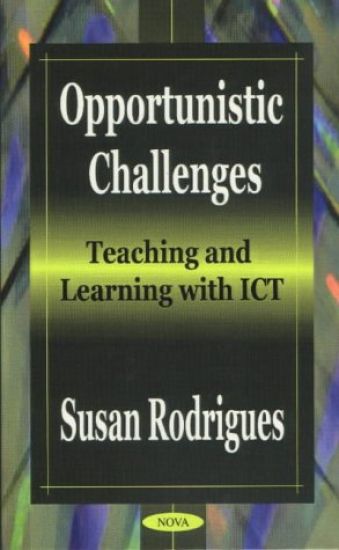
Opportunistic Challenges

Opportunistic Challenges

Susan Rodrigues

Nova Biomedical
2003
sidottu
Over the last few years there has been a raft of initiatives involving the use of information communication technology (ICT) in various learning environments. The use of ICT to transfer and support the construction of knowledge in schools and tertiary institutions has received a lot of investment and a certain degree of thought. Many of the initiatives are aimed at developing more flexible systems of learning with a core aim to provide the learner with more choice, in terms of what, where and how they learn. A key aim of this book is to signal some of the challenges and opportunities that we face in designing and using appropriate technologies within various learning environments. A key intention of the book is to report on the work of several researchers and product developers engaged in investigating the potential of ICT in learning environments in terms users, computers and organisations. There are two key themes within the book: the influence of learning theory on design and the influence of design on learning. The first section of the book discusses some implications for design of e-learning environments. The second section of the book concentrates on the influence of design on learning, and reports on investigations into the nature of interactivity and its impact on student learning.