Kirjojen hintavertailu. Mukana 12 595 353 kirjaa ja 12 kauppaa.

Kirjailija

Susan Rose-Ackerman

Kirjat ja teokset yhdessä paikassa: 9 kirjaa, julkaisuja vuosilta 1993-2022, suosituimpien joukossa O: Economic Systems and Comparative Economics I. Vertaile teosten hintoja ja tarkista saatavuus suomalaisista kirjakaupoista.

9 kirjaa

Kirjojen julkaisuhaarukka 1993-2022.

Democracy and Executive Power

Democracy and Executive Power

Susan Rose-Ackerman

Yale University Press
2022
sidottu
A defense of regulatory agencies’ efforts to combine public consultation with bureaucratic expertise to serve the interest of all citizens “This exceptional exploration of how four advanced democracies pursue legitimacy in the bureaucratic implementation of regulatory law makes an invaluable contribution.”—Peter M. Shane, author of Madison’s Nightmare: How Executive Power Threatens American Democracy The statutory delegation of rule-making authority to the executive has recently become a source of controversy. There are guiding models, but none, Susan Rose-Ackerman claims, is a good fit with the needs of regulating in the public interest. Using a cross-national comparison of public policy-making in the United States, the United Kingdom, France, and Germany, she argues that public participation inside executive rule-making processes is necessary to preserve the legitimacy of regulatory policy-making.

Due Process of Lawmaking

Due Process of Lawmaking

Susan Rose-Ackerman; Stefanie Egidy; James Fowkes

Cambridge University Press
2018
pokkari
With nuanced perspective and detailed case studies, Due Process of Lawmaking explores the law of lawmaking in the United States, South Africa, Germany, and the European Union. This comparative work deals broadly with public policymaking in the legislative and executive branches. It frames the inquiry through three principles of legitimacy: democracy, rights, and competence. Drawing on the insights of positive political economy, the authors explicate the ways in which courts uphold these principles in the different systems. Judicial review in the American presidential system suggests lessons for the parliamentary systems in Germany and South Africa, while the experience of parliamentary government yields potential insights into the reform of the American law of lawmaking. Taken together, the national experiences shed light on the special case of the EU. In dialogue with each other, the case studies demonstrate the interplay between constitutional principles and political imperatives under a range of different conditions.
Corruption and Government

Corruption and Government

Susan Rose-Ackerman; Bonnie J. Palifka

Cambridge University Press
2016
sidottu
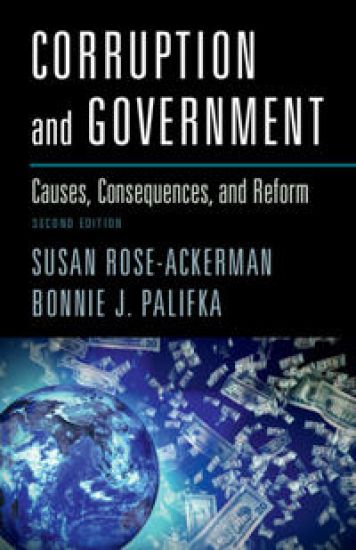
The second edition of Corruption and Government updates Susan Rose-Ackerman's 1999 book to address emerging issues and to rethink old questions in light of new data. The book analyzes the research explosion that accompanied the fall of the Berlin Wall, the founding of Transparency International, and the World Bank's decision to give anti-corruption policy a key place on its agenda. Time has vindicated Rose-Ackerman's emphasis on institutional reform as the necessary condition for serious progress. The book deals with routine payoffs and with corruption in contracting and privatization. It gives special attention to political corruption and to instruments of accountability. The authors have expanded the treatment of culture as a source of entrenched corruption and added chapters on criminal law, organized crime, and post-conflict societies. The book outlines domestic conditions for reform and discusses international initiatives - including both explicit anti-corruption policies and efforts to constrain money laundering.
Corruption and Government

Corruption and Government

Susan Rose-Ackerman; Bonnie J. Palifka

Cambridge University Press
2016
pokkari
The second edition of Corruption and Government updates Susan Rose-Ackerman's 1999 book to address emerging issues and to rethink old questions in light of new data. The book analyzes the research explosion that accompanied the fall of the Berlin Wall, the founding of Transparency International, and the World Bank's decision to give anti-corruption policy a key place on its agenda. Time has vindicated Rose-Ackerman's emphasis on institutional reform as the necessary condition for serious progress. The book deals with routine payoffs and with corruption in contracting and privatization. It gives special attention to political corruption and to instruments of accountability. The authors have expanded the treatment of culture as a source of entrenched corruption and added chapters on criminal law, organized crime, and post-conflict societies. The book outlines domestic conditions for reform and discusses international initiatives - including both explicit anti-corruption policies and efforts to constrain money laundering.
Due Process of Lawmaking

Due Process of Lawmaking

Susan Rose-Ackerman; Stefanie Egidy; James Fowkes

Cambridge University Press
2015
sidottu
With nuanced perspective and detailed case studies, Due Process of Lawmaking explores the law of lawmaking in the United States, South Africa, Germany, and the European Union. This comparative work deals broadly with public policymaking in the legislative and executive branches. It frames the inquiry through three principles of legitimacy: democracy, rights, and competence. Drawing on the insights of positive political economy, the authors explicate the ways in which courts uphold these principles in the different systems. Judicial review in the American presidential system suggests lessons for the parliamentary systems in Germany and South Africa, while the experience of parliamentary government yields potential insights into the reform of the American law of lawmaking. Taken together, the national experiences shed light on the special case of the EU. In dialogue with each other, the case studies demonstrate the interplay between constitutional principles and political imperatives under a range of different conditions.
From Elections to Democracy

From Elections to Democracy

Susan Rose-Ackerman

Cambridge University Press
2007
pokkari
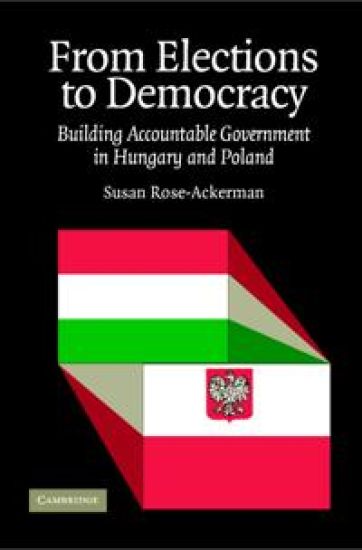
The countries of Central Europe in the first round for admission to the European Union have all established constitutional, electoral democracies and market economies. However, much remains to be done to achieve fully consolidated democratic states. This study documents the weaknesses of public oversight and participation in policymaking in Hungary and Poland, two of the most advanced countries in the region. It discusses five alternative routes to accountability including European Union oversight, constitutional institutions such as presidents and courts, devolution to lower-level governments, the use of neo-corporatist bodies, and open-ended participation rights. It urges more emphasis on the fifth option, public participation. Case studies of the environmental movement in Hungary and of student groups in Poland illustrate these general points. The book reviews the United States' experience of open-ended public participation and draws some lessons for the transition countries from the strengths and weaknesses of the American system.
From Elections to Democracy

From Elections to Democracy

Susan Rose-Ackerman

Cambridge University Press
2005
sidottu
The countries of Central Europe in the first round for admission to the European Union have all established constitutional, electoral democracies and market economies. However, much remains to be done to achieve fully consolidated democratic states. This study documents the weaknesses of public oversight and participation in policymaking in Hungary and Poland, two of the most advanced countries in the region. It discusses five alternative routes to accountability including European Union oversight, constitutional institutions such as presidents and courts, devolution to lower-level governments, the use of neo-corporatist bodies, and open-ended participation rights. It urges more emphasis on the fifth option, public participation. Case studies of the environmental movement in Hungary and of student groups in Poland illustrate these general points. The book reviews the United States' experience of open-ended public participation and draws some lessons for the transition countries from the strengths and weaknesses of the American system.
Rethinking the Progressive Agenda

Rethinking the Progressive Agenda

Susan Rose-Ackerman

The Free Press
1993
pokkari
Rose-Ackerman sees recent advances in law and economics as an opportunity to tackle some of the failings of the US state. She proposes a progressive and positive agenda of reform rather than simple reduction or expansion of existing functions and services.