Kirjojen hintavertailu. Mukana 12 657 676 kirjaa ja 12 kauppaa.

Kirjailija

Susanne Tietze

Kirjat ja teokset yhdessä paikassa: 8 kirjaa, julkaisuja vuosilta 2003-2024, suosituimpien joukossa Understanding Organizations through Language. Vertaile teosten hintoja ja tarkista saatavuus suomalaisista kirjakaupoista.

8 kirjaa

Kirjojen julkaisuhaarukka 2003-2024.

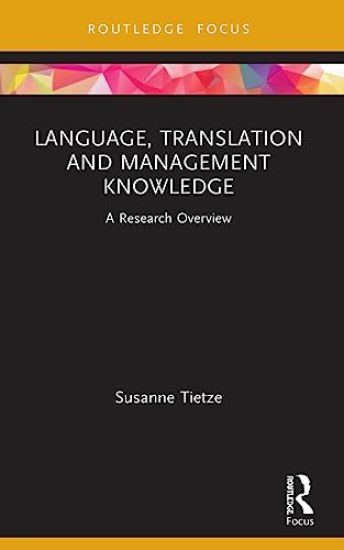
Language, Translation and Management Knowledge

Language, Translation and Management Knowledge

Susanne Tietze

TAYLOR FRANCIS LTD
2023
nidottu
The book provides insights, description and analysis over the knowledge production process within business, organization, and management research. Importantly, it does so from a language and translation perspective. It critically engages with the role of English in this process and provides theoretical argument for the need to include multilingualism in research. Translation is investigated as a concept for future inquiry.The book is expressive and formative of language-based research that is gaining momentum in business, management, and organization research. It offers conceptual innovation through a thorough treatment of multilingualism and translation, having the potentiality to guide future empirical and theoretical research, and to dispel hidden hegemonic knowledge production practices. The readers will gain insights into the current status quo of language-based inquiry, discussions of multilingualism for research design and be informed about the philosophical underpinnings of language-based research. Specifically, the benefits include the review and summary of key publications in this field, discussion and analysis of hidden assumptions of knowledge production, a critical take on knowledge production, an outline and discussion of implications of multilingual research for research design and methods, discussion of philosophical underpinnings and a vision for future research.The book is an invaluable source for all research students whose projects contain elements of multilingual research, whether empirical or theoretical. Likewise, the growing body of researchers who take a language-sensitive approach to their research may find it as a source that ‘pulls together’ the current knowledge status quo while offering discussions of future trajectories. The book is extremely useful for the teaching of research methods in undergraduate, postgraduate and also Master’s or doctoral programmes as many students are not native English speakers and are directly confronted with the subject matter of the book.
Language, Translation and Management Knowledge
The book provides insights, description and analysis over the knowledge production process within business, organization, and management research. Importantly, it does so from a language and translation perspective. It critically engages with the role of English in this process and provides theoretical argument for the need to include multilingualism in research. Translation is investigated as a concept for future inquiry.The book is expressive and formative of language-based research that is gaining momentum in business, management, and organization research. It offers conceptual innovation through a thorough treatment of multilingualism and translation, having the potentiality to guide future empirical and theoretical research, and to dispel hidden hegemonic knowledge production practices. The readers will gain insights into the current status quo of language-based inquiry, discussions of multilingualism for research design and be informed about the philosophical underpinnings of language-based research. Specifically, the benefits include the review and summary of key publications in this field, discussion and analysis of hidden assumptions of knowledge production, a critical take on knowledge production, an outline and discussion of implications of multilingual research for research design and methods, discussion of philosophical underpinnings and a vision for future research.The book is an invaluable source for all research students whose projects contain elements of multilingual research, whether empirical or theoretical. Likewise, the growing body of researchers who take a language-sensitive approach to their research may find it as a source that ‘pulls together’ the current knowledge status quo while offering discussions of future trajectories. The book is extremely useful for the teaching of research methods in undergraduate, postgraduate and also Master’s or doctoral programmes as many students are not native English speakers and are directly confronted with the subject matter of the book.
International Management and Language
Globalization processes have resulted in the emergence of business and management networks in which the sharing of knowledge is of crucial importance. Combining two contemporary and important subject areas – namely that of international management and also language and communication in multi-language contexts – the author of this book presents a wealth of ideas, examples and applications taken from international and global contexts, which show that ‘language matters’ in the pursuit of international business affairs.The book establishes the theoretical core of its main ideas by introducing two orientations (social construction and linguistic relativity) and demonstrates how they can be drawn on to frame and understand the activities of managers. Highly innovative and topical, Susanne Tietze’s book will appeal to students of international management and international human resource management as well as those studying intercultural communication. It is also useful for managers and practitioners who work internationally.
International Management and Language
Globalization processes have resulted in the emergence of business and management networks in which the sharing of knowledge is of crucial importance. Combining two contemporary and important subject areas – namely that of international management and also language and communication in multi-language contexts – the author of this book presents a wealth of ideas, examples and applications taken from international and global contexts, which show that ‘language matters’ in the pursuit of international business affairs.The book establishes the theoretical core of its main ideas by introducing two orientations (social construction and linguistic relativity) and demonstrates how they can be drawn on to frame and understand the activities of managers. Highly innovative and topical, Susanne Tietze’s book will appeal to students of international management and international human resource management as well as those studying intercultural communication. It is also useful for managers and practitioners who work internationally.
Understanding Organizations through Language

Understanding Organizations through Language

Susanne Tietze; Laurie Cohen; Gillian Musson

SAGE Publications Inc
2003
sidottu
`Makes fascinating reading and at the same time provides a good grounding in the study of the language of organizations, both for those who know little of the area and for those who are looking for a comprehensive overview of the field. Overall I would warmly recommend this book as an asset for students and teachers of organizational behaviour and for those with a general interest in the way in which language shapes our lives and work' - Organization Studies `The book is extremely clear in its explanation of how language works.... The authors treat their readers as curious, intelligent and concerned to find new and powerful tools to come at the workings of organizations from a lateral and newly illuminating perspective' - Virginia Valentine, Semiotic Solutions, London `The authors are able to apply their personal fascination with language to give students insights into organisational behaviour that significantly surpasses what is normally achieved by the tired old rituals of standard organizational behaviour texts and teaching' - Tony Watson, Nottingham Trent University Taking issue with functional approaches to communication, Understanding Organizations through Language offers a viable alternative based on `webs of meaning'. Instead of viewing communication as a thing that can be unproblematically controlled and managed, the authors use semiology as a theoretical bedrock to develop a new metaphor for communication. Understanding Organizations through Language applies this approach to areas of interest, including: metaphor, story-telling, discourse, gender, leadership and electronic communication. Spanning the gap between highly theoretical organization studies texts and highly prescriptive communication texts, the book talks to the reader in a sophisticated yet approachable style. This style is complemented by a range of examples, activities and mini case studies. Also included are chapter summaries and further reading suggestions, making this a useful text for both academics and students. Advanced undergraduates and postgraduates will utilize this book for any course dealing with communication, particularly courses in HRM and organizational behaviour.
Understanding Organizations through Language

Understanding Organizations through Language

Susanne Tietze; Laurie Cohen; Gillian Musson

SAGE Publications Inc
2003
nidottu
`Makes fascinating reading and at the same time provides a good grounding in the study of the language of organizations, both for those who know little of the area and for those who are looking for a comprehensive overview of the field. Overall I would warmly recommend this book as an asset for students and teachers of organizational behaviour and for those with a general interest in the way in which language shapes our lives and work' - Organization Studies `The book is extremely clear in its explanation of how language works.... The authors treat their readers as curious, intelligent and concerned to find new and powerful tools to come at the workings of organizations from a lateral and newly illuminating perspective' - Virginia Valentine, Semiotic Solutions, London `The authors are able to apply their personal fascination with language to give students insights into organisational behaviour that significantly surpasses what is normally achieved by the tired old rituals of standard organizational behaviour texts and teaching' - Tony Watson, Nottingham Trent University Taking issue with functional approaches to communication, Understanding Organizations through Language offers a viable alternative based on `webs of meaning'. Instead of viewing communication as a thing that can be unproblematically controlled and managed, the authors use semiology as a theoretical bedrock to develop a new metaphor for communication. Understanding Organizations through Language applies this approach to areas of interest, including: metaphor, story-telling, discourse, gender, leadership and electronic communication. Spanning the gap between highly theoretical organization studies texts and highly prescriptive communication texts, the book talks to the reader in a sophisticated yet approachable style. This style is complemented by a range of examples, activities and mini case studies. Also included are chapter summaries and further reading suggestions, making this a useful text for both academics and students. Advanced undergraduates and postgraduates will utilize this book for any course dealing with communication, particularly courses in HRM and organizational behaviour.