Kirjojen hintavertailu. Mukana 12 595 353 kirjaa ja 12 kauppaa.

Kirjailija

Sushil Jajodia

Kirjat ja teokset yhdessä paikassa: 15 kirjaa, julkaisuja vuosilta 1999-2018, suosituimpien joukossa Trusted Recovery and Defensive Information Warfare. Vertaile teosten hintoja ja tarkista saatavuus suomalaisista kirjakaupoista.

15 kirjaa

Kirjojen julkaisuhaarukka 1999-2018.

Trusted Recovery and Defensive Information Warfare

Trusted Recovery and Defensive Information Warfare

Peng Liu; Sushil Jajodia

Springer-Verlag New York Inc.
2010
nidottu
Information security concerns the confidentiality, integrity, and availability of information processed by a computer system. With an emphasis on prevention, traditional information security research has focused little on the ability to survive successful attacks, which can seriously impair the integrity and availability of a system. Trusted Recovery And Defensive Information Warfare uses database trusted recovery, as an example, to illustrate the principles of trusted recovery in defensive information warfare. Traditional database recovery mechanisms do not address trusted recovery, except for complete rollbacks, which undo the work of benign transactions as well as malicious ones, and compensating transactions, whose utility depends on application semantics. Database trusted recovery faces a set of unique challenges. In particular, trusted database recovery is complicated mainly by (a) the presence of benign transactions that depend, directly or indirectly on malicious transactions; and (b) the requirement by many mission-critical database applications that trusted recovery should be done on-the-fly without blocking the execution of new user transactions. Trusted Recovery And Defensive Information Warfare proposes a new model and a set of innovative algorithms for database trusted recovery. Both read-write dependency based and semantics based trusted recovery algorithms are proposed. Both static and dynamic database trusted recovery algorithms are proposed. These algorithms can typically save a lot of work by innocent users and can satisfy a variety of attack recovery requirements of real world database applications. Trusted Recovery And Defensive Information Warfare is suitable as a secondary text for a graduate level course in computer science, and as a reference for researchers and practitioners in information security.
Trusted Recovery and Defensive Information Warfare
Information security concerns the confidentiality, integrity, and availability of information processed by a computer system. With an emphasis on prevention, traditional information security research has focused little on the ability to survive successful attacks, which can seriously impair the integrity and availability of a system. Trusted Recovery And Defensive Information Warfare uses database trusted recovery, as an example, to illustrate the principles of trusted recovery in defensive information warfare. Traditional database recovery mechanisms do not address trusted recovery, except for complete rollbacks, which undo the work of benign transactions as well as malicious ones, and compensating transactions, whose utility depends on application semantics. Database trusted recovery faces a set of unique challenges. In particular, trusted database recovery is complicated mainly by (a) the presence of benign transactions that depend, directly or indirectly on malicious transactions; and (b) the requirement by many mission-critical database applications that trusted recovery should be done on-the-fly without blocking the execution of new user transactions. Trusted Recovery And Defensive Information Warfare proposes a new model and a set of innovative algorithms for database trusted recovery. Both read-write dependency based and semantics based trusted recovery algorithms are proposed. Both static and dynamic database trusted recovery algorithms are proposed. These algorithms can typically save a lot of work by innocent users and can satisfy a variety of attack recovery requirements of real world database applications. Trusted Recovery And Defensive Information Warfare is suitable as a secondary text for a graduate level course in computer science, and as a reference for researchers and practitioners in information security.
Network Security Metrics

Network Security Metrics

Lingyu Wang; Sushil Jajodia; Anoop Singhal

Springer International Publishing AG
2018
nidottu
This book examines different aspects of network security metrics and their application to enterprise networks. One of the most pertinent issues in securing mission-critical computing networks is the lack of effective security metrics which this book discusses in detail. Since “you cannot improve what you cannot measure”, a network security metric is essential to evaluating the relative effectiveness of potential network security solutions. The authors start by examining the limitations of existing solutions and standards on security metrics, such as CVSS and attack surface, which typically focus on known vulnerabilities in individual software products or systems. The first few chapters of this book describe different approaches to fusing individual metric values obtained from CVSS scores into an overall measure of network security using attack graphs. Since CVSS scores are only available for previously known vulnerabilities, such approaches do not consider the threat of unknownattacks exploiting the so-called zero day vulnerabilities. Therefore, several chapters of this book are dedicated to develop network security metrics especially designed for dealing with zero day attacks where the challenge is that little or no prior knowledge is available about the exploited vulnerabilities, and thus most existing methodologies for designing security metrics are no longer effective. Finally, the authors examine several issues on the application of network security metrics at the enterprise level. Specifically, a chapter presents a suite of security metrics organized along several dimensions for measuring and visualizing different aspects of the enterprise cyber security risk, and the last chapter presents a novel metric for measuring the operational effectiveness of the cyber security operations center (CSOC). Security researchers who work on network security or security analytics related areas seeking new research topics, as well as security practitioners including network administrators and security architects who are looking for state of the art approaches to hardening their networks, will find this book helpful as a reference. Advanced-level students studying computer science and engineering will find this book useful as a secondary text.
Network Security Metrics

Network Security Metrics

Lingyu Wang; Sushil Jajodia; Anoop Singhal

Springer International Publishing AG
2017
sidottu
This book examines different aspects of network security metrics and their application to enterprise networks. One of the most pertinent issues in securing mission-critical computing networks is the lack of effective security metrics which this book discusses in detail. Since “you cannot improve what you cannot measure”, a network security metric is essential to evaluating the relative effectiveness of potential network security solutions. The authors start by examining the limitations of existing solutions and standards on security metrics, such as CVSS and attack surface, which typically focus on known vulnerabilities in individual software products or systems. The first few chapters of this book describe different approaches to fusing individual metric values obtained from CVSS scores into an overall measure of network security using attack graphs. Since CVSS scores are only available for previously known vulnerabilities, such approaches do not consider the threat of unknownattacks exploiting the so-called zero day vulnerabilities. Therefore, several chapters of this book are dedicated to develop network security metrics especially designed for dealing with zero day attacks where the challenge is that little or no prior knowledge is available about the exploited vulnerabilities, and thus most existing methodologies for designing security metrics are no longer effective. Finally, the authors examine several issues on the application of network security metrics at the enterprise level. Specifically, a chapter presents a suite of security metrics organized along several dimensions for measuring and visualizing different aspects of the enterprise cyber security risk, and the last chapter presents a novel metric for measuring the operational effectiveness of the cyber security operations center (CSOC). Security researchers who work on network security or security analytics related areas seeking new research topics, as well as security practitioners including network administrators and security architects who are looking for state of the art approaches to hardening their networks, will find this book helpful as a reference. Advanced-level students studying computer science and engineering will find this book useful as a secondary text.
Network Hardening

Network Hardening

Lingyu Wang; Massimiliano Albanese; Sushil Jajodia

Springer International Publishing AG
2014
nidottu
This Springer Brief examines the tools based on attack graphs that help reveal network hardening threats. Existing tools detail all possible attack paths leading to critical network resources. Though no current tool provides a direct solution to remove the threats, they are a more efficient means of network defense than relying solely on the experience and skills of a human analyst. Key background information on attack graphs and network hardening helps readers understand the complexities of these tools and techniques. A common network hardening technique generates hardening solutions comprised of initially satisfied conditions, thereby making the solution more enforceable. Following a discussion of the complexity issues in this technique, the authors provide an improved technique that considers the dependencies between hardening options and employs a near-optimal approximation algorithm to scale linearly with the size of the inputs. Also included are automated solutions for hardening a network against sophisticated multi-step intrusions. Network Hardening: An Automated Approach to Improving Network Security is a valuable resource for researchers and professionals working in network security. It is also a useful tool for advanced-level students focused on security in computer science and electrical engineering.
Intrusion Detection in Distributed Systems

Intrusion Detection in Distributed Systems

Peng Ning; Sushil Jajodia; Xiaoyang Sean Wang

Springer-Verlag New York Inc.
2013
nidottu
Intrusion Detection In Distributed Systems: An Abstraction-Based Approach presents research contributions in three areas with respect to intrusion detection in distributed systems. The first contribution is an abstraction-based approach to addressing heterogeneity and autonomy of distributed environments. The second contribution is a formal framework for modeling requests among cooperative IDSs and its application to Common Intrusion Detection Framework (CIDF). The third contribution is a novel approach to coordinating different IDSs for distributed event correlation.
Multilevel Secure Transaction Processing

Multilevel Secure Transaction Processing

Vijay Atluri; Sushil Jajodia; Binto George

Springer-Verlag New York Inc.
2012
nidottu
Information security is receiving a great deal of attention as computers increasingly process more and more sensitive information. A multilevel secure database management system (MLS DBMS) is designed to store, retrieve and process information in compliance with certain mandatory security requirements, essential for protecting sensitive information from unauthorized access, modification and abuse. Such systems are characterized by data objects labeled at different security levels and accessed by users cleared to those levels. Unless transaction processing modules for these systems are designed carefully, they can be exploited to leak sensitive information to unauthorized users. In recent years, considerable research has been devoted to the area of multilevel secure transactions that has impacted the design and development of trusted MLS DBMS products. Multilevel Secure Transaction Processing presents the progress and achievements made in this area. The book covers state-of-the-art research in developing secure transaction processing for popular MLS DBMS architectures, such as kernelized, replicated, and distributed architectures, and advanced transaction models such as workflows, long duration and nested models. Further, it explores the technical challenges that require future attention. Multilevel Secure Transaction Processing is an excellent reference for researchers and developers in the area of multilevel secure database systems and may be used in advanced level courses in database security, information security, advanced database systems, and transaction processing.
Information Hiding: Steganography and Watermarking-Attacks and Countermeasures

Information Hiding: Steganography and Watermarking-Attacks and Countermeasures

Neil F. Johnson; Zoran Duric; Sushil Jajodia

Springer-Verlag New York Inc.
2012
nidottu
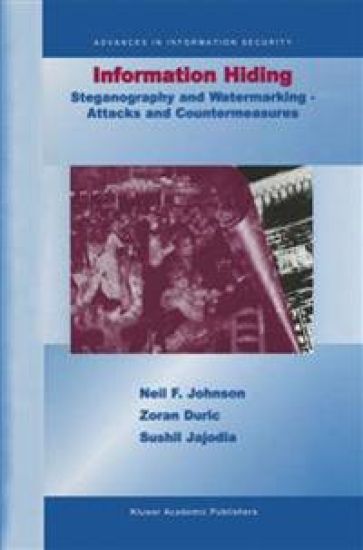
Information Hiding: Steganography and Watermarking - Attacks and Countermeasures deals with information hiding. With the proliferation of multimedia on the Internet, information hiding addresses two areas of concern: privacy of information from surveillance (steganography) and protection of intellectual property (digital watermarking). Steganography (literally, covered writing) explores methods to hide the existence of hidden messages. These methods include invisible ink, microdot, digital signature, covert channel, and spread spectrum communication. Digital watermarks represent a commercial application of steganography. Watermarks can be used to track the copyright and ownership of electronic media. In this volume, the authors focus on techniques for hiding information in digital media. They analyze the hiding techniques to uncover their limitations. These limitations are employed to devise attacks against hidden information. The goal of these attacks is to expose the existence of a secret message or render a digital watermark unusable. In assessing these attacks, countermeasures are developed to assist in protecting digital watermarking systems. Understanding the limitations of the current methods will lead us to build more robust methods that can survive various manipulation and attacks. The more information that is placed in the public's reach on the Internet, the more owners of such information need to protect themselves from theft and false representation. Systems to analyze techniques for uncovering hidden information and recover seemingly destroyed information will be useful to law enforcement authorities in computer forensics and digital traffic analysis. Information Hiding: Steganography and Watermarking - Attacks and Countermeasures presents the authors' research contributions in three fundamental areas with respect to image-based steganography and watermarking: analysis of data hiding techniques, attacks against hidden information, and countermeasures to attacks against digital watermarks. Information Hiding: Steganography and Watermarking &endash; Attacks and Countermeasures is suitable for a secondary text in a graduate level course, and as a reference for researchers and practitioners in industry.
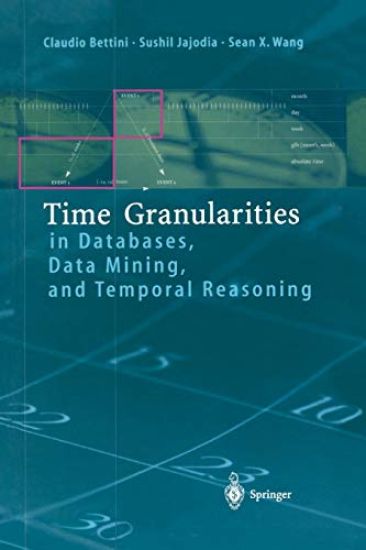
Time Granularities in Databases, Data Mining, and Temporal Reasoning

Time Granularities in Databases, Data Mining, and Temporal Reasoning

Claudio Bettini; Sushil Jajodia; Sean Wang

Springer-Verlag Berlin and Heidelberg GmbH Co. K
2010
nidottu
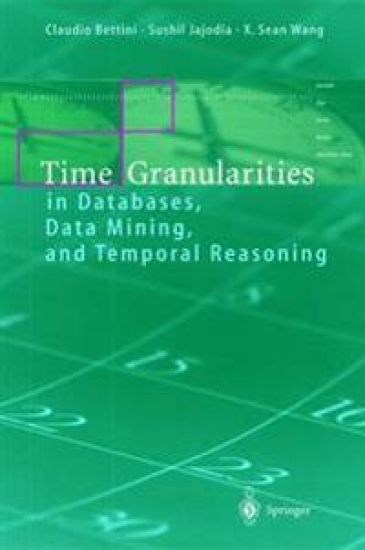
Calendar units, such as months and days, clock units, such as hours and seconds, and specialized units, such as business days and academic years, play a major role in a wide range of information system applications. System support for reasoning about these units, called granularities in this book, is important for the efficient design, use, and implementation of such applications. The book deals with several aspects of temporal information and provides a unifying model for granularities. It is intended for computer scientists and engineers who are interested in the formal models and technical development of specific issues. Practitioners can learn about critical aspects that must be taken into account when designing and implementing databases supporting temporal information. Lecturers may find this book useful for an advanced course on databases. Moreover, any graduate student working on time representation and reasoning, either in data or knowledge bases, should definitely read it.
Preserving Privacy in On-Line Analytical Processing (OLAP)

Preserving Privacy in On-Line Analytical Processing (OLAP)

Lingyu Wang; Sushil Jajodia; Duminda Wijesekera

Springer-Verlag New York Inc.
2010
nidottu
Preserving Privacy for On-Line Analytical Processing addresses the privacy issue of On-Line Analytic Processing (OLAP) systems. OLAP systems usually need to meet two conflicting goals. First, the sensitive data stored in underlying data warehouses must be kept secret. Second, analytical queries about the data must be allowed for decision support purposes. The main challenge is that sensitive data can be inferred from answers to seemingly innocent aggregations of the data. This volume reviews a series of methods that can precisely answer data cube-style OLAP, regarding sensitive data while provably preventing adversaries from inferring data. Preserving Privacy for On-Line Analytical Processing is appropriate for practitioners in industry as well as graduate-level students in computer science and engineering.
Preserving Privacy in On-Line Analytical Processing (OLAP)

Preserving Privacy in On-Line Analytical Processing (OLAP)

Lingyu Wang; Sushil Jajodia; Duminda Wijesekera

Springer-Verlag New York Inc.
2006
sidottu
Preserving Privacy for On-Line Analytical Processing addresses the privacy issue of On-Line Analytic Processing (OLAP) systems. OLAP systems usually need to meet two conflicting goals. First, the sensitive data stored in underlying data warehouses must be kept secret. Second, analytical queries about the data must be allowed for decision support purposes. The main challenge is that sensitive data can be inferred from answers to seemingly innocent aggregations of the data. This volume reviews a series of methods that can precisely answer data cube-style OLAP, regarding sensitive data while provably preventing adversaries from inferring data. Preserving Privacy for On-Line Analytical Processing is appropriate for practitioners in industry as well as graduate-level students in computer science and engineering.
Intrusion Detection in Distributed Systems

Intrusion Detection in Distributed Systems

Peng Ning; Sushil Jajodia; Xiaoyang Sean Wang

Springer-Verlag New York Inc.
2003
sidottu
Intrusion Detection In Distributed Systems: An Abstraction-Based Approach presents research contributions in three areas with respect to intrusion detection in distributed systems. The first contribution is an abstraction-based approach to addressing heterogeneity and autonomy of distributed environments. The second contribution is a formal framework for modeling requests among cooperative IDSs and its application to Common Intrusion Detection Framework (CIDF). The third contribution is a novel approach to coordinating different IDSs for distributed event correlation.
Information Hiding: Steganography and Watermarking-Attacks and Countermeasures

Information Hiding: Steganography and Watermarking-Attacks and Countermeasures

Neil F. Johnson; Zoran Duric; Sushil Jajodia

Springer
2000
sidottu
Information Hiding: Steganography and Watermarking - Attacks and Countermeasures deals with information hiding. With the proliferation of multimedia on the Internet, information hiding addresses two areas of concern: privacy of information from surveillance (steganography) and protection of intellectual property (digital watermarking). Steganography (literally, covered writing) explores methods to hide the existence of hidden messages. These methods include invisible ink, microdot, digital signature, covert channel, and spread spectrum communication. Digital watermarks represent a commercial application of steganography. Watermarks can be used to track the copyright and ownership of electronic media. In this volume, the authors focus on techniques for hiding information in digital media. They analyze the hiding techniques to uncover their limitations. These limitations are employed to devise attacks against hidden information. The goal of these attacks is to expose the existence of a secret message or render a digital watermark unusable. In assessing these attacks, countermeasures are developed to assist in protecting digital watermarking systems. Understanding the limitations of the current methods will lead us to build more robust methods that can survive various manipulation and attacks. The more information that is placed in the public's reach on the Internet, the more owners of such information need to protect themselves from theft and false representation. Systems to analyze techniques for uncovering hidden information and recover seemingly destroyed information will be useful to law enforcement authorities in computer forensics and digital traffic analysis. Information Hiding: Steganography and Watermarking - Attacks and Countermeasures presents the authors' research contributions in three fundamental areas with respect to image-based steganography and watermarking: analysis of data hiding techniques, attacks against hidden information, and countermeasures to attacks against digital watermarks. Information Hiding: Steganography and Watermarking &endash; Attacks and Countermeasures is suitable for a secondary text in a graduate level course, and as a reference for researchers and practitioners in industry.
Time Granularities in Databases, Data Mining, and Temporal Reasoning

Time Granularities in Databases, Data Mining, and Temporal Reasoning

Claudio Bettini; Sushil Jajodia; Sean Wang

Springer-Verlag Berlin and Heidelberg GmbH Co. K
2000
sidottu
Calendar units, such as months and days, clock units, such as hours and seconds, and specialized units, such as business days and academic years, play a major role in a wide range of information system applications. System support for reasoning about these units, called granularities in this book, is important for the efficient design, use, and implementation of such applications. The book deals with several aspects of temporal information and provides a unifying model for granularities. It is intended for computer scientists and engineers who are interested in the formal models and technical development of specific issues. Practitioners can learn about critical aspects that must be taken into account when designing and implementing databases supporting temporal information. Lecturers may find this book useful for an advanced course on databases. Moreover, any graduate student working on time representation and reasoning, either in data or knowledge bases, should definitely read it.
Multilevel Secure Transaction Processing

Multilevel Secure Transaction Processing

Vijay Atluri; Sushil Jajodia; Binto George

Springer
1999
sidottu
Information security is receiving a great deal of attention as computers increasingly process more and more sensitive information. A multilevel secure database management system (MLS DBMS) is designed to store, retrieve and process information in compliance with certain mandatory security requirements, essential for protecting sensitive information from unauthorized access, modification and abuse. Such systems are characterized by data objects labeled at different security levels and accessed by users cleared to those levels. Unless transaction processing modules for these systems are designed carefully, they can be exploited to leak sensitive information to unauthorized users. In recent years, considerable research has been devoted to the area of multilevel secure transactions that has impacted the design and development of trusted MLS DBMS products. Multilevel Secure Transaction Processing presents the progress and achievements made in this area. The book covers state-of-the-art research in developing secure transaction processing for popular MLS DBMS architectures, such as kernelized, replicated, and distributed architectures, and advanced transaction models such as workflows, long duration and nested models. Further, it explores the technical challenges that require future attention. Multilevel Secure Transaction Processing is an excellent reference for researchers and developers in the area of multilevel secure database systems and may be used in advanced level courses in database security, information security, advanced database systems, and transaction processing.