Kirjojen hintavertailu. Mukana 12 595 353 kirjaa ja 12 kauppaa.

Kirjailija

Suzanne Benn

Kirjat ja teokset yhdessä paikassa: 6 kirjaa, julkaisuja vuosilta 2011-2021, suosituimpien joukossa Key Concepts in Corporate Social Responsibility. Vertaile teosten hintoja ja tarkista saatavuus suomalaisista kirjakaupoista.

6 kirjaa

Kirjojen julkaisuhaarukka 2011-2021.

Sustainability

Sustainability

Suzanne Benn; Melissa Edwards; Tim Williams

Routledge
2021
sidottu
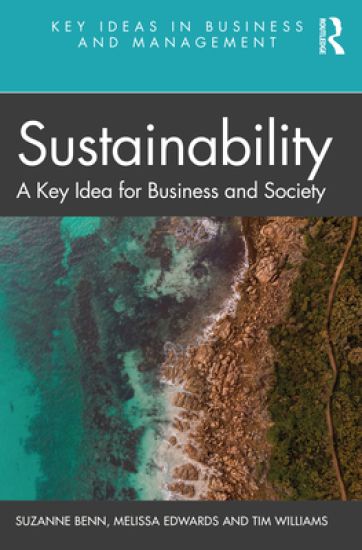
The heightening impact of ecological and societal crises makes sustainability an increasingly urgent imperative, requiring a fundamental shift in how we understand and practice management and business.In this book, the authors set out the key characteristics of sustainability such as its temporal and multilevel effects and highlight the complex array of sustainability risks and opportunities for business and management. Setting business within a systems perspective, the authors outline different sustainability discourses that frame how business responds to the sustainability imperative. They call for the normative and scientific approaches to sustainability to be merged so that a new transdisciplinary approach that brings together the material and relational traditions in sustainability management is developed. Sustainability work is understood as the reframing of tools, technologies, practices and business strategies to respond to the imperative. The book concludes by highlighting dynamic features of the imperative as it is shaped by the urgent need to restore and regenerate social and ecological systems. Sustainability transitions such as the Circular Economy and Net Zero are suggested as inspiration for profound business transformation.By facing the intractable complexity associated with sustainability, this book challenges students and scholars to draw from across the sciences and social sciences to understand, reflect upon and deliver responsible business outcomes in contemporary society.
Sustainability

Sustainability

Suzanne Benn; Melissa Edwards; Tim Williams

Routledge
2021
nidottu
The heightening impact of ecological and societal crises makes sustainability an increasingly urgent imperative, requiring a fundamental shift in how we understand and practice management and business.In this book, the authors set out the key characteristics of sustainability such as its temporal and multilevel effects and highlight the complex array of sustainability risks and opportunities for business and management. Setting business within a systems perspective, the authors outline different sustainability discourses that frame how business responds to the sustainability imperative. They call for the normative and scientific approaches to sustainability to be merged so that a new transdisciplinary approach that brings together the material and relational traditions in sustainability management is developed. Sustainability work is understood as the reframing of tools, technologies, practices and business strategies to respond to the imperative. The book concludes by highlighting dynamic features of the imperative as it is shaped by the urgent need to restore and regenerate social and ecological systems. Sustainability transitions such as the Circular Economy and Net Zero are suggested as inspiration for profound business transformation.By facing the intractable complexity associated with sustainability, this book challenges students and scholars to draw from across the sciences and social sciences to understand, reflect upon and deliver responsible business outcomes in contemporary society.
Organizational Change for Corporate Sustainability

Organizational Change for Corporate Sustainability

Suzanne Benn; Melissa Edwards; Tim Williams

Routledge
2018
sidottu
Since this classic book was first published in 2003, sustainability has increasingly been accepted as standard business practice for leading corporations, while the science itself has revealed how human activity has become the dominant force influencing irreversible changes in the planetary systems.The fourth edition of this trailblazing book on corporate sustainability provides new insights into how organizations can transition towards a more responsible way of conducting their business. It charts new thinking on value creation, business models and organizational purpose as the basis of a broader-based transition to a sustainable society. The sustainability phase model has been substantially revised to incorporate emergent approaches in sustainable supply chain management, strategic sustainability, sustainability-oriented innovation and new business models. There is a companion website that contains a range of materials to support learning.This new edition with the authors’ unified approach to sustainable business reshapes its plan of action to bring about corporate change by drawing in new management theory and practice on strategy-making and leadership, making it core reading for students and researchers of sustainability and business, organizational change and corporate social responsibility.
Organizational Change for Corporate Sustainability

Organizational Change for Corporate Sustainability

Suzanne Benn; Melissa Edwards; Tim Williams

Routledge
2018
nidottu
Since this classic book was first published in 2003, sustainability has increasingly been accepted as standard business practice for leading corporations, while the science itself has revealed how human activity has become the dominant force influencing irreversible changes in the planetary systems.The fourth edition of this trailblazing book on corporate sustainability provides new insights into how organizations can transition towards a more responsible way of conducting their business. It charts new thinking on value creation, business models and organizational purpose as the basis of a broader-based transition to a sustainable society. The sustainability phase model has been substantially revised to incorporate emergent approaches in sustainable supply chain management, strategic sustainability, sustainability-oriented innovation and new business models. There is a companion website that contains a range of materials to support learning.This new edition with the authors’ unified approach to sustainable business reshapes its plan of action to bring about corporate change by drawing in new management theory and practice on strategy-making and leadership, making it core reading for students and researchers of sustainability and business, organizational change and corporate social responsibility.
Key Concepts in Corporate Social Responsibility

Key Concepts in Corporate Social Responsibility

Suzanne Benn; Dianne Bolton

SAGE Publications Ltd
2011
nidottu
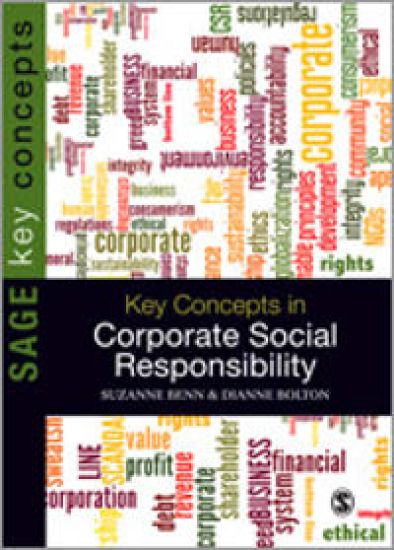
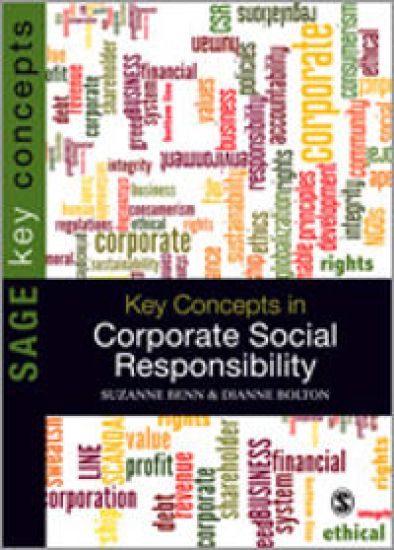
Introducing the key concepts in corporate social responsibility, the authors bring together the essential issues relevant to the responsible management of businesses, not-for-profit organizations and government. With detailed coverage and cross-referencing for each concept and over 50 concepts introduced, this guide to both the theory and implementation of CSR and sustainability, provides an indispensable reference for any student of the subject. Key concepts include: accountability; business ethics; corporate citizenship; corporate environmental reporting; definitions of CSR; ethical consumerism; human rights; NGOs; risk management; stakeholder theory and sustainable development.
Key Concepts in Corporate Social Responsibility

Key Concepts in Corporate Social Responsibility

Suzanne Benn; Dianne Bolton

SAGE Publications Ltd
2011
sidottu
Introducing the key concepts in corporate social responsibility, the authors bring together the essential issues relevant to the responsible management of businesses, not-for-profit organizations and government. With detailed coverage and cross-referencing for each concept and over 50 concepts introduced, this guide to both the theory and implementation of CSR and sustainability, provides an indispensable reference for any student of the subject. Key concepts include: accountability; business ethics; corporate citizenship; corporate environmental reporting; definitions of CSR; ethical consumerism; human rights; NGOs; risk management; stakeholder theory and sustainable development.