

Kirjailija
Suzanne Mettler
Kirjat ja teokset yhdessä paikassa: 8 kirjaa, julkaisuja vuosilta 1998-2026, suosituimpien joukossa Against All Odds. Vertaile teosten hintoja ja tarkista saatavuus suomalaisista kirjakaupoista.
8 kirjaa
Kirjojen julkaisuhaarukka 1998-2026.

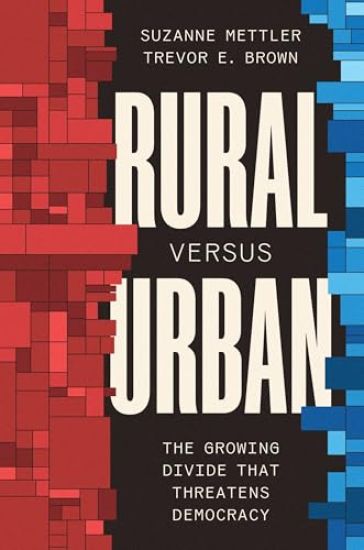
How the urban-rural divide drives partisan polarization Why have Americans living in different places come to experience politics as a battle between “us” and “them”? In Rural Versus Urban, Suzanne Mettler and Trevor Brown argue that political polarization is not just about red states and blue states, or coastal elites who alienate those in fly-over country. Instead, polarization permeates every region and every state—and has become organized through a pernicious rural-urban division. Mettler and Brown explain the evolution of this gulf across five decades, charting political trends in both places. Drawing on data on individuals, communities, and members of Congress, as well as interviews with local party leaders and former elected officials, they show how the divide emerged and why it poses a threat to democracy.Until about thirty years ago, both political parties attracted support from rural and urban voters. But after place-based inequality grew due to deregulation and trade liberalization, white rural dwellers began to view urban people and Democrats as affluent elites out of touch with their needs. Politically active evangelical churches, antiabortion organizations, and gun groups helped deepen the divide, encouraging many of these rural residents to become staunch supporters of the GOP. Now, regional one-party rule in rural America gives Republicans a systematic edge for gaining control of crucial political institutions, including the Senate, House of Representatives, the Presidency, and even the Supreme Court. This is helping enable an extremist political party and pushing democracy to the brink. Mettler and Brown argue that the divide can be repaired—but only if the Democrats build their own robust local organizations and offer citizens a meaningful choice.

Americans' relationship to the federal government is paradoxical. Polls show that public opinion regarding the government has plummeted to all-time lows, with only one in five saying they trust the government or believe that it operates in their interest. Yet, at the same time, more Americans than ever benefit from some form of government social provision. Political scientist Suzanne Mettler calls this growing gulf between people's perceptions of government and the actual role it plays in their lives the "government-citizen disconnect." In The Government-Citizen Disconnect, she explores the rise of this phenomenon and its implications for policymaking and politics. Drawing from original survey data which probed Americans' experiences of 21 federal social policies -- such as food stamps, Social Security, Medicaid, and the home mortgage interest deduction -- Mettler shows that 96 percent of adults have received benefits from at least one of them, and that the average person has utilized five. Overall usage rates transcend social, economic, and political divisions, and most Americans report positive experiences of their policy experiences. However, the fact that they have benefited from these policies has little positive effect on people's attitudes toward government. Mettler finds that shared identities and group affiliations, as well as ideological forces, are more powerful and consistent influences. In particular, those who oppose welfare tend to extrapolate their unfavorable views of it to government in general. Deep antipathy toward the government has emerged as the result of a conservative movement that has waged a war on social welfare policies for over forty years, even as economic inequality and benefit use have increased. Mettler finds that voting patterns exacerbate the government-citizen disconnect, as those holding positive views of federal programs and supporting expanded benefits have lower rates of political participation than those holding more hostile views of the government. As a result, the loudest political voice belongs to those who have benefited from policies but who give government little credit for their economic well-being, seeing their success more as a matter of their own deservingness. This contributes to the election of politicians who advocate cutting federal social programs. According to Mettler, the government-citizen disconnect frays the bonds of representative government and democracy. The Government-Citizen Disconnect illuminates a paradox that increasingly shapes American politics. Mettler's examination of hostility toward government at a time when most Americans will at some point rely on the social benefits it provides helps us better understand the roots of today's fractious political climate.
"Keep your government hands off my Medicare!" Such comments spotlight a central question animating Suzanne Mettler's provocative and timely book: why are many Americans unaware of government social benefits and so hostile to them in principle, even though they receive them? The Obama administration has been criticized for its inability to convey how much it has accomplished for ordinary citizens. Mettler argues that this difficulty is not merely a failure of communication; rather it is endemic to the formidable presence of the "submerged state." In recent decades, federal policy makers have increasingly shunned the outright disbursing of benefits to individuals and families and favored instead less visible and more indirect incentives and subsidies, from tax breaks to payments for services to private companies. These submerged policies, Mettler shows, obscure the role of government and exaggerate that of the market. As a result, citizens are unaware not only of the benefits they receive, but of the massive advantages given to powerful interests, such as insurance companies and the financial industry. Mettler analyzes three Obama reforms - student aid, tax relief, and health care - to reveal the submerged state and its consequences, demonstrating how structurally difficult it is to enact policy reforms. She concludes with recommendations for reform to help make hidden policies more visible and governance more comprehensible to all Americans. The sad truth is that many American citizens do not know how major social programs work - or even whether they benefit from them. Suzanne Mettler's important new book will bring government policies back to the surface and encourage citizens to reclaim their voice in the political process.
"Keep your government hands off my Medicare!" Such comments spotlight a central question animating Suzanne Mettler's provocative and timely book: why are many Americans unaware of government social benefits and so hostile to them in principle, even though they receive them? The Obama administration has been criticized for its inability to convey how much it has accomplished for ordinary citizens. Mettler argues that this difficulty is not merely a failure of communication; rather it is endemic to the formidable presence of the "submerged state." In recent decades, federal policy makers have increasingly shunned the outright disbursing of benefits to individuals and families and favored instead less visible and more indirect incentives and subsidies, from tax breaks to payments for services to private companies. These submerged policies, Mettler shows, obscure the role of government and exaggerate that of the market. As a result, citizens are unaware not only of the benefits they receive, but of the massive advantages given to powerful interests, such as insurance companies and the financial industry. Mettler analyzes three Obama reforms - student aid, tax relief, and health care - to reveal the submerged state and its consequences, demonstrating how structurally difficult it is to enact policy reforms. She concludes with recommendations for reform to help make hidden policies more visible and governance more comprehensible to all Americans. The sad truth is that many American citizens do not know how major social programs work - or even whether they benefit from them. Suzanne Mettler's important new book will bring government policies back to the surface and encourage citizens to reclaim their voice in the political process.

The G.I. Bill fueled not only the development of the middle class: it also revitalized American democracy. Americans who came of age during World War II joined fraternal groups and neighborhood and community organizations and took part in politics at rates that made the postwar era the twentieth century's civic "golden age." Drawing on extensive interviews and surveys with hundreds of members of the "greatest generation," Suzanne Mettler finds that by treating veterans as first-class citizens and in granting advanced education, the Bill inspired them to become the active participants thanks to whom memberships in civic organizations soared and levels of political activity peaked. Mettler probes how this landmark law produced such a civic renaissance. Most fundamentally, she discovers, it communicated to veterans that government was for and about people like them, and they responded in turn. In our current age of rising inequality and declining civic engagement, Soldiers to Citizens offers critical lessons about how public programs can make a difference.
The New Deal was not the same deal for men and women—a finding strikingly demonstrated in Dividing Citizens. Rich with implications for current debates over citizenship and welfare policy, this book provides a detailed historical account of how governing institutions and public policies shape social status and civic life. In her examination of the impact of New Deal social and labor policies on the organization and character of American citizenship, Suzanne Mettler offers an incisive analysis of the formation and implementation of the pillars of the modern welfare state: the Social Security Act, including Old Age and Survivors' Insurance, Old Age Assistance, Unemployment Insurance, and Aid to Dependent Children (later known simply as "welfare"), as well as the Fair Labor Standards Act, which guaranteed the minimum wage. Mettler draws on the methods of historical-institutionalists to develop a "structured governance" approach to her analysis of the New Deal. She shows how the new welfare state institutionalized gender politically, most clearly by incorporating men, particularly white men, into nationally administered policies and consigning women to more variable state-run programs. Differential incorporation of citizens, in turn, prompted different types of participation in politics. These gender-specific consequences were the outcome of a complex interplay of institutional dynamics, political imperatives, and the unintended consequences of policy implementation actions. By tracing the subtle and complicated political dynamics that emerged with New Deal policies, Mettler sounds a cautionary note as we once again negotiate the bounds of American federalism and public policy.