Kirjojen hintavertailu. Mukana 12 199 912 kirjaa ja 12 kauppaa.

Kirjailija

Swagatam Das

Kirjat ja teokset yhdessä paikassa: 8 kirjaa, julkaisuja vuosilta 2009-2026, suosituimpien joukossa Statistical Methods and Analyses for Optimization Algorithms and Artificial Intelligence. Vertaile teosten hintoja ja tarkista saatavuus suomalaisista kirjakaupoista.

8 kirjaa

Kirjojen julkaisuhaarukka 2009-2026.

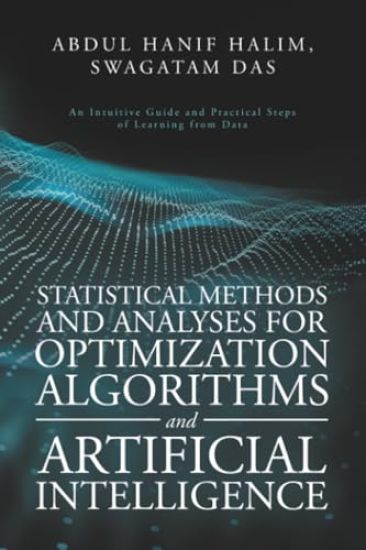
Statistical Methods and Analyses for Optimization Algorithms and Artificial Intelligence

Statistical Methods and Analyses for Optimization Algorithms and Artificial Intelligence

Abdul Hanif Halim; Swagatam Das

Partridge Publishing Singapore
2026
pokkari
In the perspective of analyzing the stochastic algorithms, a concept of presenting a single solution per problem type is typically incorrect and far from a fair comparison. Such algorithms shall run for n number of trials before initiating its respective perfomance. As a benchmark to a known standard such as CEC 2017 that requires 25 number of trials with 20000*D maximum number of function evaluations for constrained real parameter optimization (D as the number of dimensions), whereas in multimodal multiobjective problems CEC 2020 requires 21 runs for performance comparison. The main reason is due to its stochastic nature that may resulted in a spectrum of n solutions by executing the algorithm in n number of trials. Comparing several solutions with respect to the number of algorithms and problem types lead the analyst to focus on the statistical method that able to characterize the algorithm's efficiency and effectiveness towards finding the optimum solution. Besides its importance, a correct statistical method and comprehensive analysis is also highly recommended to avoid any judgmental error that lead into wrong conclusion. In general, the analysis of algorithm performance in the scope of efficiency and effectiveness can be viewed in two clusters: the group difference and trends. The group difference is described as the comparison of algorithm performance such as the converged fitness or computation time required after reached the maximum number of evaluations. The most appropriate method for analyzing the group difference is via two-sample or multiple sample comparison. The trend analysis is related to the dynamic progress of each compared algorithm towards finding the optimum solution. Typical measures for observing the trend between algorithm is based on the run-time analysis and convergence. These measures can be characterized by comparing the cumulative distribution and ordered alternatives method. This book reviews the recommended basic concept and detail statistical analysis that been carried out in numerous analyses of metaheuristic algorithm, which cover both descriptive and inferential statistics. In addition to each sub-topic, the book also discusses several basic applications and examples related to the parametric and non-parametric analysis. This book also discusses several Bayesian statistic that been proposed in the literatures for evaluating the algorithm performance.

Into a Deeper Understanding of Evolutionary Computing: Exploration, Exploitation, and Parameter Control

Into a Deeper Understanding of Evolutionary Computing: Exploration, Exploitation, and Parameter Control

Abdul Hanif Abdul Halim; Swagatam Das; Idris Ismail

Springer International Publishing AG
2025
sidottu
This book delves into fundamental and advanced strategies for enhancing evolutionary and metaheuristic algorithms, focusing on the crucial balance between exploration and exploitation in search mechanisms. As technological advancements increase optimization complexity, effectively managing this balance becomes essential for achieving optimal solutions within reasonable computational resources. The book's distinctive structure organizes content according to optimization stages and processes, offering a comprehensive discussion of various approaches supported by extensive literature. The authors note a scarcity of literature addressing the trade-offs between exploration and exploitation with contemporary references, making this work particularly valuable. It aims to deepen the reader's understanding of evolutionary computing, emphasizing exploration, exploitation, and parameter control. It is relevant not only to algorithm developers and the evolutionary computation community but also to students and researchers across scientific disciplines. The book is designed to be accessible to those without extensive algorithm development backgrounds, providing theoretical and practical insights into optimization methods.
Into a Deeper Understanding of Evolutionary Computing: Exploration, Exploitation, and Parameter Control

Into a Deeper Understanding of Evolutionary Computing: Exploration, Exploitation, and Parameter Control

Abdul Hanif Abdul Halim; Swagatam Das; Idris Ismail

Springer International Publishing AG
2024
sidottu
This book delves into fundamental and advanced strategies for enhancing evolutionary and metaheuristic algorithms, focusing on the crucial balance between exploration and exploitation in search mechanisms. As technological advancements increase optimization complexity, effectively managing this balance becomes essential for achieving optimal solutions within reasonable computational resources. The book's distinctive structure organizes content according to optimization stages and processes, offering a comprehensive discussion of various approaches supported by extensive literature. The authors note a scarcity of literature addressing the trade-offs between exploration and exploitation with contemporary references, making this work particularly valuable. It aims to deepen the reader's understanding of evolutionary computing, emphasizing exploration, exploitation, and parameter control. It is relevant not only to algorithm developers and the evolutionary computation community but also to students and researchers across scientific disciplines. The book is designed to be accessible to those without extensive algorithm development backgrounds, providing theoretical and practical insights into optimization methods.
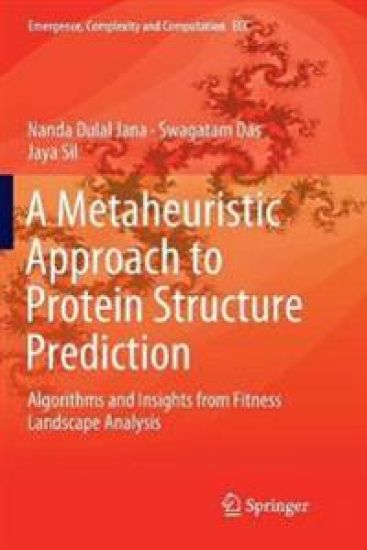
A Metaheuristic Approach to Protein Structure Prediction

A Metaheuristic Approach to Protein Structure Prediction

Nanda Dulal Jana; Swagatam Das; Jaya Sil

Springer Nature Switzerland AG
2018
nidottu
This book introduces characteristic features of the protein structure prediction (PSP) problem. It focuses on systematic selection and improvement of the most appropriate metaheuristic algorithm to solve the problem based on a fitness landscape analysis, rather than on the nature of the problem, which was the focus of methodologies in the past. Protein structure prediction is concerned with the question of how to determine the three-dimensional structure of a protein from its primary sequence. Recently a number of successful metaheuristic algorithms have been developed to determine the native structure, which plays an important role in medicine, drug design, and disease prediction. This interdisciplinary book consolidates the concepts most relevant to protein structure prediction (PSP) through global non-convex optimization. It is intended for graduate students from fields such as computer science, engineering, bioinformatics and as a reference for researchers and practitioners.
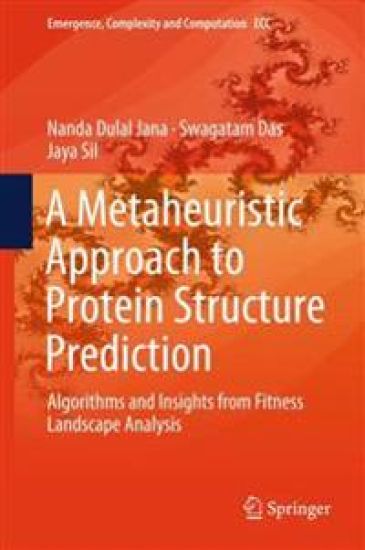
A Metaheuristic Approach to Protein Structure Prediction

A Metaheuristic Approach to Protein Structure Prediction

Nanda Dulal Jana; Swagatam Das; Jaya Sil

Springer International Publishing AG
2018
sidottu
This book introduces characteristic features of the protein structure prediction (PSP) problem. It focuses on systematic selection and improvement of the most appropriate metaheuristic algorithm to solve the problem based on a fitness landscape analysis, rather than on the nature of the problem, which was the focus of methodologies in the past. Protein structure prediction is concerned with the question of how to determine the three-dimensional structure of a protein from its primary sequence. Recently a number of successful metaheuristic algorithms have been developed to determine the native structure, which plays an important role in medicine, drug design, and disease prediction. This interdisciplinary book consolidates the concepts most relevant to protein structure prediction (PSP) through global non-convex optimization. It is intended for graduate students from fields such as computer science, engineering, bioinformatics and as a reference for researchers and practitioners.
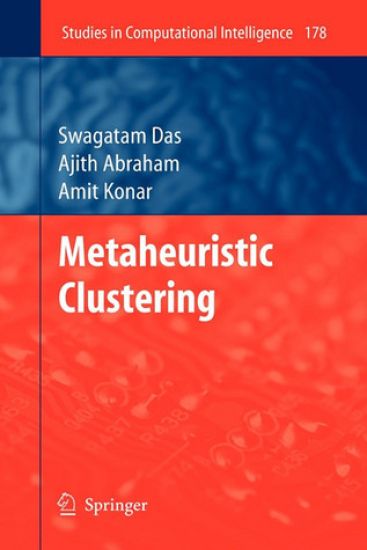
Metaheuristic Clustering

Metaheuristic Clustering

Swagatam Das; Ajith Abraham; Amit Konar

Springer-Verlag Berlin and Heidelberg GmbH Co. K
2010
nidottu
Cluster analysis means the organization of an unlabeled collection of objects or patterns into separate groups based on their similarity. The task of computerized data clustering has been approached from diverse domains of knowledge like graph theory, multivariate analysis, neural networks, fuzzy set theory, and so on. Clustering is often described as an unsupervised learning method but most of the traditional algorithms require a prior specification of the number of clusters in the data for guiding the partitioning process, thus making it not completely unsupervised. Modern data mining tools that predict future trends and behaviors for allowing businesses to make proactive and knowledge-driven decisions, demand fast and fully automatic clustering of very large datasets with minimal or no user intervention. In this volume, we formulate clustering as an optimization problem, where the best partitioning of a given dataset is achieved by minimizing/maximizing one (single-objective clustering) or more (multi-objective clustering) objective functions. Using several real world applications, we illustrate the performance of several metaheuristics, particularly the Differential Evolution algorithm when applied to both single and multi-objective clustering problems, where the number of clusters is not known beforehand and must be determined on the run. This volume comprises of 7 chapters including an introductory chapter giving the fundamental definitions and the last Chapter provides some important research challenges. Academics, scientists as well as engineers engaged in research, development and application of optimization techniques and data mining will find the comprehensive coverage of this book invaluable.
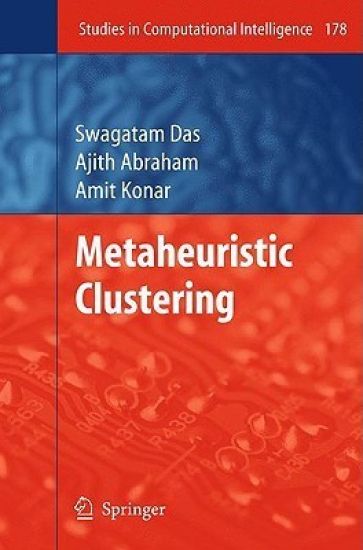
Metaheuristic Clustering

Metaheuristic Clustering

Swagatam Das; Ajith Abraham; Amit Konar

Springer-Verlag Berlin and Heidelberg GmbH Co. K
2009
sidottu
Cluster analysis means the organization of an unlabeled collection of objects or patterns into separate groups based on their similarity. The task of computerized data clustering has been approached from diverse domains of knowledge like graph theory, multivariate analysis, neural networks, fuzzy set theory, and so on. Clustering is often described as an unsupervised learning method but most of the traditional algorithms require a prior specification of the number of clusters in the data for guiding the partitioning process, thus making it not completely unsupervised. Modern data mining tools that predict future trends and behaviors for allowing businesses to make proactive and knowledge-driven decisions, demand fast and fully automatic clustering of very large datasets with minimal or no user intervention. In this volume, we formulate clustering as an optimization problem, where the best partitioning of a given dataset is achieved by minimizing/maximizing one (single-objective clustering) or more (multi-objective clustering) objective functions. Using several real world applications, we illustrate the performance of several metaheuristics, particularly the Differential Evolution algorithm when applied to both single and multi-objective clustering problems, where the number of clusters is not known beforehand and must be determined on the run. This volume comprises of 7 chapters including an introductory chapter giving the fundamental definitions and the last Chapter provides some important research challenges. Academics, scientists as well as engineers engaged in research, development and application of optimization techniques and data mining will find the comprehensive coverage of this book invaluable.