Kirjojen hintavertailu. Mukana 12 657 676 kirjaa ja 12 kauppaa.
Kirjailija
Sylvie Meleard
Kirjat ja teokset yhdessä paikassa: 4 kirjaa, julkaisuja vuosilta 1996-2026, suosituimpien joukossa Random Models in Biology, Ecology and Evolution. Vertaile teosten hintoja ja tarkista saatavuus suomalaisista kirjakaupoista.
Le but du livre est de définir et développer une grande gamme d'outils probabilistes pour la modélisation en biologie des populations, afin de décrire des dynamiques temporelles de quantités biologiques telles que la taille d'une ou plusieurs populations, la proportion d'un allèle dans une population ou la position d'un individu. En partant de modèles markoviens discrets (marches aléatoires, processus de Galton-Watson), nous abordons progressivement le calcul stochastique et les équations différentielles stochastiques, puis les processus markoviens de saut, tels les processus de branchement à temps continu et les processus de naissance et mort. Nous étudions également les processus discret et continu pour l'évolution génétique et les généalogies: processus de Wright-Fisher et coalescent. Le livre détaille systématiquement les calculs de quantités d'intérêt pour les biologistes. De nombreux exercices d'application sont proposés. Le dernier chapitre montre l'apport de ces outils pour des problématiques biologiques actuelles. Il développe en détail des travaux de recherche très récents. This book defines and develops probabilistic tools for the modeling of populations in order to describe the dynamics of biological quantities such as population size, allele proportion in a population and individual location. From discrete Markovian models (random walks, Galton-Watson processes), it gradually introduces the stochastic calculus and the stochastic differential equations, as well as the jump Markov processes, such as the branching processes in continuous time and the birth and death processes. It also discusses the discrete and continuous processes of genetic evolution, genealogies and the Wright-Fisher processes and coalescent. The book systematically details the computation of quantities of interest to biologists and provides a number of exercises. The last chapter shows the use of probabilistic tools for real-world biological problems, and discusses recent research in detail.
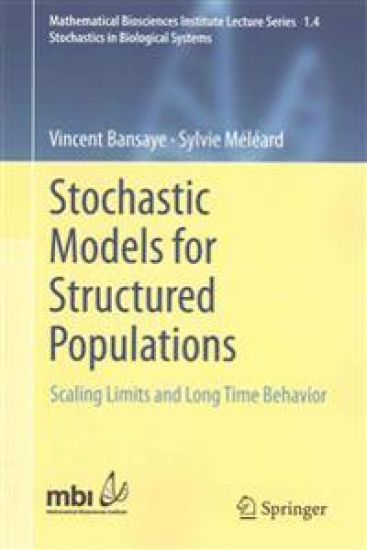
In this contribution, several probabilistic tools to study population dynamics are developed. The focus is on scaling limits of qualitatively different stochastic individual based models and the long time behavior of some classes of limiting processes.Structured population dynamics are modeled by measure-valued processes describing the individual behaviors and taking into account the demographic and mutational parameters, and possible interactions between individuals. Many quantitative parameters appear in these models and several relevant normalizations are considered, leading to infinite-dimensional deterministic or stochastic large-population approximations. Biologically relevant questions are considered, such as extinction criteria, the effect of large birth events, the impact of environmental catastrophes, the mutation-selection trade-off, recovery criteria in parasite infections, genealogical properties of a sample ofindividuals.These notes originated from a lecture series on Structured Population Dynamics at Ecole polytechnique (France).Vincent Bansaye and Sylvie Méléard are Professors at Ecole Polytechnique (France). They are a specialists of branching processes and random particle systems in biology. Most of their research concerns the applications of probability to biodiversity, ecology and evolution.
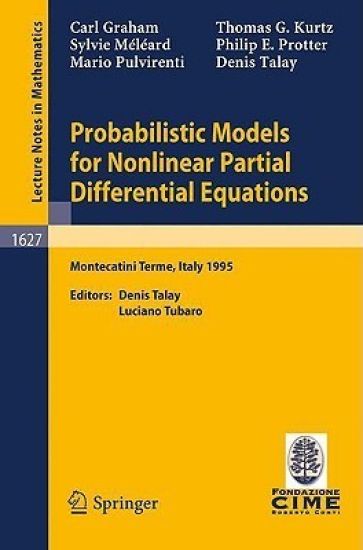
The lecture courses of the CIME Summer School on Probabilistic Models for Nonlinear PDE's and their Numerical Applications (April 1995) had a three-fold emphasis: first, on the weak convergence of stochastic integrals; second, on the probabilistic interpretation and the particle approximation of equations coming from Physics (conservation laws, Boltzmann-like and Navier-Stokes equations); third, on the modelling of networks by interacting particle systems. This book, collecting the notes of these courses, will be useful to probabilists working on stochastic particle methods and on the approximation of SPDEs, in particular, to PhD students and young researchers.