Kirjojen hintavertailu. Mukana 12 314 260 kirjaa ja 12 kauppaa.

Kirjailija

T. C. Edwin Cheng

Kirjat ja teokset yhdessä paikassa: 9 kirjaa, julkaisuja vuosilta 2010-2024, suosituimpien joukossa Shipping and Logistics Management. Vertaile teosten hintoja ja tarkista saatavuus suomalaisista kirjakaupoista.

Mukana myös kirjoitusasut: T.C. Edwin Cheng

9 kirjaa

Kirjojen julkaisuhaarukka 2010-2024.

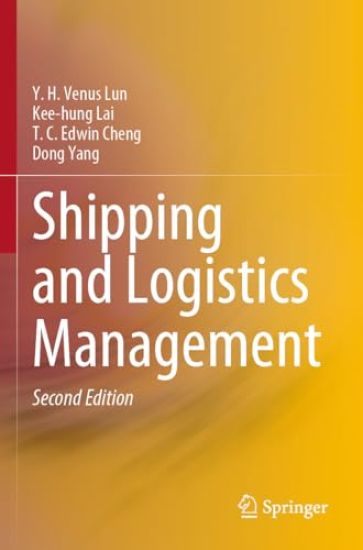
Shipping and Logistics Management

Shipping and Logistics Management

Y. H. Venus Lun; Kee-hung Lai; T. C. Edwin Cheng; Dong Yang

Springer International Publishing AG
2024
nidottu
This book explains global trends and strategies in the shipping business, looking at the role of logistics service providers and at how information technology can help shipping operations. It also introduces best practices and advice that will allow professionals to improve the management of shipping and logistics activities. The book consists of sections examining shipping and trade, business strategies for shipping, intermodal container transport operations, and ports. This new edition adds a new fifth section with four new chapters that discusses contemporary issues in shipping. The new chapters are related to risk management in shipping, shipping security and safety, environmental and social sustainability, and a review of new technologies in the shipping industry and their future potential. An invaluable source of information for researchers and advanced, or graduate, students, Shipping and Logistics Management is also a useful reference for shipping practitioners and consultants.
Shipping and Logistics Management

Shipping and Logistics Management

Y. H. Venus Lun; Kee-hung Lai; T. C. Edwin Cheng; Dong Yang

Springer International Publishing AG
2023
sidottu
This book explains global trends and strategies in the shipping business, looking at the role of logistics service providers and at how information technology can help shipping operations. It also introduces best practices and advice that will allow professionals to improve the management of shipping and logistics activities. The book consists of sections examining shipping and trade, business strategies for shipping, intermodal container transport operations, and ports. This new edition adds a new fifth section with four new chapters that discusses contemporary issues in shipping. The new chapters are related to risk management in shipping, shipping security and safety, environmental and social sustainability, and a review of new technologies in the shipping industry and their future potential. An invaluable source of information for researchers and advanced, or graduate, students, Shipping and Logistics Management is also a useful reference for shipping practitioners and consultants.
Contract Analysis and Design for Supply Chains with Stochastic Demand

Contract Analysis and Design for Supply Chains with Stochastic Demand

Yingxue Zhao; Xiaoge Meng; Shouyang Wang; T. C. Edwin Cheng

Springer-Verlag New York Inc.
2016
nidottu
This book is devoted to analysis and design of supply chain contracts with stochastic demand. Given the extensive utilization of contracts in supply chains, the issues concerning contract analysis and design are extremely important for supply chain management (SCM), and substantial research has been developed to address those issues over the past years. Despite the abundance of classical research, new research needs to be conducted in response to new issues emerging with the recent changing business environments, such as the fast-shortening life cycle of product and the increasing globalization of supply chains. This book addresses these issues, with the intention to present new research on how to apply contracts to improve SCM.Contract Analysis and Design for Supply Chains with Stochastic Demand contains eight chapters and each chapter is summarized as follows: Chapter 1 provides a comprehensive review of the classical development of supply chain contracts. Chapter 2 examines the effects of demand uncertainty on the applicability of buyback contracts. Chapter 3 conducts a mean-risk analysis for wholesale price contracts, taking into account contracting value risk and risk preferences. Chapter 4 studies the optimization of product service system by franchise fee contracts in the service-oriented manufacturing supply chain with demand information asymmetry. Chapter 5 develops a bidirectional option contract model and explores the optimal contracting decisions and supply chain coordination issue with the bidirectional option. Chapter 6 addresses supply chain options pricing issue and a value-based pricing scheme is developed for the supply chain options. With a cooperative game theory approach, Chapter 7 explores the issues concerning supply chain contract selection/implementation with the option contract under consideration. Chapter 8 concludes the book and suggests worthy directions for future research.
Environmental Management

Environmental Management

Christina W.Y. Wong; Kee-hung Lai; Y.H. Venus Lun; T.C. Edwin Cheng

Springer International Publishing AG
2015
nidottu
In view of the increasing quest for environmental management in businesses, this book provides a good reference to firms to understand how they may manage their supply chains to improve business and environmental performance. The book consists of six chapters covering such topics as environmental management, environmental management practices with supply chain efforts, collaborative environmental management, organizational capabilities in environmental management, environmental disclosure, and closed-loop supply chains. The book presents theory-driven discussions on the link between environmental management and business performance in the context of supply chain management. The book will be useful for firms to learn from the research findings and real-life cases to develop plans to implement environmental management practices jointly with supply chain partners.
Contract Analysis and Design for Supply Chains with Stochastic Demand

Contract Analysis and Design for Supply Chains with Stochastic Demand

Yingxue Zhao; Xiaoge Meng; Shouyang Wang; T. C. Edwin Cheng

Springer-Verlag New York Inc.
2015
sidottu
This book is devoted to analysis and design of supply chain contracts with stochastic demand. Given the extensive utilization of contracts in supply chains, the issues concerning contract analysis and design are extremely important for supply chain management (SCM), and substantial research has been developed to address those issues over the past years. Despite the abundance of classical research, new research needs to be conducted in response to new issues emerging with the recent changing business environments, such as the fast-shortening life cycle of product and the increasing globalization of supply chains. This book addresses these issues, with the intention to present new research on how to apply contracts to improve SCM.Contract Analysis and Design for Supply Chains with Stochastic Demand contains eight chapters and each chapter is summarized as follows: Chapter 1 provides a comprehensive review of the classical development of supply chain contracts. Chapter 2 examines the effects of demand uncertainty on the applicability of buyback contracts. Chapter 3 conducts a mean-risk analysis for wholesale price contracts, taking into account contracting value risk and risk preferences. Chapter 4 studies the optimization of product service system by franchise fee contracts in the service-oriented manufacturing supply chain with demand information asymmetry. Chapter 5 develops a bidirectional option contract model and explores the optimal contracting decisions and supply chain coordination issue with the bidirectional option. Chapter 6 addresses supply chain options pricing issue and a value-based pricing scheme is developed for the supply chain options. With a cooperative game theory approach, Chapter 7 explores the issues concerning supply chain contract selection/implementation with the option contract under consideration. Chapter 8 concludes the book and suggests worthy directions for future research.
Oil Transport Management

Oil Transport Management

Y.H. Venus Lun; Olli-Pekka Hilmola; Alexander M. Goulielmos; Kee-hung Lai; T.C. Edwin Cheng

Springer London Ltd
2014
nidottu
The first volume in a new Springer Series on Shipping and Transport Logistics, Oil Transport Management provides a full historical account of the evolution of the oil transport industry since the 1800's. In this comprehensive guide, the authors investigate the industry and describe the shipping market and its structure, as well as forecasting, location plan and the transportation chain. They dedicate a separate chapter to each topic to cover various concepts, including:an introduction to the tanker shipping market, including how the freight, new vessel building, second hand and demolition markets influence one another,the economic structure and organization of the tanker industry in both the past and present, andforecasting the need for oil-based sea transportation. Further chapters present case studies and simulations to illustrate the importance of factory location decisions and the need for oil infrastructure investments. Chapter One also includes a regression equation to predict the fleet size in tanker shipping. Oil Transport Management is a key reference, which can be practically applied to wider global research and practices. Ideal for both industry practitioners, and researchers and students of shipping studies, Oil Transport Management provides a concise yet comprehensive coverage of the oil transport industry's history and a guide for its future development.
Oil Transport Management

Oil Transport Management

Y.H. Venus Lun; Olli-Pekka Hilmola; Alexander M. Goulielmos; Kee-hung Lai; T.C. Edwin Cheng

Springer London Ltd
2012
sidottu
The first volume in a new Springer Series on Shipping and Transport Logistics, Oil Transport Management provides a full historical account of the evolution of the oil transport industry since the 1800's. In this comprehensive guide, the authors investigate the industry and describe the shipping market and its structure, as well as forecasting, location plan and the transportation chain. They dedicate a separate chapter to each topic to cover various concepts, including:an introduction to the tanker shipping market, including how the freight, new vessel building, second hand and demolition markets influence one another,the economic structure and organization of the tanker industry in both the past and present, andforecasting the need for oil-based sea transportation. Further chapters present case studies and simulations to illustrate the importance of factory location decisions and the need for oil infrastructure investments. Chapter One also includes a regression equation to predict the fleet size in tanker shipping. Oil Transport Management is a key reference, which can be practically applied to wider global research and practices. Ideal for both industry practitioners, and researchers and students of shipping studies, Oil Transport Management provides a concise yet comprehensive coverage of the oil transport industry's history and a guide for its future development.
Postponement Strategies in Supply Chain Management

Postponement Strategies in Supply Chain Management

T. C. Edwin Cheng; Jian Li; C. L. Johnny Wan; Shouyang Wang

Springer-Verlag New York Inc.
2012
nidottu
Postponement strategy is one of the major supply chain management (SCM) pr- tices that has a discernible impact on rms’ competitive advantage and organi- tional performance. Postponement is a mass customization strategy that captures the advantages of both mass production and mass customization. Recent research studies have identi ed four common postponement strategies, namely pull, logistics, form and price postponement. The former three postponement strategies are linked to production and manufacturing, while the last one is a pure pricing strategy. They aim at balancing the costs and bene ts of mass production and mass customization. Practical examples of postponement can be found in the high-tech industry, food industry and other industries that require high differentiation. However, empirical studies have found that postponement may not be an evident SCM practice compared to the other practices. In addition, postponement has both positive and negative impacts on a supply chain. The advantages include following the JIT principles, reducing end-product inventory, making forecasting easier and pooling risk. The high cost of designing and manufacturing generic components is the main drawback of postponement. Thus, the evaluation of postponement strategy is an important research issue and there have been many qualitative and quantitative models for analyzing postponement under different scenarios.
Postponement Strategies in Supply Chain Management

Postponement Strategies in Supply Chain Management

T. C. Edwin Cheng; Jian Li; C. L. Johnny Wan; Shouyang Wang

Springer-Verlag New York Inc.
2010
sidottu
Postponement strategy is one of the major supply chain management (SCM) pr- tices that has a discernible impact on rms’ competitive advantage and organi- tional performance. Postponement is a mass customization strategy that captures the advantages of both mass production and mass customization. Recent research studies have identi ed four common postponement strategies, namely pull, logistics, form and price postponement. The former three postponement strategies are linked to production and manufacturing, while the last one is a pure pricing strategy. They aim at balancing the costs and bene ts of mass production and mass customization. Practical examples of postponement can be found in the high-tech industry, food industry and other industries that require high differentiation. However, empirical studies have found that postponement may not be an evident SCM practice compared to the other practices. In addition, postponement has both positive and negative impacts on a supply chain. The advantages include following the JIT principles, reducing end-product inventory, making forecasting easier and pooling risk. The high cost of designing and manufacturing generic components is the main drawback of postponement. Thus, the evaluation of postponement strategy is an important research issue and there have been many qualitative and quantitative models for analyzing postponement under different scenarios.