Kirjojen hintavertailu. Mukana 12 595 353 kirjaa ja 12 kauppaa.

Kirjailija

T. J. Demos

Kirjat ja teokset yhdessä paikassa: 9 kirjaa, julkaisuja vuosilta 2013-2023, suosituimpien joukossa Art & Crisis. Vertaile teosten hintoja ja tarkista saatavuus suomalaisista kirjakaupoista.

9 kirjaa

Kirjojen julkaisuhaarukka 2013-2023.

Radikale futurismer

Radikale futurismer

T. J. Demos

Informations Forlag
2023
sidottu
Vi nærmer os afslutningen – på demokratiet, på liberalismen, på kapitalismen, på en sund planet og på civilisationen, som vi kender den. Men hvad kommer efter verdens undergang?Radikale futurismer er en undersøgelse af, hvad der følger efter undergangsfortællingerne, og hvordan vi derfor bør organisere os. Med udgangspunkt i eksempler på eksperimentel visuel kultur, nye medier og sociale bevægelser fremkalder kunsthistorikeren T. J. Demos visioner for retfærdige fremtider og argumenterer for, at det er lige så vigtigt at bekæmpe nihilistisk sortsyn som kapitalismens greenwashing og algoritmiske herredømme.T. J. Demos (f. 1966) er kunsthistoriker og professor i visuel kultur ved University of California. Han har vundet flere priser for sine bøger om samtidskunst, international politik og økologi. Radikale futurismer er hans første bog på dansk.Bogen er del af Bibliotek for ny kunstteori. Tidligere bøger i serien: Kunstner i arbejde af Bojana Kunst, Retsteknisk arkitektur af Eyal Weizman, Den frigjorte beskuer og Det sanseliges deling af Jacques Rancière, Vores æstetiske kategorier af Sianne Ngai, Toldfri kunst af Hito Steyerl og Samtidskunstens teorier af Juliane Rebentisch.
Radical Futurisms

Radical Futurisms

T. J. Demos

STERNBERG PRESS
2023
pokkari
What comes after end-of-world narratives: visions of just futurity and multispecies flourishing.There is widespread consensus that we are living at the end--of democracy, of liberalism, of capitalism, of a healthy planet, of the Holocene, of civilization as we know it. Drawing on radical futurisms and visions of justice-to-come emerging from the traditions of the oppressed--Indigenous, African-American, multispecies, anti-capitalist--as materialized in experimental visual cultural, new media, aesthetic practices, and social movements, in this book. T. J. Demos poses speculative questions about what comes after end-of-world narratives, arguing that it's as vital to defeat fatalistic nihilism as the false solutions of green capitalism and algorithmic governance. How might we decolonize the future, and cultivate an emancipated chronopolitics in relation to an undetermined not-yet? If we are to avoid climate emergency's cooptation by technofixes, and the defuturing of multitudes by xenophobic eco-fascism, Demos argues, we must cultivate visions of just futurity and multispecies flourishing.
Gerhard Richter

Gerhard Richter

Hubertus Butin; Cathérine Hug; Ann Cotten; T. J. Demos; Matias Faldbakken; Martha Stutteregger

Hatje Cantz
2020
sidottu
Gerhard Richter is one of the most famous painters of our time, worldwide. His fascinating visual spheres are characterized by a unique originality and quality, in which the abstract and the figural intertwine and permeate each other. This extensive volume of pictures concentrates entirely upon the theme of landscape in Richter’s oeuvre. Through this genre, to which Richter has remained loyal for more than sixty years, it is possible to see more than a development in the artist’s painting style. There is also a perceptible, genuine independence in many of the works, which makes him one of the most remarkable artists of our day. This book adds to the understanding of the significance and pictorial essence of Richter’s art, opening up current insights into the theme of nature and landscape in the twenty-first century.
Beyond the World's End

Beyond the World's End

T. J. Demos

Duke University Press
2020
pokkari
In Beyond the World's End T. J. Demos explores cultural practices that provide radical propositions for living in a world beset by environmental and political crises. Rethinking relationships between aesthetics and an expanded political ecology that foregrounds just futurity, Demos examines how contemporary artists are diversely addressing urgent themes, including John Akomfrah's cinematic entanglements of racial capitalism with current environmental threats, the visual politics of climate refugees in work by Forensic Architecture and Teddy Cruz and Fonna Forman, and moving images of Afrofuturist climate justice in projects by Arthur Jafa and Martine Syms. Demos considers video and mixed-media art that responds to resource extraction in works by Angela Melitopoulos, Allora & Calzadilla, and Ursula Biemann, as well as the multispecies ecologies of Terike Haapoja and Public Studio. Throughout Demos contends that contemporary intersections of aesthetics and politics, as exemplified in the Standing Rock #NoDAPL campaign and the Zad's autonomous zone in France, are creating the imaginaries that will be crucial to building a socially just and flourishing future.
Beyond the World's End

Beyond the World's End

T. J. Demos

Duke University Press
2020
sidottu
In Beyond the World's End T. J. Demos explores cultural practices that provide radical propositions for living in a world beset by environmental and political crises. Rethinking relationships between aesthetics and an expanded political ecology that foregrounds just futurity, Demos examines how contemporary artists are diversely addressing urgent themes, including John Akomfrah's cinematic entanglements of racial capitalism with current environmental threats, the visual politics of climate refugees in work by Forensic Architecture and Teddy Cruz and Fonna Forman, and moving images of Afrofuturist climate justice in projects by Arthur Jafa and Martine Syms. Demos considers video and mixed-media art that responds to resource extraction in works by Angela Melitopoulos, Allora & Calzadilla, and Ursula Biemann, as well as the multispecies ecologies of Terike Haapoja and Public Studio. Throughout Demos contends that contemporary intersections of aesthetics and politics, as exemplified in the Standing Rock #NoDAPL campaign and the Zad's autonomous zone in France, are creating the imaginaries that will be crucial to building a socially just and flourishing future.
Art & Crisis

Art & Crisis

Caroline Ann Baur; T. J. Demos; Florian Dombois; David Keller; Dominique Lammli; Rodrigo Nunes; El Rass; Erik Steinbrecher; Judith Welter

JRP Ringier
2018
nidottu
Art & Crisis is a theoretical publication on educational processes and what it means to teach and learn fine arts in a city such as Zurich. It brings together contributions from 2017 MFA students, their professors at Zurich University of the Arts and guest writers.
The Migrant Image

The Migrant Image

T. J. Demos

Duke University Press
2013
pokkari
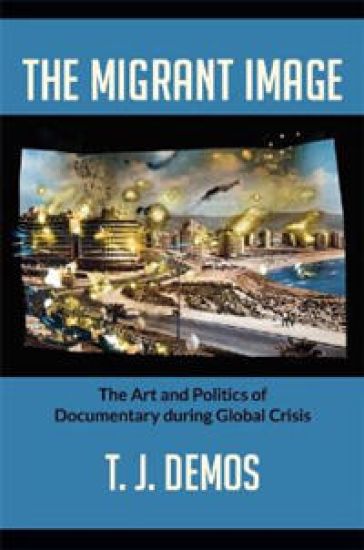
In The Migrant Image T. J. Demos examines the ways contemporary artists have reinvented documentary practices in their representations of mobile lives: refugees, migrants, the stateless, and the politically dispossessed. He presents a sophisticated analysis of how artists from the United States, Europe, North Africa, and the Middle East depict the often ignored effects of globalization and the ways their works connect viewers to the lived experiences of political and economic crisis. Demos investigates the cinematic approaches Steve McQueen, the Otolith Group, and Hito Steyerl employ to blur the real and imaginary in their films confronting geopolitical conflicts between North and South. He analyzes how Emily Jacir and Ahlam Shibli use blurs, lacuna, and blind spots in their photographs, performances, and conceptual strategies to directly address the dire circumstances of dislocated Palestinian people. He discusses the disparate interventions of Walid Raad in Lebanon, Ursula Biemann in North Africa, and Ayreen Anastas and Rene Gabri in the United States, and traces how their works offer images of conflict as much as a conflict of images. Throughout Demos shows the ways these artists creatively propose new possibilities for a politics of equality, social justice, and historical consciousness from within the aesthetic domain.
The Migrant Image

The Migrant Image

T. J. Demos

Duke University Press
2013
sidottu
In The Migrant Image T. J. Demos examines the ways contemporary artists have reinvented documentary practices in their representations of mobile lives: refugees, migrants, the stateless, and the politically dispossessed. He presents a sophisticated analysis of how artists from the United States, Europe, North Africa, and the Middle East depict the often ignored effects of globalization and the ways their works connect viewers to the lived experiences of political and economic crisis. Demos investigates the cinematic approaches Steve McQueen, the Otolith Group, and Hito Steyerl employ to blur the real and imaginary in their films confronting geopolitical conflicts between North and South. He analyzes how Emily Jacir and Ahlam Shibli use blurs, lacuna, and blind spots in their photographs, performances, and conceptual strategies to directly address the dire circumstances of dislocated Palestinian people. He discusses the disparate interventions of Walid Raad in Lebanon, Ursula Biemann in North Africa, and Ayreen Anastas and Rene Gabri in the United States, and traces how their works offer images of conflict as much as a conflict of images. Throughout Demos shows the ways these artists creatively propose new possibilities for a politics of equality, social justice, and historical consciousness from within the aesthetic domain.