Kirjojen hintavertailu. Mukana 12 390 323 kirjaa ja 12 kauppaa.

Kirjailija

Takeshi Matsuura

Kirjat ja teokset yhdessä paikassa: 15 kirjaa, julkaisuja vuosilta 1993-2022, suosituimpien joukossa Gas Separation Membranes. Vertaile teosten hintoja ja tarkista saatavuus suomalaisista kirjakaupoista.

15 kirjaa

Kirjojen julkaisuhaarukka 1993-2022.

Nanotechnology in Membrane Processes

Nanotechnology in Membrane Processes

Kailash Chandra Khulbe; Takeshi Matsuura

Springer Nature Switzerland AG
2022
nidottu
Nanotechnology has been established in membrane technology for decades. In this book, comprehensive coverage is given to nanotechnology applications in synthetic membrane processes, which are used in different fields such as water treatment, separation of gases, the food industry, military use, drug delivery, air filtration, and green chemistry. Nanomaterials such as carbon nanotubes, nanoparticles, and dendrimers are contributing to the development of more efficient and cost-effective water filtration processes. Gas separation and carbon capture can be significantly improved in flue gas applications. Nanoporous membrane systems engineered to mimic natural filtration systems are being actively developed for use in smart implantable drug delivery systems, bio artificial organs, and other novel nano-enabled medical devices. The microscopic structure of nanoporous ceramic membranes, mainly focusing on zeolite materials, as well as the energy-saving effect of membrane separation, contribute to various chemical synthesis processes. In the food industry, nanotechnology has the potential to create new tools for pathogen detection and packaging. For each application, nanotechnology is mostly used to make composite membranes, and the book provides a detailed look at the mechanisms by which the composite membrane works in each application area.
Membrane Separation Processes

Membrane Separation Processes

Ahmad Fauzi Ismail; Takeshi Matsuura

Elsevier Science Publishing Co Inc
2021
nidottu
Membrane Separation Processes: Theories, Problems, and Solutions provides graduate and senior undergraduate students and membrane researchers in academia and industry with the fundamental knowledge on the topic by explaining the underlying theory that is indispensable for solving problems that occur in membrane separation processes. All major membrane processes are discussed, and an economic analysis is provided. Separation processes such as RO, UF, MF, RO, PRO and MD are thoroughly discussed. During the last two decades, the scope of the R&D of membrane separation processes has been significantly broadened. Other sections in the book cover membrane contactor and membrane adsorption. In addition, hybrid systems in which two or more membrane systems are combined are now being investigated for large-scale applications.
Nanotechnology in Membrane Processes

Nanotechnology in Membrane Processes

Kailash Chandra Khulbe; Takeshi Matsuura

Springer Nature Switzerland AG
2021
sidottu
Nanotechnology has been established in membrane technology for decades. In this book, comprehensive coverage is given to nanotechnology applications in synthetic membrane processes, which are used in different fields such as water treatment, separation of gases, the food industry, military use, drug delivery, air filtration, and green chemistry. Nanomaterials such as carbon nanotubes, nanoparticles, and dendrimers are contributing to the development of more efficient and cost-effective water filtration processes. Gas separation and carbon capture can be significantly improved in flue gas applications. Nanoporous membrane systems engineered to mimic natural filtration systems are being actively developed for use in smart implantable drug delivery systems, bio artificial organs, and other novel nano-enabled medical devices. The microscopic structure of nanoporous ceramic membranes, mainly focusing on zeolite materials, as well as the energy-saving effect of membrane separation, contribute to various chemical synthesis processes. In the food industry, nanotechnology has the potential to create new tools for pathogen detection and packaging. For each application, nanotechnology is mostly used to make composite membranes, and the book provides a detailed look at the mechanisms by which the composite membrane works in each application area.
Synthetic Membranes and Membrane Separation Processes
Synthetic Membranes and Membrane Separation Processes addresses both fundamental and practical aspects of the subject. Topics discussed in the book cover major industrial membrane separation processes, including reverse osmosis, ultrafiltration, microfiltration, membrane gas and vapor separation, and pervaporation. Membrane materials, membrane preparation, membrane structure, membrane transport, membrane module and separation design, and applications are discussed for each separation process. Many problem-solving examples are included to help readers understand the fundamental concepts of the theory behind the processes. The book will benefit practitioners and students in chemical engineering, environmental engineering, and materials science.
Reverse Osmosis

Reverse Osmosis

Fauzi Ismail; Kailash Chandra Khulbe; Takeshi Matsuura

Elsevier Science Publishing Co Inc
2018
nidottu
Reverse Osmosis starts with an overview of the historic development of the RO membrane, the RO process, and its effect on other membrane separation processes. Other chapters cover the development of nanocomposites of TFC membranes and modern membrane characterization techniques, such as TEM, AFM and PALS, the RO membrane transport model, and RO membrane fouling. The book also describes, in detail, experimental methods for setting up RO experiments, RO membrane modules, RO membrane systems, and desalination and water treatment by RO. Applications in food, pharmaceutical, chemical, biochemical, petroleum and petrochemical industries are also summarized. Other sections cover the development of RO membranes with high thermal and chemical stability, attempts to develop polymeric or inorganic membranes, and hybrid processes where RO is combined with forward osmosis (FO) or membrane distillation (MD).
Gas Separation Membranes

Gas Separation Membranes

Ahmad Fauzi Ismail; Kailash Chandra Khulbe; Takeshi Matsuura

Springer International Publishing AG
2016
nidottu
This book describes the tremendous progress that has been made in the development of gas separation membranes based both on inorganic and polymeric materials. Materials discussed include polymer inclusion membranes (PIMs), metal organic frameworks (MOFs), carbon based materials, zeolites, as well as other materials, and mixed matrix membranes (MMMs) in which the above novel materials are incorporated. This broad survey of gas membranes covers material, theory, modeling, preparation, characterization (for example, by AFM, IR, XRD, ESR, Positron annihilation spectroscopy), tailoring of membranes, membrane module and system design, and applications. The book is concluded with some perspectives about the future direction of the field.
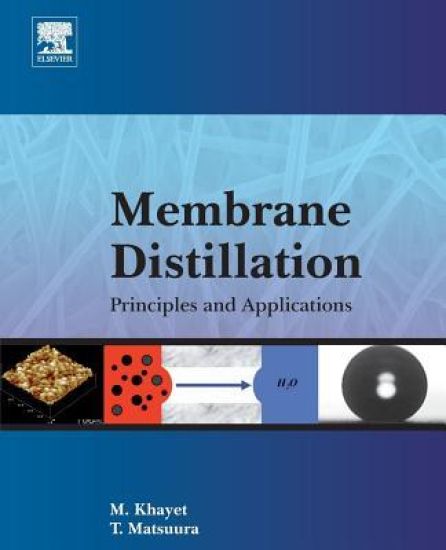
Membrane Distillation

Membrane Distillation

Mohamed Khayet Souhaimi; Takeshi Matsuura

Elsevier Science Ltd
2016
nidottu
Modern membrane engineering is critical to the development of process-intensification strategies and to the stimulation of industrial growth. Membrane Distillation (MD) is a broad reference that covers specific information on membranes available and methods for MD membrane preparation and characterization. The book offers an introduction to the terminology and fundamental concepts as well as a historical review of MD development. Commercial membranes used in MD as well as laboratory-made membranes, including emerging membranes, are described in detail and illustrated by a number of clear and instructive schematic drawings and images.
Gas Separation Membranes

Gas Separation Membranes

Ahmad Fauzi Ismail; Kailash Chandra Khulbe; Takeshi Matsuura

Springer International Publishing AG
2015
sidottu
This book describes the tremendous progress that has been made in the development of gas separation membranes based both on inorganic and polymeric materials. Materials discussed include polymer inclusion membranes (PIMs), metal organic frameworks (MOFs), carbon based materials, zeolites, as well as other materials, and mixed matrix membranes (MMMs) in which the above novel materials are incorporated. This broad survey of gas membranes covers material, theory, modeling, preparation, characterization (for example, by AFM, IR, XRD, ESR, Positron annihilation spectroscopy), tailoring of membranes, membrane module and system design, and applications. The book is concluded with some perspectives about the future direction of the field.
Carbon-based Membranes for Separation Processes

Carbon-based Membranes for Separation Processes

Ahmad Fauzi Ismail; Dipak Rana; Takeshi Matsuura; Henry C. Foley

Springer-Verlag New York Inc.
2014
nidottu
This book provides a significant overview of carbon-related membranes. It will cover the development of carbon related membranes and membrane modules from its onset to the latest research on carbon mixed matrix membranes. After reviewing progress in the field, the authors indicate future research directions and prospective development. The authors also attempt to provide a guideline for the readers who would like to establish their own laboratories for carbon membrane research. For this purpose, detailed information on preparation, characterization and testing of various types of carbon membrane is provided. Design and construction of carbon membrane modules are also described in detail.
Carbon-based Membranes for Separation Processes

Carbon-based Membranes for Separation Processes

Ahmad Fauzi Ismail; Dipak Rana; Takeshi Matsuura; Henry C. Foley

Springer-Verlag New York Inc.
2011
sidottu
This book provides a significant overview of carbon-related membranes. It will cover the development of carbon related membranes and membrane modules from its onset to the latest research on carbon mixed matrix membranes. After reviewing progress in the field, the authors indicate future research directions and prospective development. The authors also attempt to provide a guideline for the readers who would like to establish their own laboratories for carbon membrane research. For this purpose, detailed information on preparation, characterization and testing of various types of carbon membrane is provided. Design and construction of carbon membrane modules are also described in detail.
Polymer Membranes In Biotechnology: Preparation, Functionalization And Application

Polymer Membranes In Biotechnology: Preparation, Functionalization And Application

Seeram Ramakrishna; Zuwei Ma; Takeshi Matsuura

Imperial College Press
2011
nidottu
This book provides a concise and comprehensive introduction of polymer membranes' preparation, functionalization and applications in biotechniques including affinity membrane chromatography, membrane-based biosensor and membrane-based bioreactor.Following an introduction to the general concept of membrane separation in Chapter 1, preparation of polymeric membranes is discussed in Chapter 2. The book then describes in Chapter 3 membrane surface activation, which is a key step in ligand immobilizations. Chapter 4 focuses on ligand immobilization techniques and the organic chemistries behind them. Chapter 5 introduces the application of affinity membrane chromatography. Finally, in Chapter 6, membranes used in biosensors and gas sensors, enzymatic membranes used as biosensor, and membrane biosensor for waste water treatment will be discussed.A novel filter medium, i.e. nonwoven nanofiber membrane, and its preparation method, i.e. electrospinning technique, are also introduced in this book.
Polymer Membranes In Biotechnology: Preparation, Functionalization And Application

Polymer Membranes In Biotechnology: Preparation, Functionalization And Application

Seeram Ramakrishna; Zuwei Ma; Takeshi Matsuura

Imperial College Press
2011
sidottu
This book provides a concise and comprehensive introduction of polymer membranes' preparation, functionalization and applications in biotechniques including affinity membrane chromatography, membrane-based biosensor and membrane-based bioreactor.Following an introduction to the general concept of membrane separation in Chapter 1, preparation of polymeric membranes is discussed in Chapter 2. The book then describes in Chapter 3 membrane surface activation, which is a key step in ligand immobilizations. Chapter 4 focuses on ligand immobilization techniques and the organic chemistries behind them. Chapter 5 introduces the application of affinity membrane chromatography. Finally, in Chapter 6, membranes used in biosensors and gas sensors, enzymatic membranes used as biosensor, and membrane biosensor for waste water treatment will be discussed.A novel filter medium, i.e. nonwoven nanofiber membrane, and its preparation method, i.e. electrospinning technique, are also introduced in this book.
Synthetic Polymeric Membranes

Synthetic Polymeric Membranes

K. C. Khulbe; C. Y. Feng; Takeshi Matsuura

Springer-Verlag Berlin and Heidelberg GmbH Co. K
2010
nidottu
Tis book concentrates on atomic force microscopy (AFM), a method recently - veloped to study the surfaces of synthetic polymeric membranes. AFM is becoming a very important tool for the characterization of synthetic polymeric membranes. Te development of membranes of improved performance depends on the exact kn- ledge of the morphology of a thin selective layer that exists at the surface of the m- brane. Te control of the morphology of the selective layer is crucial for the design of synthetic polymeric membranes. With a relatively short history of only twen- ?ve years, AFM has ?rmly established its position as a method to characterize the membrane surface. Each chapter of this book includes information on basic principles, commercial applications, current research, and guidelines for future research. Each chapter is summarized at the end and contains a comprehensive list of references. Te introductory chapter gives a brief overview of synthetic polymeric m- branes and their applications both in industrial processes and in biomedical ?elds. It also gives an overview of studies on membrane surface morphology by various methods. Chapter ? deals with the synthesis of membranes, the properties of membranes, and the application of membranes. Te beginning also identi?es the three types of membranes (i.e., biological, synthetic, and theoretical) and their applications.
Synthetic Polymeric Membranes

Synthetic Polymeric Membranes

K. C. Khulbe; C. Y. Feng; Takeshi Matsuura

Springer-Verlag Berlin and Heidelberg GmbH Co. K
2007
sidottu
Tis book concentrates on atomic force microscopy (AFM), a method recently - veloped to study the surfaces of synthetic polymeric membranes. AFM is becoming a very important tool for the characterization of synthetic polymeric membranes. Te development of membranes of improved performance depends on the exact kn- ledge of the morphology of a thin selective layer that exists at the surface of the m- brane. Te control of the morphology of the selective layer is crucial for the design of synthetic polymeric membranes. With a relatively short history of only twen- ?ve years, AFM has ?rmly established its position as a method to characterize the membrane surface. Each chapter of this book includes information on basic principles, commercial applications, current research, and guidelines for future research. Each chapter is summarized at the end and contains a comprehensive list of references. Te introductory chapter gives a brief overview of synthetic polymeric m- branes and their applications both in industrial processes and in biomedical ?elds. It also gives an overview of studies on membrane surface morphology by various methods. Chapter ? deals with the synthesis of membranes, the properties of membranes, and the application of membranes. Te beginning also identi?es the three types of membranes (i.e., biological, synthetic, and theoretical) and their applications.
Synthetic Membranes and Membrane Separation Processes
Synthetic Membranes and Membrane Separation Processes addresses both fundamental and practical aspects of the subject. Topics discussed in the book cover major industrial membrane separation processes, including reverse osmosis, ultrafiltration, microfiltration, membrane gas and vapor separation, and pervaporation. Membrane materials, membrane preparation, membrane structure, membrane transport, membrane module and separation design, and applications are discussed for each separation process. Many problem-solving examples are included to help readers understand the fundamental concepts of the theory behind the processes. The book will benefit practitioners and students in chemical engineering, environmental engineering, and materials science.