Kirjojen hintavertailu. Mukana 12 390 323 kirjaa ja 12 kauppaa.

Kirjailija

Terence Cave

Kirjat ja teokset yhdessä paikassa: 9 kirjaa, julkaisuja vuosilta 1985-2023, suosituimpien joukossa Hunger. Vertaile teosten hintoja ja tarkista saatavuus suomalaisista kirjakaupoista.

9 kirjaa

Kirjojen julkaisuhaarukka 1985-2023.

Hunger

Hunger

Knut Hamsun; Tore Rem; Terence Cave

Oxford University Press
2023
nidottu
'It was at the time when I was wandering around hungry in Kristiania, that strange city no one leaves before it has set its mark on them...' Hunger is the first-person story of a young man desperately trying to establish himself in the city as a writer, living in shabby lodgings where he can seldom afford to pay the rent, eating almost nothing, and engaging spasmodically and manically with landladies, eccentric elderly men, policemen, shopkeepers, pawnbrokers, and others on the way. He wanders around the streets, sits on benches trying to write, spends a night locked in a pitch-dark police cell, thinks, slides into remarkably inventive reveries, speculates on his mental health, his ethical comportment, his relation to the divinity, the topics he might write about. The traces of a consistent narrative logic are uncertain and blurred; the voice of the narrator keeps shifting between pragmatic appraisal of his situation, wild fantasies, manic outbursts, anger, and despair. This is a story that lies on the threshold of modernism, anticipating many of the dislocations that narrative will be subject to in the decades to come. This new translation seeks to restore the startling freshness and epidermal unease of Hamsun's breakthrough story of 1890. It remains faithful to the style and voice of the text, the shifts of tense, the indirect free style, and the constant changes of register as the inner monologue moves between poetic sensitivity, wild fantasies, manic outbursts, and hyperbolic emotion. Tore Rem's introduction provides an updated and fresh account of the genesis of Hunger, its book history and its reception. ABOUT THE SERIES: For over 100 years Oxford World's Classics has made available the widest range of literature from around the globe. Each affordable volume reflects Oxford's commitment to scholarship, providing the most accurate text plus a wealth of other valuable features, including expert introductions by leading authorities, helpful notes to clarify the text, up-to-date bibliographies for further study, and much more.
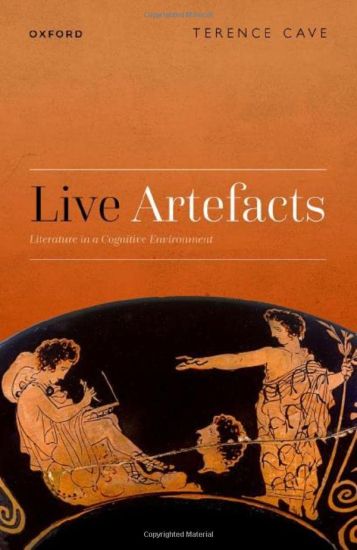
Live Artefacts

Live Artefacts

Terence Cave

Oxford University Press
2022
sidottu
Literary artefacts--the stories people tell, the songs they sing, the scenes they enact--are neither a by-product nor a side-issue in human culture. They provide a model of everything that cognition does. They refuse to separate thought from emotion, bodily responses from ethical reflection, perception from imagination, logic from desire. Above all, they demonstrate the essential fluidity and mobility of human cognition, its adaptive inventiveness. If we are astonished by the art of Chauvet or Lascaux as an early model of human cognition, then we should be continually astonished by what literature is and does as it reaches beyond itself to reimagine the world. This book argues that literary artefacts are quasi-autonomous living entities, fashioned to animate captured environments, embodied people and other creatures, ways of being and living that remain virtual. They own a freely delegated agency that allows them to speak to listeners and readers present and distant, present and future, adapting themselves and their meanings to whatever cognitive environment they encounter. Such an approach offers a way of linking a close attention to the specific properties of literary artefacts with the insights of cognitive anthropology and archaeology, and thus of satisfying the conditions for a properly interdisciplinary understanding of literature. It aims both to defend literary study against utilitarian and reductive arguments of all kinds and to argue that literary artefacts may give us new insights into how the mind (and its indispensable substratum, the brain) functions in the human ecology.
Thinking with Literature

Thinking with Literature

Terence Cave

Oxford University Press
2018
nidottu
To speak of 'thinking with literature' is to make the assumption that literature (in the broadest sense) is neither a side-show nor a side-issue in human cultures: it belongs to the spectrum of imaginative modes that includes both philosophical and scientific thought. Whether one regards it as a practice or as an archive, literature is highly pervasive, robust, enduring, and pregnant with values. Thinking with Literature argues that what it affords above all is a way of thinking, whether for writer, reader, or critic. Literature constitutes one of the prime instruments of cultural improvisation; it is the embodiment of a powerful, inventive, and ever-changing cognitive agency. As such, it invites a cognitive mode of criticism, one which asserts the priority of the individual literary work as a unique product of human cognition. In this book, discussions of topics, arguments, and hypotheses from the cognitive sciences, philosophy, and the theory of communication are woven into the fabric of a critical analysis which insists on the value of close reading: a poem by Yeats, a scene from Shakespeare, novels by Mme de Lafayette, Conrad, Frantzen, stories from Winnie-the-Pooh, and many others appear here on their own terms, with their own cognitive energies. Written in an accessible style, Thinking with Literature speaks both to mainstream readers of literature and to specialists in cognitive studies.
Thinking with Literature

Thinking with Literature

Terence Cave

Oxford University Press
2016
sidottu
To speak of 'thinking with literature' is to make the assumption that literature (in the broadest sense) is neither a side-show nor a side-issue in human cultures: it belongs to the spectrum of imaginative modes that includes both philosophical and scientific thought. Whether one regards it as a practice or as an archive, literature is highly pervasive, robust, enduring, and pregnant with values. Thinking with Literature argues that what it affords above all is a way of thinking, whether for writer, reader, or critic. Literature constitutes one of the prime instruments of cultural improvisation; it is the embodiment of a powerful, inventive, and ever-changing cognitive agency. As such, it invites a cognitive mode of criticism, one which asserts the priority of the individual literary work as a unique product of human cognition. In this book, discussions of topics, arguments, and hypotheses from the cognitive sciences, philosophy, and the theory of communication are woven into the fabric of a critical analysis which insists on the value of close reading: a poem by Yeats, a scene from Shakespeare, novels by Mme de Lafayette, Conrad, Frantzen, stories from Winnie-the-Pooh and many others appear here on their own terms, with their own cognitive energies. Written in an accessible style, Thinking with Literature speaks both to mainstream readers of literature and to specialists in cognitive studies.
Mignon's Afterlives

Mignon's Afterlives

Terence Cave

Oxford University Press
2011
sidottu
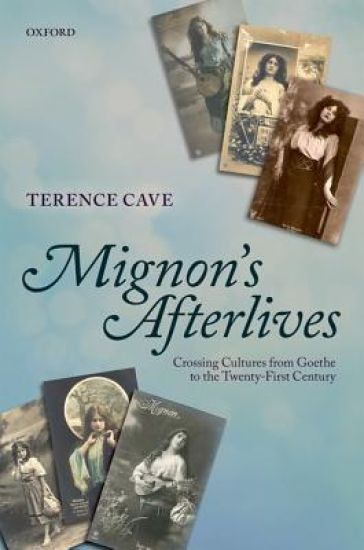
By tracing the afterlives of Mignon, an apparently minor character in Goethe's novel Wilhelm Meisters Lehrjahre, Terence Cave explores a phenomenal success story in the history of literature and music, and more broadly of cultural history. Mignon steps out of the shadow of its protagonist Wilhelm and fashions a destiny of her own: she becomes the object of an obsessive interest that reached its peak in the later nineteenth century but continues to reverberate into the twenty-first century. Mignon reappears - often as a character bearing a different name but sharing an unmistakable family resemblance with her - in a wide range of different literary works from Goethe himself via the German Romantic Novel, Mme de Staël, George Sand, Nerval and Baudelaire, Walter Scott and George Eliot to Gerhart Hauptmann and Angela Carter. Her songs, set by dozens of composers from Reichardt and Beethoven to Wolf, reverberated through the drawing-rooms and concert-halls of nineteenth-century Europe. She is the heroine of the most popular French opera of the late nineteenth century, and she has featured in a number of films. She is fascinating because she is poised on the threshold between childhood and adolescence, aphasia and expressive power, words and music; she is a wanderer who has lost her home, an exile who has been abducted and abused; and the many stories in which her life is reenacted provide a litmus test for key cultural values of the nineteenth and twentieth centuries.
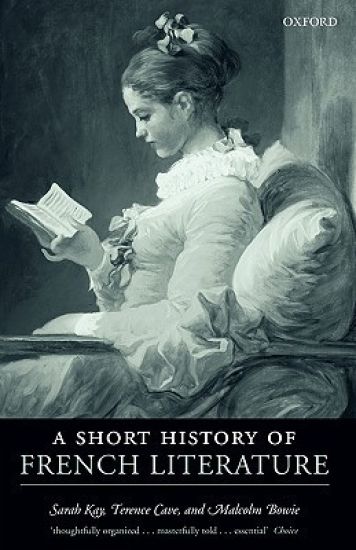
A Short History of French Literature

A Short History of French Literature

Sarah Kay; Terence Cave; Malcolm Bowie

Oxford University Press
2006
nidottu
This book traces the history of French literature from its beginnings to the present. Within its remarkably brief compass, it offers a wide-ranging, personal, and detailed account of major writers and movements. Developments in French literature are presented in an innovative way, not as an even sequence of literary events but as a series of stories told at varying pace and with different kinds of focus. Readers can thus take in the broad sweep of historical change, grasp the main characteristics of major periods, or enjoy a close appraisal of individual works and their contexts. The book is written in an accessible and non-technical style that will make it attractive to students and to all those who enjoy French Literature.
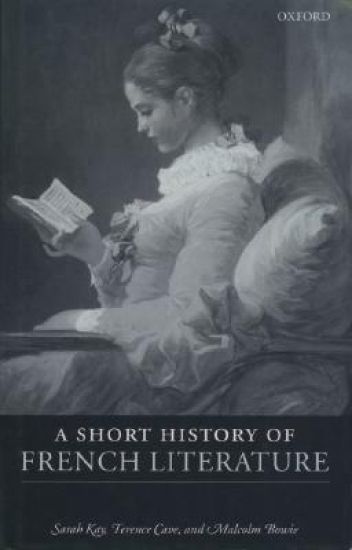
A Short History of French Literature

A Short History of French Literature

Sarah Kay; Terence Cave; Malcolm Bowie

Oxford University Press
2003
sidottu
In this lucid and innovative volume, three distinguished scholars trace this history of French literature from its beginnings to the present day. From the oral, unstable anonymous works of the early Middle Ages via the emergence of a print culture in the Renaissance, through to the attempted codification of genres and styles in the nineteenth century and the resourceful experimentation of the twentieth, A Short History of French Literature demonstrates the world importance of French literature, and the extraordinary richness of its range. The three main parts of the volume cover the Middle Ages, the Early Modern period, and the Modern period, and offer wide-ranging, personal, and detailed coverage of major writers and movements. Writing for the interested general reader as much as for students, the authors range expertly between authors and their works, historical events, and literary movements, offering as a whole an authoritative and innovative account of the history of French literature.
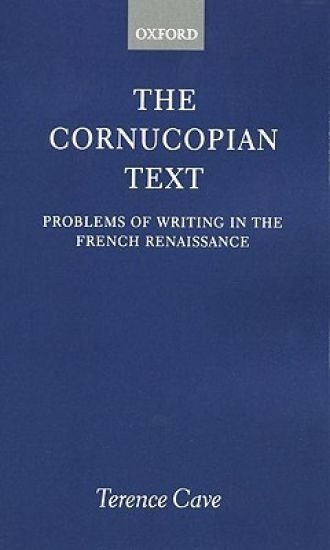
The Cornucopian Text

The Cornucopian Text

Terence Cave

Oxford University Press
1985
nidottu
This seminal book examines the interaction of literary practice and theory in 16th-century France in the context of the great Renaissance writers, Erasmus, Rabelais, Ronsard, and Montaigne.