Kirjailija
Terezinha Nunes
Kirjat ja teokset yhdessä paikassa: 11 kirjaa, julkaisuja vuosilta 1993-2021, suosituimpien joukossa Teaching Mathematics to Deaf Children. Vertaile teosten hintoja ja tarkista saatavuus suomalaisista kirjakaupoista.
11 kirjaa
Kirjojen julkaisuhaarukka 1993-2021.
Using Mathematics to Understand the World: How Culture Promotes Children's Mathematics offers fundamental insight into how mathematics permeates our lives as a way of representing and thinking about the world. Internationally renowned experts Terezinha Nunes and Peter Bryant examine research into children’s mathematical development to show why it is important to distinguish between quantities, relations and numbers. Using Mathematics to Understand the World presents a theory about the development of children’s quantitative reasoning and reveals why and how teaching about quantitative reasoning can be used to improve children’s mathematical attainment in school. It describes how learning about the analytical meaning of numbers is established as part of mathematics at school but quantitative reasoning is emphasized less even though it is increasingly acclaimed as essential for thinking mathematically and for using mathematics to understand the world.This essential text is for all students of mathematics education, developmental psychology and cognitive psychology. By including activities for parents and professionals to try themselves, it may help you to recognize your own quantitative reasoning.
Teaching and Learning About Whole Numbers in Primary School
Terezinha Nunes; Beatriz Vargas Dorneles; Pi-Jen Lin; Elisabeth Rathgeb-Schnierer
Springer International Publishing AG
2016
nidottu
This book offers a theory for the analysis of how children learn and are taught about whole numbers. Two meanings of numbers are distinguished – the analytical meaning, defined by the number system, and the representational meaning, identified by the use of numbers as conventional signs that stand for quantities. This framework makes it possible to compare different approaches to making numbers meaningful in the classroom and contrast the outcomes of these diverse aspects of teaching. The book identifies themes and trends in empirical research on the teaching and learning of whole numbers since the launch of the major journals in mathematics education research in the 1970s. It documents a shift in focus in the teaching of arithmetic from research about teaching written algorithms to teaching arithmetic in ways that result in flexible approaches to calculation. The analysis of studies on quantitative reasoning reveals classifications of problem types that are related to different cognitive demands and rates of success in both additive and multiplicative reasoning. Three different approaches to quantitative reasoning education illustrate current thinking on teaching problem solving: teaching reasoning before arithmetic, schema-based instruction, and the use of pre-designed diagrams. The book also includes a summary of contemporary approaches to the description of the knowledge of numbers and arithmetic that teachers need to be effective teachers of these aspects of mathematics in primary school. The concluding section includes a brief summary of the major themes addressed and the challenges for the future. The new theoretical framework presented offers researchers in mathematics education novel insights into the differences between empirical studies in this domain. At the same time the description of the two meanings of numbers helps teachers distinguish between the different aims of teaching about numbers supported by diverse methods used in primary school. The framework is a valuable tool for comparing the different methods and identifying the various assumptions about teaching and learning.
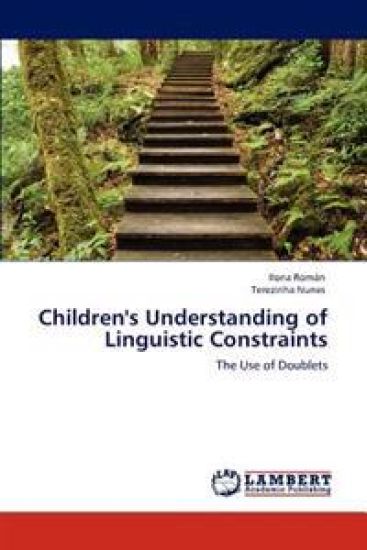
Children's Understanding of Linguistic Constraints
Ilona Rom N; Terezinha Nunes; Ilona Roman
LAP Lambert Academic Publishing
2012
pokkari
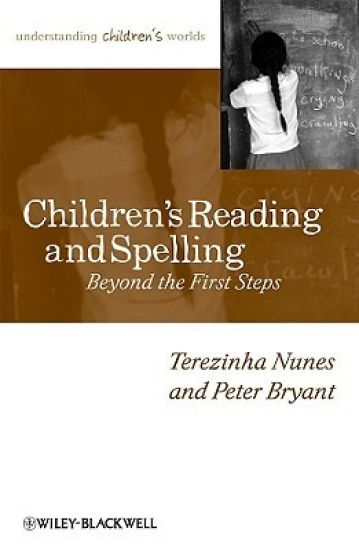
Children's Reading and Spelling
Terezinha Nunes; Peter Bryant
Wiley-Blackwell (an imprint of John Wiley Sons Ltd)
2009
nidottu
This book extends models of early literacy, analyzing how children’s reading and spelling skills develop throughout their school career. An account of how a child’s reading and spelling develop which goes beyond the early yearsShows that there are radical changes in the way children read and spell as they get olderDescribes a new theory about the learning that goes on in the later stages of reading and spellingMakes clear the educational implications of this theoryThe authors' research has previously contributed to the 'literacy hour' – a government initiative to improve the teaching of literacy skills in UK schools
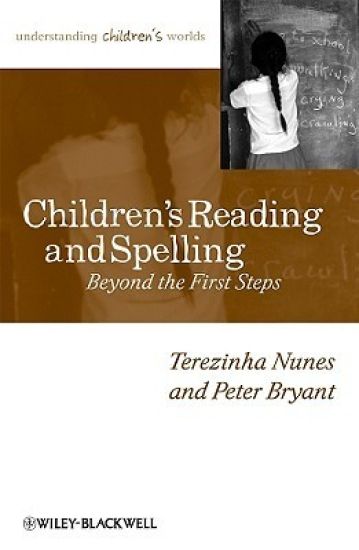
Children's Reading and Spelling
Terezinha Nunes; Peter Bryant
Wiley-Blackwell (an imprint of John Wiley Sons Ltd)
2009
sidottu
This book extends models of early literacy, analyzing how children’s reading and spelling skills develop throughout their school career. An account of how a child’s reading and spelling develop which goes beyond the early yearsShows that there are radical changes in the way children read and spell as they get olderDescribes a new theory about the learning that goes on in the later stages of reading and spellingMakes clear the educational implications of this theoryThe authors' research has previously contributed to the 'literacy hour' – a government initiative to improve the teaching of literacy skills in UK schools
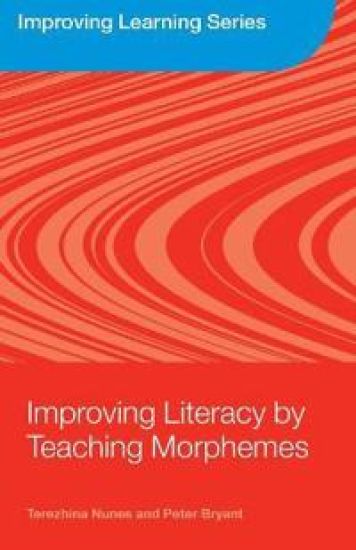
With reports from several studies showing the benefits of teaching young children about morphemes, this book is essential reading for anyone concerned with helping children to read and write. By breaking words down into chunks of meaning that can be analyzed as complete units rather than as strings of individual letters, children are better able to make sense of the often contradictory spelling and reading rules of English. As a result, their enjoyment of learning about words increases, and their literacy skills improve. Written by leading researchers for trainee teachers, practising teachers and interested parents, this highly accessible and innovative book provides sound, evidence-based advice and materials that can be used to help teach children about morphemes, and highlights the beneficial effects of this approach.
From an early age, deaf children excel in thinking about and remembering what they learn through visual spatial instruction. This strength in information processing can be used in the mathematics classroom to achieve better learning outcomes. This book discusses ways to teach deaf children about the four arithmetic operations through spatial representation in problem solving. Examples for the teaching of fractions and graphs are also included. These visual representations are useful to support the children's understanding of mathematical concepts and to promote peer collaboration. The teaching programme was tested with deaf children in six schools with excellent results: the children in the project made significantly more progress in one school year than expected for either deaf and hearing children over the same time. This work was made possible through the generous support of The Nuffield Foundation.
Children Doing Mathematics provides a reliable and up to date review of the substantial recent work in children' mathematical understanding. The authors also present important new research on children's understanding of number, measurement, arithmetic operation and fractions both in and out of school. The central theme of Children Doing Mathematics is that there are crucial conditions for children's mathematical learning. Firstly, children have to come to grips with conventional mathematical systems. Secondly, but equally important, they have to be able to present mathematical knowledge in a way that solves problems. The book also discusses how mathematical activities and knowledge involve much more than what is currently viewed as mathematics in the school curriculum. Most recent work illustrates how children can be successful in mathematical activities outside school whereas they fail in similar activities in the classroom. Through these two underlying themes the authors bring together discussions on conventional mathematical learning and on real life mathematical success. In so doing, they also highlight new and better ways of analysing children's abilities and of advancing their learning in school.
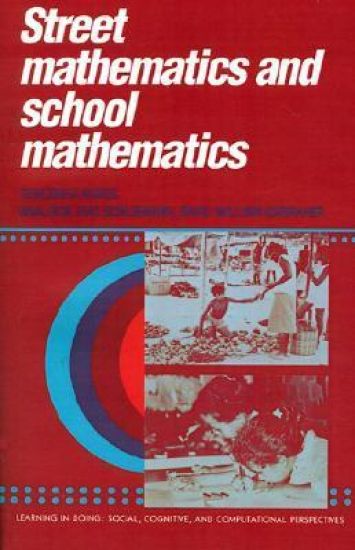
Street Mathematics and School Mathematics
Terezinha Nunes; David William Carraher; Analucia Dias Schliemann
Cambridge University Press
1993
pokkari
People who learn to solve problems ‘on the job’ often have to do it differently from people who learn in theory. Practical knowledge and theoretical knowledge is different in some ways but similar in other ways - or else one would end up with wrong solutions to the problems. Mathematics is also like this. People who learn to calculate, for example, because they are involved in commerce frequently have a more practical way of doing mathematics than the way we are taught at school. This book is about the differences between what we call practical knowledge of mathematics - that is street mathematics - and mathematics learned in school, which is not learned in practice. The authors look at the differences between these two ways of solving mathematical problems and discuss their advantages and disadvantages. They also discuss ways of trying to put theory and practice together in mathematics teaching.