Kirjojen hintavertailu. Mukana 12 390 323 kirjaa ja 12 kauppaa.

Kirjailija

Terry D. Clark

Kirjat ja teokset yhdessä paikassa: 15 kirjaa, julkaisuja vuosilta 2001-2019, suosituimpien joukossa Application of Fuzzy Logic to Social Choice Theory. Vertaile teosten hintoja ja tarkista saatavuus suomalaisista kirjakaupoista.

Mukana myös kirjoitusasut: Terry D Clark

15 kirjaa

Kirjojen julkaisuhaarukka 2001-2019.

Application of Fuzzy Logic to Social Choice Theory

Application of Fuzzy Logic to Social Choice Theory

John N. Mordeson; Davender S. Malik; Terry D. Clark

CRC Press
2019
nidottu
Fuzzy social choice theory is useful for modeling the uncertainty and imprecision prevalent in social life yet it has been scarcely applied and studied in the social sciences. Filling this gap, Application of Fuzzy Logic to Social Choice Theory provides a comprehensive study of fuzzy social choice theory.The book explains the concept of a fuzzy maximal subset of a set of alternatives, fuzzy choice functions, the factorization of a fuzzy preference relation into the "union" (conorm) of a strict fuzzy relation and an indifference operator, fuzzy non-Arrowian results, fuzzy versions of Arrow’s theorem, and Black’s median voter theorem for fuzzy preferences. It examines how unambiguous and exact choices are generated by fuzzy preferences and whether exact choices induced by fuzzy preferences satisfy certain plausible rationality relations. The authors also extend known Arrowian results involving fuzzy set theory to results involving intuitionistic fuzzy sets as well as the Gibbard–Satterthwaite theorem to the case of fuzzy weak preference relations. The final chapter discusses Georgescu’s degree of similarity of two fuzzy choice functions.

Application of Fuzzy Logic to Social Choice Theory

Application of Fuzzy Logic to Social Choice Theory

John N. Mordeson; Davender S. Malik; Terry D. Clark

Apple Academic Press Inc.
2015
sidottu
Fuzzy social choice theory is useful for modeling the uncertainty and imprecision prevalent in social life yet it has been scarcely applied and studied in the social sciences. Filling this gap, Application of Fuzzy Logic to Social Choice Theory provides a comprehensive study of fuzzy social choice theory.The book explains the concept of a fuzzy maximal subset of a set of alternatives, fuzzy choice functions, the factorization of a fuzzy preference relation into the "union" (conorm) of a strict fuzzy relation and an indifference operator, fuzzy non-Arrowian results, fuzzy versions of Arrow’s theorem, and Black’s median voter theorem for fuzzy preferences. It examines how unambiguous and exact choices are generated by fuzzy preferences and whether exact choices induced by fuzzy preferences satisfy certain plausible rationality relations. The authors also extend known Arrowian results involving fuzzy set theory to results involving intuitionistic fuzzy sets as well as the Gibbard–Satterthwaite theorem to the case of fuzzy weak preference relations. The final chapter discusses Georgescu’s degree of similarity of two fuzzy choice functions.
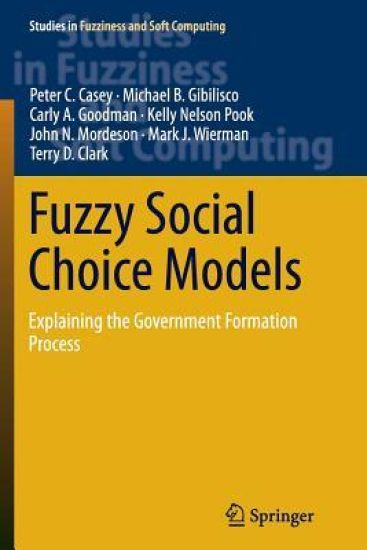
Fuzzy Social Choice Models

Fuzzy Social Choice Models

Peter C. Casey; Michael B. Gibilisco; Carly A. Goodman; Kelly Nelson Pook; John N. Mordeson; Mark J. Wierman; Terry D. Clark

Springer International Publishing AG
2014
sidottu
This book explores the extent to which fuzzy set logic can overcome some of the shortcomings of public choice theory, particularly its inability to provide adequate predictive power in empirical studies. Especially in the case of social preferences, public choice theory has failed to produce the set of alternatives from which collective choices are made. The book presents empirical findings achieved by the authors in their efforts to predict the outcome of government formation processes in European parliamentary and semi-presidential systems. Using data from the Comparative Manifesto Project (CMP), the authors propose a new approach that reinterprets error in the coding of CMP data as ambiguity in the actual political positions of parties on the policy dimensions being coded. The range of this error establishes parties’ fuzzy preferences. The set of possible outcomes in the process of government formation is then calculated on the basis of both the fuzzy Pareto set and the fuzzy maximal set, and the predictions are compared with those made by two conventional approaches as well as with the government that was actually formed. The comparison shows that, in most cases, the fuzzy approaches outperform their conventional counterparts.
Linear Models in the Mathematics of Uncertainty

Linear Models in the Mathematics of Uncertainty

Carol Jones; Mark J Wierman; Terry D Clark; Alex Pham; Michael A. Redmond

Springer-Verlag Berlin and Heidelberg GmbH Co. K
2013
sidottu
The purpose of this book is to present new mathematical techniques for modeling global issues. These mathematical techniques are used to determine linear equations between a dependent variable and one or more independent variables in cases where standard techniques such as linear regression are not suitable. In this book, we examine cases where the number of data points issmall (effects of nuclear warfare), where the experiment is not repeatable (the breakup of the former Soviet Union), and where the data is derived from expert opinion (how conservative is a political party). In all these cases the data is difficult to measure and an assumption of randomness and/or statistical validity is questionable. We apply our methods to real world issues in international relations such as nuclear deterrence, smart power, and cooperative threat reduction. We next apply our methods to issues in comparative politics such as successful democratization, quality of life, economic freedom, political stability, and failed states. Finally, issues involving deaf and hard of hearing children are explored.
Fuzzy Social Choice Models

Fuzzy Social Choice Models

Peter C. Casey; Michael B. Gibilisco; Carly A. Goodman; Kelly Nelson Pook; John N. Mordeson; Mark J. Wierman; Terry D. Clark

Springer International Publishing AG
2016
nidottu
This book explores the extent to which fuzzy set logic can overcome some of the shortcomings of public choice theory, particularly its inability to provide adequate predictive power in empirical studies. Especially in the case of social preferences, public choice theory has failed to produce the set of alternatives from which collective choices are made. The book presents empirical findings achieved by the authors in their efforts to predict the outcome of government formation processes in European parliamentary and semi-presidential systems. Using data from the Comparative Manifesto Project (CMP), the authors propose a new approach that reinterprets error in the coding of CMP data as ambiguity in the actual political positions of parties on the policy dimensions being coded. The range of this error establishes parties’ fuzzy preferences. The set of possible outcomes in the process of government formation is then calculated on the basis of both the fuzzy Pareto set and the fuzzy maximal set, and the predictions are compared with those made by two conventional approaches as well as with the government that was actually formed. The comparison shows that, in most cases, the fuzzy approaches outperform their conventional counterparts.
Fuzzy Social Choice Theory

Fuzzy Social Choice Theory

Michael B. Gibilisco; Annie M. Gowen; Karen E. Albert; John N. Mordeson; Mark J. Wierman; Terry D. Clark

Springer International Publishing AG
2016
nidottu
This book offers a comprehensive analysis of the social choice literature and shows, by applying fuzzy sets, how the use of fuzzy preferences, rather than that of strict ones, may affect the social choice theorems. To do this, the book explores the presupposition of rationality within the fuzzy framework and shows that the two conditions for rationality, completeness and transitivity, do exist with fuzzy preferences. Specifically, this book examines: the conditions under which a maximal set exists; the Arrow’s theorem; the Gibbard-Satterthwaite theorem and the median voter theorem. After showing that a non-empty maximal set does exists for fuzzy preference relations, this book goes on to demonstrating the existence of a fuzzy aggregation rule satisfying all five Arrowian conditions, including non-dictatorship. While the Gibbard-Satterthwaite theorem only considers individual fuzzy preferences, this work shows that both individuals and groups can choose alternatives to various degrees, resulting in a social choice that can be both strategy-proof and non-dictatorial. Moreover, the median voter theorem is shown to hold under strict fuzzy preferences but not under weak fuzzy preferences. By providing a standard model of fuzzy social choice and by drawing the necessary connections between the major theorems, this book fills an important gap in the current literature and encourages future empirical research in the field.
Linear Models in the Mathematics of Uncertainty

Linear Models in the Mathematics of Uncertainty

Carol Jones; Mark J Wierman; Terry D Clark; Alex Pham; Michael A. Redmond

Springer-Verlag Berlin and Heidelberg GmbH Co. K
2015
nidottu
The purpose of this book is to present new mathematical techniques for modeling global issues. These mathematical techniques are used to determine linear equations between a dependent variable and one or more independent variables in cases where standard techniques such as linear regression are not suitable. In this book, we examine cases where the number of data points issmall (effects of nuclear warfare), where the experiment is not repeatable (the breakup of the former Soviet Union), and where the data is derived from expert opinion (how conservative is a political party). In all these cases the data is difficult to measure and an assumption of randomness and/or statistical validity is questionable. We apply our methods to real world issues in international relations such as nuclear deterrence, smart power, and cooperative threat reduction. We next apply our methods to issues in comparative politics such as successful democratization, quality of life, economic freedom, political stability, and failed states. Finally, issues involving deaf and hard of hearing children are explored.
Fuzzy Social Choice Theory

Fuzzy Social Choice Theory

Michael B. Gibilisco; Annie M. Gowen; Karen E. Albert; John N. Mordeson; Mark J. Wierman; Terry D. Clark

Springer International Publishing AG
2014
sidottu
This book offers a comprehensive analysis of the social choice literature and shows, by applying fuzzy sets, how the use of fuzzy preferences, rather than that of strict ones, may affect the social choice theorems. To do this, the book explores the presupposition of rationality within the fuzzy framework and shows that the two conditions for rationality, completeness and transitivity, do exist with fuzzy preferences. Specifically, this book examines: the conditions under which a maximal set exists; the Arrow’s theorem; the Gibbard-Satterthwaite theorem and the median voter theorem. After showing that a non-empty maximal set does exists for fuzzy preference relations, this book goes on to demonstrating the existence of a fuzzy aggregation rule satisfying all five Arrowian conditions, including non-dictatorship. While the Gibbard-Satterthwaite theorem only considers individual fuzzy preferences, this work shows that both individuals and groups can choose alternatives to various degrees, resulting in a social choice that can be both strategy-proof and non-dictatorial. Moreover, the median voter theorem is shown to hold under strict fuzzy preferences but not under weak fuzzy preferences. By providing a standard model of fuzzy social choice and by drawing the necessary connections between the major theorems, this book fills an important gap in the current literature and encourages future empirical research in the field.
Applying Fuzzy Mathematics to Formal Models in Comparative Politics

Applying Fuzzy Mathematics to Formal Models in Comparative Politics

Terry D. Clark; Jennifer M. Larson; John N. Mordeson; Joshua D. Potter; Mark J. Wierman

Springer-Verlag Berlin and Heidelberg GmbH Co. K
2010
nidottu
This book explores the intersection of fuzzy mathematics and the spatial modeling of preferences in political science. Beginning with a critique of conventional modeling approaches predicated on Cantor set theoretical assumptions, the authors outline the potential benefits of a fuzzy approach to the study of ambiguous or uncertain preference profiles. While crisp models assume that ambiguity is a form of confusion emerging from imperfect information about policy options, the authors argue instead that some level of ambiguity is innate in human preferences and social interaction. What fuzzy mathematics offers the researcher, then, is a precise tool with which he can model the inherently imprecise dimensions of nuanced empirical reality. Moving beyond the limited treatment fuzzy methodologies have received in extant political science literature, this book develops single- and multidimensional models of fuzzy preference landscapes and characterizes the surprisingly high levels of stability that emerge from interactions between players operating within these models. The material presented makes it a good text for a graduate seminar in formal modeling. It is also suitable as an introductory text in fuzzy mathematics for graduate and advanced undergraduate students.
Applying Fuzzy Mathematics to Formal Models in Comparative Politics

Applying Fuzzy Mathematics to Formal Models in Comparative Politics

Terry D. Clark; Jennifer M. Larson; John N. Mordeson; Joshua D. Potter; Mark J. Wierman

Springer-Verlag Berlin and Heidelberg GmbH Co. K
2008
sidottu
This book explores the intersection of fuzzy mathematics and the spatial modeling of preferences in political science. Beginning with a critique of conventional modeling approaches predicated on Cantor set theoretical assumptions, the authors outline the potential benefits of a fuzzy approach to the study of ambiguous or uncertain preference profiles. While crisp models assume that ambiguity is a form of confusion emerging from imperfect information about policy options, the authors argue instead that some level of ambiguity is innate in human preferences and social interaction. What fuzzy mathematics offers the researcher, then, is a precise tool with which he can model the inherently imprecise dimensions of nuanced empirical reality. Moving beyond the limited treatment fuzzy methodologies have received in extant political science literature, this book develops single- and multidimensional models of fuzzy preference landscapes and characterizes the surprisingly high levels of stability that emerge from interactions between players operating within these models. The material presented makes it a good text for a graduate seminar in formal modeling. It is also suitable as an introductory text in fuzzy mathematics for graduate and advanced undergraduate students.
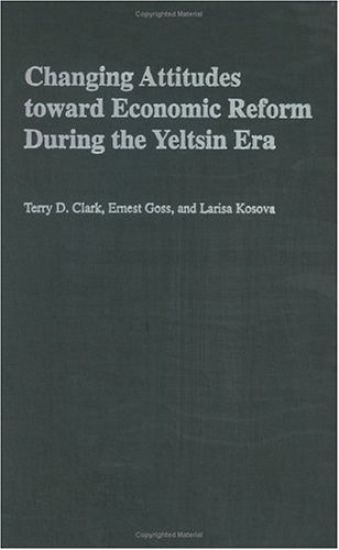
Changing Attitudes Toward Economic Reform During the Yeltsin Era

Changing Attitudes Toward Economic Reform During the Yeltsin Era

Terry D. Clark; Ernest Goss; Larisa Kosova

Praeger Publishers Inc
2003
sidottu
On December 31, 1999, Boris Yeltsin stepped down as president of the Russian Federation, marking the end of an era. While scholars and observers alike continue to debate the degree to which Russia succeeded in establishing democracy or a free market economy, the enormity of the social transformation that occurred during the Yeltsin era is far less disputable. For the social stratification that emerged changed the very face of Russian society.Much criticism has been leveled at the political corruption that marred the Yeltsin era. However, the economic and political reforms enacted under Yeltsin also permitted the opening of new channels of social mobility, particularly in the larger cities. Those who benefited most from the reforms became its strongest supporters, allowing the creation of a nascent middle class. The book's focus on this socioeconomic group is unique, as most analyses of the Yeltsin era largely ignore it.
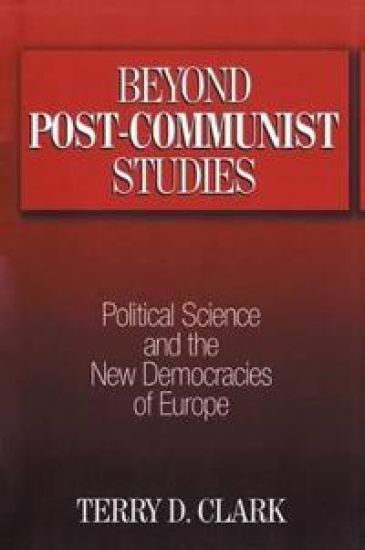
Beyond Post-communist Studies

Beyond Post-communist Studies

Terry D. Clark

Routledge
2002
sidottu
This book makes the case that several East Central European countries have emerged as fully consolidated democracies. As such, they may be integrated into the mainstream of political science research, and not consigned forever to a transitional category encompassing countries that are now fully democracies as well as some that are not democratic at all. The author outlines the steps of another transition - from post-communist studies to political science research. He demonstrates how institutionalist, or rational choice, theories can be applied to the analysis of political processes in the successfully democratized countries, and proposes a new research agenda for political scientists studying the region. The results of this work can enrich political science as well as our understanding of both democracy and the polities of contemporary Eastern Europe.
Beyond Post-communist Studies

Beyond Post-communist Studies

Terry D. Clark

Routledge
2002
nidottu
This book makes the case that several East Central European countries have emerged as fully consolidated democracies. As such, they may be integrated into the mainstream of political science research, and not consigned forever to a transitional category encompassing countries that are now fully democracies as well as some that are not democratic at all. The author outlines the steps of another transition - from post-communist studies to political science research. He demonstrates how institutionalist, or rational choice, theories can be applied to the analysis of political processes in the successfully democratized countries, and proposes a new research agenda for political scientists studying the region. The results of this work can enrich political science as well as our understanding of both democracy and the polities of contemporary Eastern Europe.
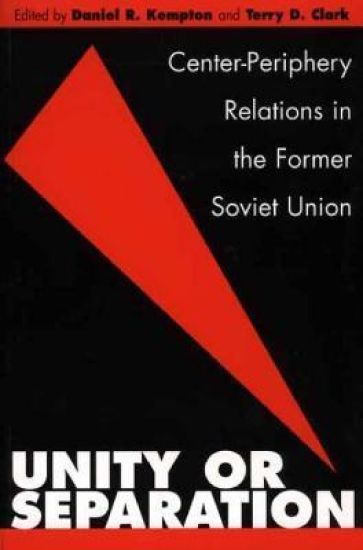
Unity or Separation

Unity or Separation

Daniel R. Kempton; Terry D. Clark

Praeger Publishers Inc
2001
nidottu
Many analysts initially believed that the process of Soviet disintegration would inevitably open a Pandora's box of ethnic nationalism and regional self-determination. But, despite obvious setbacks such as Chechnya, the developments of the last decade have shown that while forces of disintegration remain a very real threat, the fifteen successor states have managed to stay largely intact. One explanation for this somewhat unexpected success is the varied strategies of center-periphery relations adopted by the post-Soviet states, tailored to meet the unique of circumstances faced by each former republic of the Soviet Union. The contributors to this up-to-date volume examine the specific cases of success and failure in center-periphery relations in the former USSR, and offer some provocative overall conclusions about the progress made and the impact on the process of democratization.The cases examined in this volume are drawn from Russia, Lithuania, Ukraine, Uzbekistan, among others. These case studies demonstrate that realtions between national and local governments have been evolving differently in each of the successor states in the but in each case there has been a conscious attempt to create stacble center-periphery relations, which give a degree of autonomy to minority groups while still providing for a stable state and democratic development. This book will be of interest to scholars and students of the former Soviet Union and those interested in federalization and center-periphery.