Kirjailija
Theodore K. Rabb
Kirjat ja teokset yhdessä paikassa: 11 kirjaa, julkaisuja vuosilta 1967-2018, suosituimpien joukossa The Artist and the Warrior. Vertaile teosten hintoja ja tarkista saatavuus suomalaisista kirjakaupoista.
Mukana myös kirjoitusasut: Theodore K Rabb
11 kirjaa
Kirjojen julkaisuhaarukka 1967-2018.
Every human society has produced images, and to try to really understand history, we need to study its visual arts as carefully as its written documents; ignore visual arts at your peril. With increasing success, Theodore Rabb, an eminent historian, has been making this important point ever since the 1970s, in articles and reviews directed towards his colleagues and members of the educated public alike. While focusing on European history, his chronological sweep has been wide, stretching from the late Middle Ages to the 1920s, and he discusses all forms of imagery--drawing, painting, engraving, sculpture, and architecture. Intended for interested general readers as well as historians and art historians, this book contains a collection of Rabb's best essays--superbly written, and thoroughly engaging, it can be hard to put the book down. Appropriately, the title essay is a discussion of Michelangelo, whose work is essential to an understanding of his society. The essays that follow are divided into sections that concentrate on specific topics or regions, and they are shaped as questions whose answers demonstrate the ways in which historians can learn from the arts. These essays reflect the growing interest in that cross-disciplinary work, and in turn encourage an ever broader engagement with it.Carlos Eire, Professor of History and Religious Studies at Yale University, highly recommends this book: "This is a marvelous introduction to Renaissance, Baroque, and later art that also doubles as an eloquent manifesto for the historical usefulness of images. The impressive inter-disciplinary scope of these essays sheds new light on multiple dimensions of early modern European history while transcending time and place.Moreover, Rabb's prose style, erudition, and perspicuity set a new benchmark for the writing of cultural history. This book should be required reading for every historian, everywhere, regardless of their area of specialization. It should also be ardently recommended to anyone who yearns to be truly learned."And so does David Armitage, Professor of History at Harvard University: "Ted Rabb is one of the few historians as comfortable with both visual and verbal evidence. In this masterly collection, he guides us through the history of western art from the early Renaissance to twentieth-century Germany to raise big questions and weigh great reputations. There is something for everyone in his bursting Wunderkammer of a book."
Theodore K. Rabb, one of the leading historians of early modern Europe, presents here the first full-scale biography of the influential English parliamentarian, colonizer, and religious thinker Sir Edwin Sandys (1561-1629). Rabb has studied Sandys's life and work for more than thirty years and shows that he played a vital role in the Jacobean Age's two most distinctive achievements: the early development of England's constitutional structure and the overseas expansion that began the British empire. Sandys made his contributions, Rabb demonstrates, in the course of an extraordinarily diverse career. Sandys sat in the House of Commons from the 1580s to the mid-1620s, becoming its elder statesman and most influential voice on economic affairs, constitutional issues, and parliamentary procedure. He was a leader of the Virginia Company and the Bermuda Company, which established and settled these two early English colonies, and was also a director of the East India Company. And in an age beset by religious extremism, Sandys wrote a book on religious toleration that was widely read and discussed throughout Europe. reassessment of parliamentary politics on the eve of the English Civil War. Rabb shows that Sandys helped shape gentry positions, independent of Crown or Court, on major political issues, which in turn gave the House of Commons a new prominence in English affairs. This long-needed work will prompt a reexamination of vital aspects of the constitutional, colonial, and religious history of the Stuart period. Originally published in 1998. The Princeton Legacy Library uses the latest print-on-demand technology to again make available previously out-of-print books from the distinguished backlist of Princeton University Press. These editions preserve the original texts of these important books while presenting them in durable paperback and hardcover editions. The goal of the Princeton Legacy Library is to vastly increase access to the rich scholarly heritage found in the thousands of books published by Princeton University Press since its founding in 1905.
Theodore K. Rabb, one of the leading historians of early modern Europe, presents here the first full-scale biography of the influential English parliamentarian, colonizer, and religious thinker Sir Edwin Sandys (1561-1629). Rabb has studied Sandys's life and work for more than thirty years and shows that he played a vital role in the Jacobean Age's two most distinctive achievements: the early development of England's constitutional structure and the overseas expansion that began the British empire. Sandys made his contributions, Rabb demonstrates, in the course of an extraordinarily diverse career. Sandys sat in the House of Commons from the 1580s to the mid-1620s, becoming its elder statesman and most influential voice on economic affairs, constitutional issues, and parliamentary procedure. He was a leader of the Virginia Company and the Bermuda Company, which established and settled these two early English colonies, and was also a director of the East India Company. And in an age beset by religious extremism, Sandys wrote a book on religious toleration that was widely read and discussed throughout Europe. reassessment of parliamentary politics on the eve of the English Civil War. Rabb shows that Sandys helped shape gentry positions, independent of Crown or Court, on major political issues, which in turn gave the House of Commons a new prominence in English affairs. This long-needed work will prompt a reexamination of vital aspects of the constitutional, colonial, and religious history of the Stuart period. Originally published in 1998. The Princeton Legacy Library uses the latest print-on-demand technology to again make available previously out-of-print books from the distinguished backlist of Princeton University Press. These editions preserve the original texts of these important books while presenting them in durable paperback and hardcover editions. The goal of the Princeton Legacy Library is to vastly increase access to the rich scholarly heritage found in the thousands of books published by Princeton University Press since its founding in 1905.
Action and Conviction in Early Modern Europe
Theodore K. Rabb; Jerrold E. Seigel
Princeton University Press
2016
sidottu
The essays in this volume cover a wide range of topics in the history of Europe from the later Middle Ages through the seventeenth century. They are concerned with the relations between outer morality and inner conviction. Originally published in 1969. The Princeton Legacy Library uses the latest print-on-demand technology to again make available previously out-of-print books from the distinguished backlist of Princeton University Press. These editions preserve the original texts of these important books while presenting them in durable paperback and hardcover editions. The goal of the Princeton Legacy Library is to vastly increase access to the rich scholarly heritage found in the thousands of books published by Princeton University Press since its founding in 1905.
Action and Conviction in Early Modern Europe
Theodore K. Rabb; Jerrold E. Seigel
Princeton University Press
2015
pokkari
The essays in this volume cover a wide range of topics in the history of Europe from the later Middle Ages through the seventeenth century. They are concerned with the relations between outer morality and inner conviction. Originally published in 1969. The Princeton Legacy Library uses the latest print-on-demand technology to again make available previously out-of-print books from the distinguished backlist of Princeton University Press. These editions preserve the original texts of these important books while presenting them in durable paperback and hardcover editions. The goal of the Princeton Legacy Library is to vastly increase access to the rich scholarly heritage found in the thousands of books published by Princeton University Press since its founding in 1905.
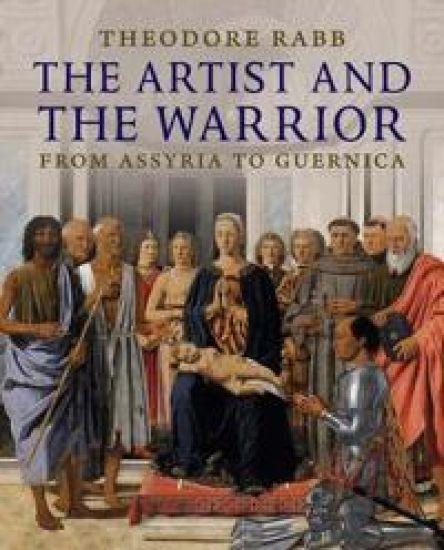
An illustrated exploration of artists' depictions of war and warriors, from antiquity to modern times How have artists across the millennia responded to warfare? In this uniquely wide-ranging book, Theodore Rabb blends military history and the history of art to search for the answers. He draws our attention to masterpieces from the ancient world to the twentieth century—paintings, sculpture, ceramics, textiles, engravings, architecture, and photographs—and documents the evolving nature of warfare as artists have perceived it. The selected works represent landmarks in the history of art and are drawn mainly from the western tradition, though important examples from Japan, India, and the Middle East are also brought into the discussion. Together these works tell a story of long centuries during which warfare inspired admiration and celebration. Yet a shift toward criticism and condemnation emerged in the Renaissance, and by the end of the nineteenth century, glorification of the warrior by leading artists had ceased. Rabb traces this progression, from such works as the Column of Trajan and the Titian "Battle of Lepanto", whose makers celebrated glorious victories, to the antiwar depictions created by Brueghel, Goya, Picasso, and others. Richly illustrated and accessibly written, this book presents a study of unprecedented sweep and multidisciplinary interest.
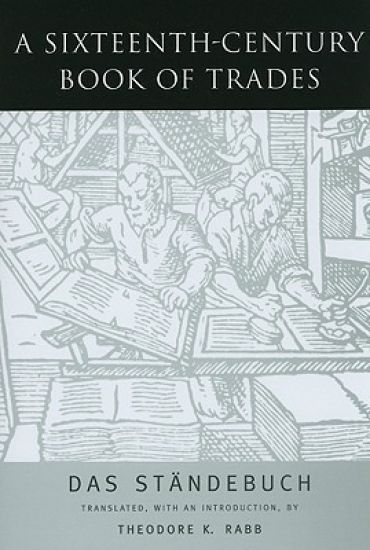
A Sixteenth-Century Book of Trades
Theodore K. Rabb
Society for the Promotion of Science Scholarship Inc.,U.S.
2009
sidottu
This extraordinary book of verses by Hans Sachs and engravings by Jost Ammam offers a vivid portrait of city life in Renaissance Germany. Covering 114 ranks (such as "king") and trades (including "thimblemaker"), it provides a unique cross-section of the daily life and social attitudes of the 16th century.Through words and pictures, the reader can experience at first hand one of the first instances of the small-town outlook that was to be an essential part of European culture for centuries. Mixing popular attitudes, such as the contempt for lawyers, Jews, and beggars, with precise descriptions of occupations that range from clockmaking to fishing, the book opens a direct window into the distant past.Das Standebuch was also a remarkable pioneering venture by one of the leading publishers of the day, Sigmund Feyerabend. Its complex publication history, as well as the implications of its contents, are unraveled in the Introduction by Theodore K. Rabb, who in this book has also produced the first complete translation into modern English of the doggerel verse for which Sachs was famous.
First published in 1999. Routledge is an imprint of Taylor & Francis, an informa company.
With the publication of The Population History of England in 1981 it has become possible for the first time to trace in detail the demographic changes that occurred in a major European country throughout the early modern period and during the industrial revolution. It is therefore also now possible to test our understanding of the functioning of early modern economies in relation to their demographic patterns against the new empirical data. The discussion of this historical theme, first initiated by Malthus in the late eighteenth century, can now be taken a substantial step further. All of the essays published here take advantage of this new possibility, either by using the English data themselves, or by reflecting on the implications of a comparison between English patterns and those found elsewhere. The essays contribute not only to a richer understanding of the relationships in the past between population and economy, but also to a fuller appreciation of the circumstances that limited economic growth in pre-industrial economies and with the train of events that led to the escape from these constraints with the industrial revolution.