Kirjojen hintavertailu. Mukana 12 595 353 kirjaa ja 12 kauppaa.

Kirjailija

Thomas A Severini

Kirjat ja teokset yhdessä paikassa: 11 kirjaa, julkaisuja vuosilta 2000-2026, suosituimpien joukossa Econometrics, Finance, and Time Series Analysis. Vertaile teosten hintoja ja tarkista saatavuus suomalaisista kirjakaupoista.

Mukana myös kirjoitusasut: Thomas A. Severini

11 kirjaa

Kirjojen julkaisuhaarukka 2000-2026.

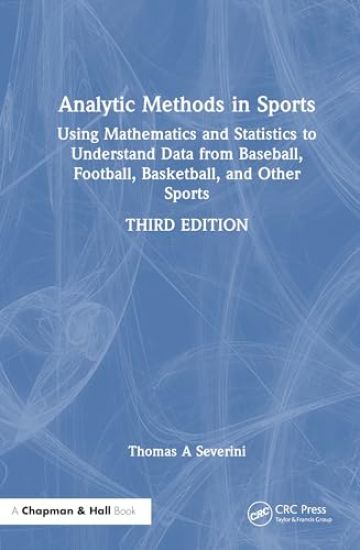
Analytic Methods in Sports

Analytic Methods in Sports

Thomas A Severini

TAYLOR FRANCIS LTD
2026
sidottu
One of the greatest changes in sports analytics in the past 25 years has been the use of mathematical methods to analyze performances, recognize trends and patterns, and predict results. Analytic Methods in Sports: Using Mathematics and Statistics to Understand Data from Baseball, Football, Basketball, and Other Sports, Third Edition, provides a concise, yet thorough, introduction to the analytic and statistical methods that are useful in studying sports. Key Features: New to the third edition is a chapter on applying mathematical and statistical methods to the analysis of daily fantasy sports Covers numerous statistical procedures for analyzing data based on sports results Presents fundamental methods for describing and summarizing data Describes aspects of probability theory and basic statistical concepts that are necessary to understand and deal with the randomness inherent in sports data Explains the statistical reasoning underlying the methods Discusses several more advanced methods, including logistic regression models, random forests, regression models with random effects, spline methods, principal components analysis, multidimensional scaling, quantile regression, and more Illustrates the methods using real data drawn from a wide variety of sports Offers many of the data sets on the author’s website, enabling you to replicate the analyses or conduct related analyses R code is included for all calculations Exercises are given for each chapter, to enable use for courses and self-study This popular textbook is primarily designed to be used to teach an introductory course on statistics to undergraduate students using sports examples. Its practical focus on application rather than theory ensures students develop immediately applicable skills for the rapidly expanding field of sports analytics. It is a perfect reference for readers comfortable with mathematics seeking to enter the growing field of sports analytics without prior statistical training. Its concise yet thorough approach makes it equally suitable for self-study by sports enthusiasts, coaches, and industry professionals looking to leverage the power of data-driven decision making in competitive environments.
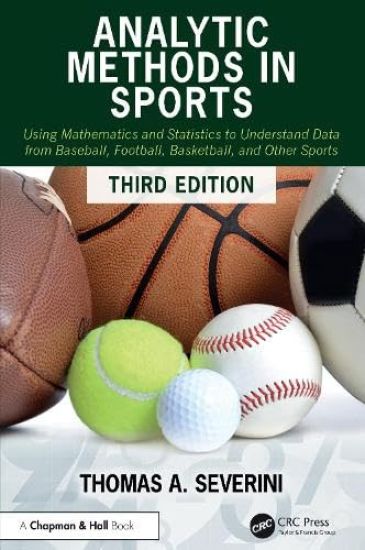
Analytic Methods in Sports

Analytic Methods in Sports

Thomas A Severini

TAYLOR FRANCIS LTD
2026
nidottu
One of the greatest changes in sports analytics in the past 25 years has been the use of mathematical methods to analyze performances, recognize trends and patterns, and predict results. Analytic Methods in Sports: Using Mathematics and Statistics to Understand Data from Baseball, Football, Basketball, and Other Sports, Third Edition, provides a concise, yet thorough, introduction to the analytic and statistical methods that are useful in studying sports. Key Features: New to the third edition is a chapter on applying mathematical and statistical methods to the analysis of daily fantasy sports Covers numerous statistical procedures for analyzing data based on sports results Presents fundamental methods for describing and summarizing data Describes aspects of probability theory and basic statistical concepts that are necessary to understand and deal with the randomness inherent in sports data Explains the statistical reasoning underlying the methods Discusses several more advanced methods, including logistic regression models, random forests, regression models with random effects, spline methods, principal components analysis, multidimensional scaling, quantile regression, and more Illustrates the methods using real data drawn from a wide variety of sports Offers many of the data sets on the author’s website, enabling you to replicate the analyses or conduct related analyses R code is included for all calculations Exercises are given for each chapter, to enable use for courses and self-study This popular textbook is primarily designed to be used to teach an introductory course on statistics to undergraduate students using sports examples. Its practical focus on application rather than theory ensures students develop immediately applicable skills for the rapidly expanding field of sports analytics. It is a perfect reference for readers comfortable with mathematics seeking to enter the growing field of sports analytics without prior statistical training. Its concise yet thorough approach makes it equally suitable for self-study by sports enthusiasts, coaches, and industry professionals looking to leverage the power of data-driven decision making in competitive environments.
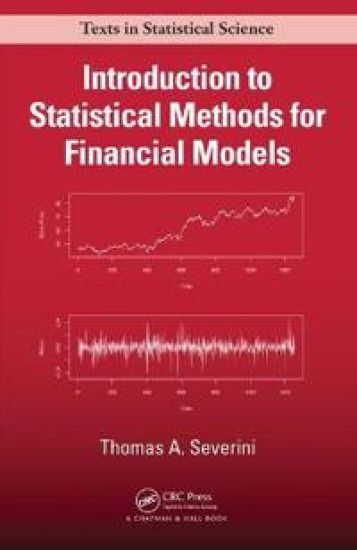
Introduction to Statistical Methods for Financial Models
This book provides an introduction to the use of statistical concepts and methods to model and analyze financial data. The ten chapters of the book fall naturally into three sections. Chapters 1 to 3 cover some basic concepts of finance, focusing on the properties of returns on an asset. Chapters 4 through 6 cover aspects of portfolio theory and the methods of estimation needed to implement that theory. The remainder of the book, Chapters 7 through 10, discusses several models for financial data, along with the implications of those models for portfolio theory and for understanding the properties of return data. The audience for the book is students majoring in Statistics and Economics as well as in quantitative fields such as Mathematics and Engineering. Readers are assumed to have some background in statistical methods along with courses in multivariate calculus and linear algebra.
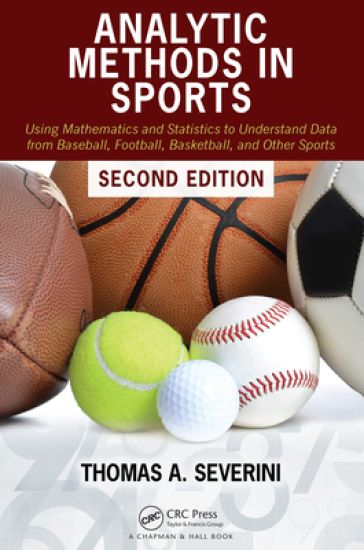
Analytic Methods in Sports

Analytic Methods in Sports

Thomas A Severini

CRC Press
2020
nidottu
One of the greatest changes in the sports world in the past 20 years has been the use of mathematical methods to analyze performances, recognize trends and patterns, and predict results. Analytic Methods in Sports: Using Mathematics and Statistics to Understand Data from Baseball, Football, Basketball, and Other Sports, Second Edition provides a concise yet thorough introduction to the analytic and statistical methods that are useful in studying sports. The book gives you all the tools necessary to answer key questions in sports analysis. It explains how to apply the methods to sports data and interpret the results, demonstrating that the analysis of sports data is often different from standard statistical analyses. The book integrates a large number of motivating sports examples throughout and offers guidance on computation and suggestions for further reading in each chapter. Features Covers numerous statistical procedures for analyzing data based on sports results Presents fundamental methods for describing and summarizing data Describes aspects of probability theory and basic statistical concepts that are necessary to understand and deal with the randomness inherent in sports data Explains the statistical reasoning underlying the methods Illustrates the methods using real data drawn from a wide variety of sports Offers many of the datasets on the author’s website, enabling you to replicate the analyses or conduct related analyses New to the Second Edition R code included for all calculations A new chapter discussing several more advanced methods, such as binary response models, random effects, multilevel models, spline methods, and principal components analysis, and more Exercises added to the end of each chapter, to enable use for courses and self-study Full solutions manual available to course instructors.
Analytic Methods in Sports

Analytic Methods in Sports

Thomas A Severini

CRC Press
2020
sidottu
One of the greatest changes in the sports world in the past 20 years has been the use of mathematical methods to analyze performances, recognize trends and patterns, and predict results. Analytic Methods in Sports: Using Mathematics and Statistics to Understand Data from Baseball, Football, Basketball, and Other Sports, Second Edition provides a concise yet thorough introduction to the analytic and statistical methods that are useful in studying sports. The book gives you all the tools necessary to answer key questions in sports analysis. It explains how to apply the methods to sports data and interpret the results, demonstrating that the analysis of sports data is often different from standard statistical analyses. The book integrates a large number of motivating sports examples throughout and offers guidance on computation and suggestions for further reading in each chapter. Features Covers numerous statistical procedures for analyzing data based on sports results Presents fundamental methods for describing and summarizing data Describes aspects of probability theory and basic statistical concepts that are necessary to understand and deal with the randomness inherent in sports data Explains the statistical reasoning underlying the methods Illustrates the methods using real data drawn from a wide variety of sports Offers many of the datasets on the author’s website, enabling you to replicate the analyses or conduct related analyses New to the Second Edition R code included for all calculations A new chapter discussing several more advanced methods, such as binary response models, random effects, multilevel models, spline methods, and principal components analysis, and more Exercises added to the end of each chapter, to enable use for courses and self-study Full solutions manual available to course instructors.
Introduction to Statistical Methods for Financial Models
This book provides an introduction to the use of statistical concepts and methods to model and analyze financial data. The ten chapters of the book fall naturally into three sections. Chapters 1 to 3 cover some basic concepts of finance, focusing on the properties of returns on an asset. Chapters 4 through 6 cover aspects of portfolio theory and the methods of estimation needed to implement that theory. The remainder of the book, Chapters 7 through 10, discusses several models for financial data, along with the implications of those models for portfolio theory and for understanding the properties of return data. The audience for the book is students majoring in Statistics and Economics as well as in quantitative fields such as Mathematics and Engineering. Readers are assumed to have some background in statistical methods along with courses in multivariate calculus and linear algebra.
Semiparametric Efficiency Bounds for Microeconometric Models

Semiparametric Efficiency Bounds for Microeconometric Models

Thomas A. Severini; Gautam Tripathi

now publishers Inc
2013
nidottu
Semiparametric Efficiency Bounds for Microeconometric Models offers a partial review of the vast literature in econometrics and statistics on calculating semiparametric efficiency bounds for a large class of models used in applied economics research. The main role of the efficiency bound is to give a lower bound to the asymptotic variance of an estimator. An estimator with asymptotic variance equal to the efficiency bound can therefore be said to be asymptotically efficient. These bounds are also useful for understanding how the features of a given model affect the accuracy of parameter estimation.This monograph will help researchers learn more about efficiency bounds, their calculation, and their usefulness in semiparametric estimation, in an accessible manner.
Elements of Distribution Theory

Elements of Distribution Theory

Thomas A. Severini

Cambridge University Press
2011
pokkari
This detailed introduction to distribution theory uses no measure theory, making it suitable for students in statistics and econometrics as well as for researchers who use statistical methods. Good backgrounds in calculus and linear algebra are important and a course in elementary mathematical analysis is useful, but not required. An appendix gives a detailed summary of the mathematical definitions and results that are used in the book. Topics covered range from the basic distribution and density functions, expectation, conditioning, characteristic functions, cumulants, convergence in distribution and the central limit theorem to more advanced concepts such as exchangeability, models with a group structure, asymptotic approximations to integrals, orthogonal polynomials and saddlepoint approximations. The emphasis is on topics useful in understanding statistical methodology; thus, parametric statistical models and the distribution theory associated with the normal distribution are covered comprehensively.
Elements of Distribution Theory

Elements of Distribution Theory

Thomas A. Severini

Cambridge University Press
2005
sidottu
This detailed introduction to distribution theory uses no measure theory, making it suitable for students in statistics and econometrics as well as for researchers who use statistical methods. Good backgrounds in calculus and linear algebra are important and a course in elementary mathematical analysis is useful, but not required. An appendix gives a detailed summary of the mathematical definitions and results that are used in the book. Topics covered range from the basic distribution and density functions, expectation, conditioning, characteristic functions, cumulants, convergence in distribution and the central limit theorem to more advanced concepts such as exchangeability, models with a group structure, asymptotic approximations to integrals, orthogonal polynomials and saddlepoint approximations. The emphasis is on topics useful in understanding statistical methodology; thus, parametric statistical models and the distribution theory associated with the normal distribution are covered comprehensively.
Likelihood Methods in Statistics

Likelihood Methods in Statistics

Thomas A. Severini

Oxford University Press
2000
sidottu
This book provides an introduction to the modern theory of likelihood-based statistical inference. This theory is characterized by several important features. One is the recognition that it is desirable to condition on relevant ancillary statistics. Another is that probability approximations are based on saddlepoint and closely related approximations that generally have very high accuracy. A third aspect is that, for models with nuisance parameters, inference is often based on marginal or conditional likelihoods, or approximations to these likelihoods. These methods have been shown often to yield substantial improvements over classical methods. The book also provides an up-to-date account of recent results in the field, which has been undergoing rapid development.