Kirjojen hintavertailu. Mukana 12 496 401 kirjaa ja 12 kauppaa.

Kirjailija

Thomas Aiello

Kirjat ja teokset yhdessä paikassa: 30 kirjaa, julkaisuja vuosilta 2001-2025, suosituimpien joukossa The Devil's Messages. Vertaile teosten hintoja ja tarkista saatavuus suomalaisista kirjakaupoista.

30 kirjaa

Kirjojen julkaisuhaarukka 2001-2025.

Model Airplanes Are Decadent and Depraved

Model Airplanes Are Decadent and Depraved

Thomas Aiello

Northern Illinois University Press
2015
pokkari
Model Airplanes are Decadent and Depraved tells the story of the American glue-sniffing epidemic of the 1960s, from the first reports of use to the unsuccessful crusade for federal legislation in the early 1970s. The human obsession with inhalation for intoxication has deep roots, from the oracle at Delphi to Judaic biblical ritual. The discovery of nitrous oxide, ether, and chloroform in the late eighteenth and early nineteenth centuries and the later development of paint thinners, varnishes, lighter fluid, polishes, and dry-cleaning supplies provided a variety of publicly available products with organic solvents that could be inhaled for some range of hallucinogenic or intoxicating effect. Model airplane glue was one of those products, but did not appear in warnings until the first reports of problematic behavior appeared in 1959, when children in several western cities were arrested for delinquency after huffing glue. Newspaper coverage both provided the initial shot across the bow for research into the subject and convinced children to give it a try. This "epidemic" quickly spread throughout the nation and the world. Though the hobby industry began putting an irritant in its model glue products in 1969 to make them less desirable to sniff, that wasn't what stopped the epidemic. Just as quickly as it erupted, the epidemic stopped when the media coverage and public hysteria stopped, making it one of the most unique epidemics in American history. The nation's focus drifted from adolescent glue sniffing to the countercultural student movement, with its attendant devotion to drug use, opposition to the Vietnam War, southern race policies, and anti-bureaucracy in general. This movement came to embody a tumultuous era fraught with violence, civil disobedience, and massive sea changes in American life and law—glue sniffing faded by comparison.
Jim Crow's Last Stand

Jim Crow's Last Stand

Thomas Aiello

Louisiana State University Press
2015
sidottu
The last remnant of the racist Redeemer agenda in the Louisiana's legal system, the nonunanimous jury-verdict law permits juries to convict criminal defendants with only ten out of twelve votes. A legal oddity among southern states, the ordinance has survived multiple challenges since its ratification in 1880. Despite the law's long history, few are aware of its existence, its original purpose, or its modern consequences. At a time when Louisiana's penal system has fallen under national scrutiny, Jim Crow's Last Stand presents a timely, penetrating, and concise look at the history of this law's origins and its troubling legacy. The nonunanimous jury-verdict law originally allowed a guilty verdict with only nine juror votes, funneling many of those convicted into the state's burgeoning convict lease system. Yet the law remained on the books well after convict leasing ended. Historian Thomas Aiello describes the origins of the statute in Bourbon Louisiana-a period when white Democrats sought to redeem their state after Reconstruction-its survival through the civil rights era of the 1950s and 1960s, and the Supreme Court's decision in Johnson v. Louisiana (1972), which narrowly validated the state's criminal conviction policy. Spanning over a hundred years of Louisiana law and history, Jim Crow's Last Stand investigates the ways in which legal policies and patterns of incarceration contribute to a new form of racial inequality.
The Devil's Messages

The Devil's Messages

Thomas Aiello

Cognella, Inc
2013
nidottu
The evolution of American cultural history pivots on those moments, large and small, where definitions break down, where meaning is contested, and a new kind of understanding is created in the bargain. We would be hard pressed to call that evolution progress, as new situational realities are defined by their newness and the situations that create them, but they breed difference, nonetheless, and create a new synthesis from the rubble. Those situational realities are created by shifts in meaning, by the cross-currents of language, which ultimately drive the system—not forward, perhaps, but into a new state of being, for better or worse, depending on one’s own needs or beliefs.The Devil’s Messages is a collection of essays that examines instances of definitional difference, of contested meaning. The essays move chronologically, but they are by no means comprehensive. The evolution of American history tracks along myriad similar disputes. Instead, each essay is exemplary of historical points where disagreements over language create contested space. Some of those spaces are large—Civil Rights, Christianity, the Cold War. Others are smaller, more limited examples of similar problems. The Devil’s Messages chronicles an art controversy in the mid-century South, the linguistic nomenclature that gave the country “godless communism,” and the fight to remove prayer from public schools. It finds the devil in the films of Otto Preminger and Woody Allen and in the details of Ira Levin novels and disco, remembering throughout that historians themselves can be his most effective advocate when dealing with the rest of the liberal arts.
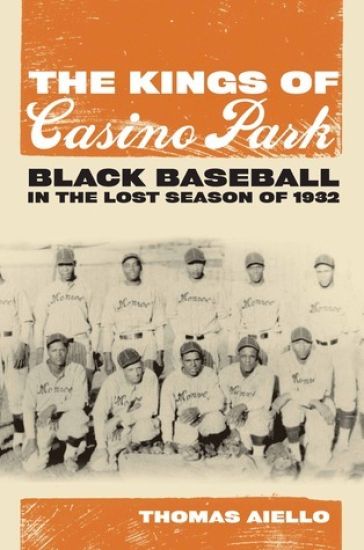
The Kings of Casino Park

The Kings of Casino Park

Thomas Aiello

The University of Alabama Press
2011
sidottu
In the 1930s, Monroe, Louisiana, was a town of twenty-six thousand in the northeastern corner of the state, an area described by the New Orleans Item as the 'lynch law center of Louisiana.' race relations were bad, and the Depression was pitiless for most, especially for the working class--a great many of whom had no work at all or seasonal work at best. Yet for a few years in the early 1930s, this unlikely spot was home to the Monarchs, a national-caliber Negro League baseball team. Crowds of black and white fans eagerly filled their segregated grandstand seats to see the players who would become the only World Series team Louisiana would ever generate, and the first from the American South. By 1932, the team had as good a claim to the national baseball championship of black America as any other. Partisans claim, with merit, that league officials awarded the National Championship to the Chicago American Giants in flagrant violation of the league's own rules: times were hard and more people would pay to see a Chicago team than an outfit from the Louisiana back country. Black newspapers in the South rallied to support Monroe's cause, railing against the league and the bias of black newspapers in the North, but the decision, unfair though it may have been, was also the only financially feasible option for the league's besieged leadership, who were struggling to maintain a black baseball league in the midst of the Great Depression. Aiello addresses long-held misunderstandings and misinterpretations of the Monarchs' 1932 season. He tells the almost-unknown story of the team--its time, its fortunes, its hometown--and positions black baseball in the context of American racial discrimination. He illuminates the culture-changing power of a baseball team and the importance of sport in cultural and social history.
On Carpentry

On Carpentry

Thomas Aiello

Lulu.com
2011
pokkari
HOW TO DEAL WITH CANCER, LOVE, LOSS, ADDICTION, AND DEATH IN THE SOUTH, WITHOUT GOING COMPLETELY BAT-SHIT CRAZY. The more clairvoyant amongst the citizens might have seen the plague coming. The town's street design, after all, told the story: had the roads of Carbondale, Arkansas been the constellation lines between stars, reaching with the stretch of their potholes and paint to the homes of those infected, they would have told the story of the tripartite battle between Hercules, Hydra, and Cancer itself. On Carpentry is dually a comedy and tragedy about a mysterious outbreak of pancreatic cancer in Carbondale. Like all Southern stories, the novel is replete with crazy old ladies, renegade street ministers, and frustrated lemonade salesmen. There is cocaine. There are Easybake Potatoes. Such are the Confederate flags of our time, flapping in the cool, cancer-ridden, Southern wind.
Bayou Classic

Bayou Classic

Thomas Aiello

Louisiana State University Press
2010
nidottu
The annual clash in New Orleans between the Grambling State University Tigers and the Southern University Jaguars represents the fiercest and most anticipated in-state football rivalry in Louisiana. The most significant national game to feature historically black colleges and universities is more than a contest; the Bayou Classic is a lavish event, featuring celebrities, a fan festival, and a halftime ""Battle of the Bands"" that offers an intensity equal to that of the gridiron. In Bayou Classic, Thomas Aiello chronicles the history of the game and explores the two schools' broader significance to Louisiana, to sports, and to the black community.When the Southern University Bushmen football team traveled to Monroe, Louisiana, to play the Tigers of Louisiana Negro Normal and Industrial Institute for the first time on Armistice Day, 1932, few realized they were witnessing the birth of a phenomenon. Aiello recounts Southern's early dominance over the smaller, two-year institution; Southern's acceptance into the Southwestern Athletic Conference; Grambling's hiring of the legendary Eddie Robinson, who would lead the Tigers to 408 wins between 1941 and 1997; Grambling's first victory over Southern; and years of alternating home and away games. In 1974, the rivalry found a neutral site in New Orleans -- first at Tulane Stadium and then the Superdome -- and became the ""Bayou Classic."" An NBC television contract introduced the Bayou Classic to a nationwide audience and completed the transformation of the game into a major event. The Bayou Classic remains the only nationally broadcast game between two historically black schools. Aiello supplements his colorful narrative with period photographs and informative appendices providing game results, statistics, and all-star teams from every year the schools have played. ""To appreciate the rivalry,"" Coach Eddie Robinson once noted, ""you have to realize Grambling and Southern fans are close friends, as well as relatives."" Bayou Classic offers a splendid history for fans, friends, and those who want to know more about this special game.
Womb of Monsters

Womb of Monsters

Thomas Aiello

Writers Club Press
2001
pokkari
A hilarious satirical romp through the apocalypse.In the late sixties, a rogue psychiatrist created a gated community of mental patients called Yesterday, utilizing some revolutionary mental health techniques. When Orson Littlefield is sent to the Yesterday mental facility, he is introduced to a new medication that makes his delusions come to life. His next-door neighbor, who is actually just another part of his delusion, becomes enraged when Orson kicks yet another figment of his imagination into her yard. She then promptly murders him with a nuclear warhead. Meanwhile, the antichrist, a Louisiana bunny rabbit, rises to power and seduces the world. One testament later, a high school football star takes on the persona of savior for a sports starved small town. His life is naturally replete with miracles, disciples, a donkey, and plenty of sex. Interspersed throughout are author Thomas Aiello's own attempts to come to terms with the fact that all the characters in his story are just figments of his imagination. Newspapers come to life, girlfriends evaporate, and various characters throughout are stricken with stigmata. A social commentary, religious satire, and absurdist comedy that examines the fine line between imagination and reality: come look inside the Womb of Monsters.