Kirjojen hintavertailu. Mukana 12 501 156 kirjaa ja 12 kauppaa.

Kirjailija

Thomas B. Pepinsky

Kirjat ja teokset yhdessä paikassa: 5 kirjaa, julkaisuja vuosilta 2009-2024, suosituimpien joukossa Pandemic Politics. Vertaile teosten hintoja ja tarkista saatavuus suomalaisista kirjakaupoista.

5 kirjaa

Kirjojen julkaisuhaarukka 2009-2024.

Pandemic Politics

Pandemic Politics

Shana Kushner Gadarian; Sara Wallace Goodman; Thomas B. Pepinsky

PRINCETON UNIVERSITY PRESS
2022
sidottu
How the politicization of the pandemic endangers our lives—and our democracyCOVID-19 has killed more people than any war or public health crisis in American history, but the scale and grim human toll of the pandemic were not inevitable. Pandemic Politics examines how Donald Trump politicized COVID-19, shedding new light on how his administration tied the pandemic to the president’s political fate in an election year and chose partisanship over public health, with disastrous consequences for all of us.Health is not an inherently polarizing issue, but the Trump administration’s partisan response to COVID-19 led ordinary citizens to prioritize what was good for their “team” rather than what was good for their country. Democrats, in turn, viewed the crisis as evidence of Trump’s indifference to public well-being. At a time when solidarity and bipartisan unity were sorely needed, Americans came to see the pandemic in partisan terms, adopting behaviors and attitudes that continue to divide us today. This book draws on a wealth of new data on public opinion to show how pandemic politics has touched all aspects of our lives—from the economy to race and immigration—and puts America’s COVID-19 response in global perspective.An in-depth account of a uniquely American tragedy, Pandemic Politics reveals how the politicization of the COVID-19 pandemic has profound and troubling implications for public health and the future of democracy itself.

Piety and Public Opinion

Piety and Public Opinion

Thomas B. Pepinsky; R. William Liddle; Saiful Mujani

Oxford University Press Inc
2018
sidottu
Across the Muslim world, religion plays an increasingly prominent role in both the private and public lives of over a billion people. Observers of these changes struggle to understand the consequences of an Islamic resurgence in a democratizing world. Will democratic political participation by an increasingly religious population lead to victories by Islamists at the ballot box? Will more conspicuously pious Muslims participate in politics and markets in a fundamentally different way than they had previously? Will a renewed attention to Islam lead Muslim democracies to reevaluate their place in the global community of states, turning away from alignments with the West or the Global South and towards an Islamic civilizational identity? The answers to all of these questions depend, at least in part, on what ordinary Muslims think and do. In order to provide these answers, the authors of this book look to Indonesia--the world's largest Muslim country and one of the world's only consolidated Muslim democracies. They draw on original public opinion data to explore how religiosity and religious belief translate into political and economic behavior at the individual level. Across various issue areas--support for democracy or Islamic law, partisan politics, Islamic finance, views about foreign engagement--they find no evidence that the religious orientations of Indonesian Muslims have any systematic relationships with their political preferences or economic behavior. The broad conclusion is that scholars of Islam, in Indonesia and elsewhere, must understand religious life and individual piety as part of a larger and more complex set of social transformations. These transformations include modernization, economic development, and globalization, each of which has occurred in parallel with Islamic revivalism throughout the world. Against the common assumption that piety would naturally inhibit any tendencies towards modernity, democracy, or cosmopolitanism, Piety and Public Opinion reveals the complex and subtle links between religion and political beliefs in a critically important Muslim democracy.
Pandemic Politics

Pandemic Politics

Shana Kushner Gadarian; Sara Wallace Goodman; Thomas B. Pepinsky

PRINCETON UNIVERSITY PRESS
2024
pokkari
How the politicization of the pandemic endangers our lives—and our democracyCOVID-19 has killed more people than any war or public health crisis in American history, but the scale and grim human toll of the pandemic were not inevitable. Pandemic Politics examines how Donald Trump politicized COVID-19, shedding new light on how his administration tied the pandemic to the president’s political fate in an election year and chose partisanship over public health, with disastrous consequences for all of us.Health is not an inherently polarizing issue, but the Trump administration’s partisan response to COVID-19 led ordinary citizens to prioritize what was good for their “team” rather than what was good for their country. Democrats, in turn, viewed the crisis as evidence of Trump’s indifference to public well-being. At a time when solidarity and bipartisan unity were sorely needed, Americans came to see the pandemic in partisan terms, adopting behaviors and attitudes that continue to divide us today. This book draws on a wealth of new data on public opinion to show how pandemic politics has touched all aspects of our lives—from the economy to race and immigration—and puts America’s COVID-19 response in global perspective.An in-depth account of a uniquely American tragedy, Pandemic Politics reveals how the politicization of the COVID-19 pandemic has profound and troubling implications for public health and the future of democracy itself.
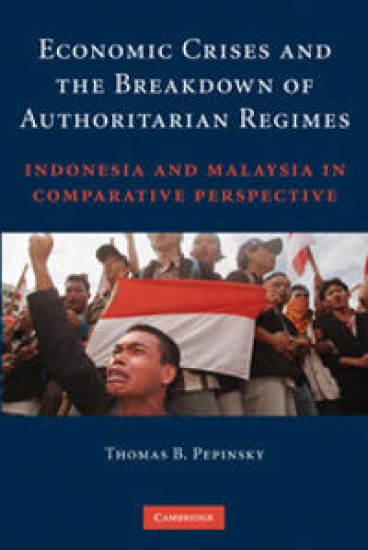
Economic Crises and the Breakdown of Authoritarian Regimes

Economic Crises and the Breakdown of Authoritarian Regimes

Thomas B. Pepinsky

Cambridge University Press
2009
sidottu
Why do some authoritarian regimes topple during financial crises, while others steer through financial crises relatively unscathed? In this book, Thomas B. Pepinsky uses the experiences of Indonesia and Malaysia and the analytical tools of open economy macroeconomics to answer this question. Focusing on the economic interests of authoritarian regimes' supporters, Pepinsky shows that differences in cross-border asset specificity produce dramatically different outcomes in regimes facing financial crises. When asset specificity divides supporters, as in Indonesia, they desire mutually incompatible adjustment policies, yielding incoherent adjustment policy followed by regime collapse. When coalitions are not divided by asset specificity, as in Malaysia, regimes adopt radical adjustment measures that enable them to survive financial crises. Combining rich qualitative evidence from Southeast Asia with cross-national time-series data and comparative case studies of Latin American autocracies, Pepinsky reveals the power of coalitions and capital mobility to explain how financial crises produce regime change.
Economic Crises and the Breakdown of Authoritarian Regimes

Economic Crises and the Breakdown of Authoritarian Regimes

Thomas B. Pepinsky

Cambridge University Press
2009
pokkari
Why do some authoritarian regimes topple during financial crises, while others steer through financial crises relatively unscathed? In this book, Thomas B. Pepinsky uses the experiences of Indonesia and Malaysia and the analytical tools of open economy macroeconomics to answer this question. Focusing on the economic interests of authoritarian regimes' supporters, Pepinsky shows that differences in cross-border asset specificity produce dramatically different outcomes in regimes facing financial crises. When asset specificity divides supporters, as in Indonesia, they desire mutually incompatible adjustment policies, yielding incoherent adjustment policy followed by regime collapse. When coalitions are not divided by asset specificity, as in Malaysia, regimes adopt radical adjustment measures that enable them to survive financial crises. Combining rich qualitative evidence from Southeast Asia with cross-national time-series data and comparative case studies of Latin American autocracies, Pepinsky reveals the power of coalitions and capital mobility to explain how financial crises produce regime change.