Kirjojen hintavertailu. Mukana 12 595 353 kirjaa ja 12 kauppaa.

Kirjailija

Thomas Browne

Kirjat ja teokset yhdessä paikassa: 135 kirjaa, julkaisuja vuosilta 1964-2025, suosituimpien joukossa Pseudodoxia Epidemica (Hardback, Ed. Wilkins). Vertaile teosten hintoja ja tarkista saatavuus suomalaisista kirjakaupoista.

135 kirjaa

Kirjojen julkaisuhaarukka 1964-2025.

Religion Medici

Religion Medici

Thomas Browne

Megali Verlag
2023
sidottu
Reproduction of the original. The publishing house Megali specialises in reproducing historical works in large print to make reading easier for people with impaired vision.
Religion Medici

Religion Medici

Thomas Browne

Megali Verlag
2023
pokkari
Reproduction of the original. The publishing house Megali specialises in reproducing historical works in large print to make reading easier for people with impaired vision.
Religio Medici

Religio Medici

Thomas Browne

Pantianos Classics
2022
pokkari
Religio Medici, the timeless book of contemplation by Sir Thomas Browne dating to 1642, is presented here unaltered and complete.Written by Browne during the 1640s as a means of profiling his own psyche while composing a personal spiritual testament to the divine, Religio Medici, or Religion of a Doctor, was received with great acclaim both in England and in continental Europe at the time of its publication.The text is principally structured around three key virtues: the first part is occupied with the attributes of Faith and Hope; while the second part is concerned with Charity. Throughout, Browne maintains his own recognisable style and tone, writing with frankness, clarity and conviction in a manner befitting an avowed Christian.For its profundity and explanatory wisdom, scholars of the 17th century offered Religio Medici much praise, and Browne became famous. The book also enjoyed a revival during the 19th century, wherein the characterful idiosyncrasies of Browne were appreciated by the artists and intellectuals of that era. Today, the text remains a favourite of Christians and scholars for its accessibility and merits of tone.
Urne Buriall, and The Garden of Cyrus

Urne Buriall, and The Garden of Cyrus

Thomas Browne

Hassell Street Press
2021
nidottu
This work has been selected by scholars as being culturally important and is part of the knowledge base of civilization as we know it.This work is in the public domain in the United States of America, and possibly other nations. Within the United States, you may freely copy and distribute this work, as no entity (individual or corporate) has a copyright on the body of the work.Scholars believe, and we concur, that this work is important enough to be preserved, reproduced, and made generally available to the public. To ensure a quality reading experience, this work has been proofread and republished using a format that seamlessly blends the original graphical elements with text in an easy-to-read typeface.We appreciate your support of the preservation process, and thank you for being an important part of keeping this knowledge alive and relevant.
Religio Medici, Urne-Buriall, and A Letter to a Friend
Sir Thomas Browne was a 17th century author who wrote on a wide variety of subjects including medicine, religion, science, and the esoteric. He is best known for his work entitled "Religio Medici", or "The Religion of a Doctor", which is Browne's own spiritual testament and an early example of a psychological self-portrait. Published in 1643, shortly after the author had qualified himself to practice medicine, "Religio Medici" became a best-seller throughout the European continent and because of its unorthodox views was admonished by the Catholic Church by being placed on the "Index Librorum Prohibitorum", or list of prohibited books. While largely an exposition of Christian faith, the work meanders into digressions upon alchemy, hermetic philosophy, astrology, and physiognomy. Also included in this edition is "Hydriotaphia" or "Urne-Buriall", and "A Letter to a Friend". The first work revolves around the discovery of a Roman urn burial in Norfolk which Browne uses to discuss ancient and current burial and funerary customs and extends to a greater inquiry of man's struggles with mortality. The second, which as written in 1656 and published posthumously in 1690, is a medical treatise of case-histories and witty speculations upon the human condition. This edition is printed on premium acid-free paper.
Gravurnor

Gravurnor

Thomas Browne

Bokförlaget Atlantis
2020
sidottu
"Gravurnor är även full av modernt klingande iakttagelser, till exempel: 'Ingenting har fått människor att förlora förståndet lika mycket som religionen.' Andra frågor som väcks i essän kommer nog aldrig att få något tillförlitligt svar, exempelvis vilken sång sirenerna sjöng för Odysseus i Odysséen. Det gör ingenting. Det gör bara Gravurnor ännu mer fascinerande." - Svenska Dagbladet Utgångspunkten för Thomas Brownes Gravurnor var ett fynd av en samling urnor i hans grannskap Norwich. Browne låter urnorna leda honom på ett strövtåg genom begravningsseder i olika tider och kulturer, men framför allt är det en meditation över tidens gång och människans skröplighet. »Vår ingrodda vana vid att leva gör oss oskickade att dö«, skriver Browne. Kanske kan hans essä göra oss lite mer skickade. Browne har haft stort inflytande på såväl det engelska språket som på en rad författare, bl.a. W. G. Sebald, Virginia Woolf och Jorge Luis Borges. Gravurnor publiceras nu för första gången på svenska, i översättning av Arne Melberg.
Hydriotaphia (Urn Burial); The Garden of Cyrus; Letter To A Friend
The son of a London merchant, Thomas Browne settled in Norwich in 1637, practising medicine and interesting himself in a wide variety of subjects, upon which his pen was rarely silent. Browne's style is complex and multilayered, deeply humane, and shot through with Classical and Biblical references. It also abounds in neologisms and he is credited with inventing more than 700 words, many - such a 'electricity' and 'computer' - still in common usage today. Thomas Browne remains one of Britain's most original writers, with a host of admirers, including such literary 'Greats' as Dr. Johnson, Coleridge, and W. G. Sebald. 'Hydriotaphia' (Urn Burial) is ostensibly an essay on ancient burial customs, but swiftly morphs into a study, at once witty and profound, on Death and humanity's vain longing for an 'immortal name' "The iniquity of oblivion blindly scattereth her poppy, and deals with the memory of men without distinction..." The second volume, 'The Garden of Cyrus', follows the pattern of the first, posing as an exposition on the importance of the 'Quincunciall' or 'Net-pattern' in both Nature and human culture, but gradual revealing itself as both a fascinating record of 17th century natural history and an insightful meditation on Life and Mysticism.Browne's celebrated 'A Letter to a Friend' takes the form of a traditional 17th century mourning letter, but the melancholy subject is transformed by the author's wit, humour and polished Baroque eloquence into an entrancing work of art. The essay came to light only after his death on October 19th 1682 which - strangely for a man obsessed with numerology - occurred exactly 77 years after his birth, on October 19th 1605.
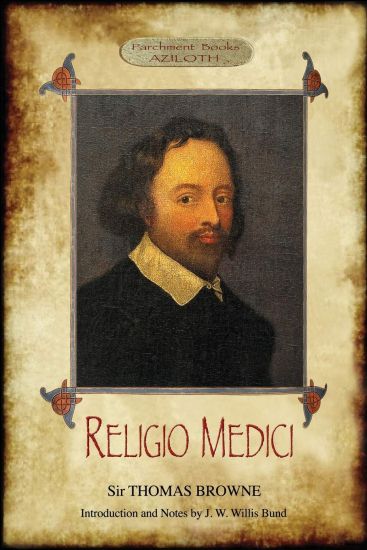
Religio Medici

Religio Medici

Thomas Browne

Aziloth Books
2019
nidottu
The proverb "Where there are three physicians there are two atheists" summed up the public perception of seventeenth century physicians. But, as the reader of Religio Medici will testify, Sir Thomas Browne, M.D., was anything but an atheist. Browne qualified as a doctor in Europe and travelled widely across the continent, living among many different Christian sects. At the age of thirty, he set down his thoughts on religion, a work that was meant for private circulation only, but when a critically annotated version was printed without his permission in 1642, Browne felt obliged to publish an authorised edition the following year. As a singularly candid piece of introspection, Religio Medici broke the mould of seventeenth century works on religion and catapulted its author to fame across Europe. The book analyses what faith and Church doctrine mean to a post-reformation Christian heavily influenced by the rationalists of the 1600s. Divided into two parts, the first looks at faith and the second at charity, but much ground is covered within these two concepts - death, heaven, hell, judgement, resurrection and even music. Browne refutes the cavil of the day about physicians by arguing that reason and religious faith are perfectly compatible. God, after all, is the immanent power behind all things, both those that man has "worked out" and those that are beyond his reasoning powers. When the limits of rational thought are reached, Browne is happy to rely on faith and to revel in God's mysteries and uncertainties - although he points out that his views will change over time (according to "the dictates of my own reason") as new facts and perspectives come to light. It is this refreshing approach that sets Religio Medici apart as a work that continues to delight and inform the modern debate on religion and science.