Kirjojen hintavertailu. Mukana 12 390 323 kirjaa ja 12 kauppaa.

Kirjailija

Thomas C. Jepsen

Kirjat ja teokset yhdessä paikassa: 3 kirjaa, julkaisuja vuosilta 2000-2003, suosituimpien joukossa My Sisters Telegraphic. Vertaile teosten hintoja ja tarkista saatavuus suomalaisista kirjakaupoista.

3 kirjaa

Kirjojen julkaisuhaarukka 2000-2003.

Distributed Storage Networks

Distributed Storage Networks

Thomas C. Jepsen

John Wiley Sons Inc
2003
sidottu
Did you know that as much as 50% of your storage capacity may be wasted or underutilized? Efficient management of stored data is becoming a necessity for every enterprise. The high cost of downtime creates a need for the increased reliability provided by distributed storage systems. Thus the use of storage networks to manage access to data not only provides an increase in performance and survivability, but also generates real and immediate cost savings. This book focuses on three primary areas: architectures for distributed storage networks, storage protocols and their inherent distance limitations, and management techniques for distributed storage networks. Distributed Storage Networks *describes the evolution of data processing from a computer-centric to a storage-centric model *introduces the concept of a distributed storage-centric processing model *explains common storage network functional components, such as fabric switches, storage directors, file managers, and gateways, and their roles in a distributed storage environment *discusses distributed storage network applications, including storage integration, remote database synchronization, and backup/recovery functions *provides a comparative view of Storage Area Network (SAN) and Network Attached Storage (NAS) functions and capabilities, and points out the advantages of each One of the primary obstacles to implementing a storage network cited by enterprise IT managers is a lack of knowledge about storage networking technology and the specific issues involved in extending a SAN or NAS over the MAN or WAN. The primary goal of this book is to provide IT managers, planners, and telecommunications professionals with the information they need in order to choose the technologies best suited for their particular environment.
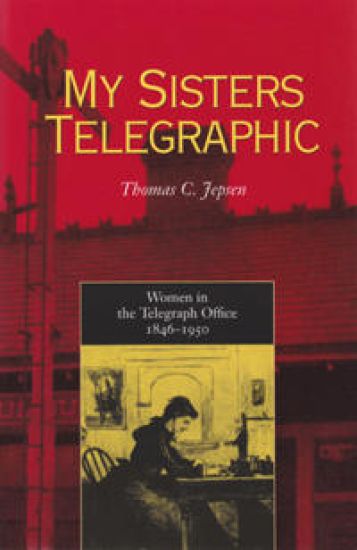
My Sisters Telegraphic

My Sisters Telegraphic

Thomas C. Jepsen

Ohio University Press
2000
pokkari
The role of the telegraph operator in the mid-nineteenth century was like that of today's software programmer/analyst, according to independent scholar Tom Jepsen, who notes that in the "cyberspace" of long ago, male operators were often surprised to learn that the "first-class man" on the other end of the wire was a woman. Like the computer, the telegraph caused a technological revolution. The telegraph soon worked synergistically with the era's other mass-scale technology, the railroad, to share facilities as well as provide communications to help trains run on time. The strategic nature of the telegraph in the Civil War opened opportunities for women, but tension arose as men began to return from military service. However, women telegraphers did not affect male employment or wage levels. Women kept their jobs after the war with support from industry—Western Union in particular—and because they defended and justified their role. "Although women were predominantly employed in lower-paying positions and in rural offices, women who persisted and made a career of the profession could work up to managerial or senior technical positions that, except for wage discrimination, were identical to those of their male counterparts," writes Jepsen. "Telegraphy as an occupation became gendered, in the sense that we understand today, only after the introduction of the teletype and the creation of a separate role for women teletype operators." My Sisters Telegraphic is a fresh introduction to this pivotal communications technology and its unsung women workers, long neglected by labor and social historians.
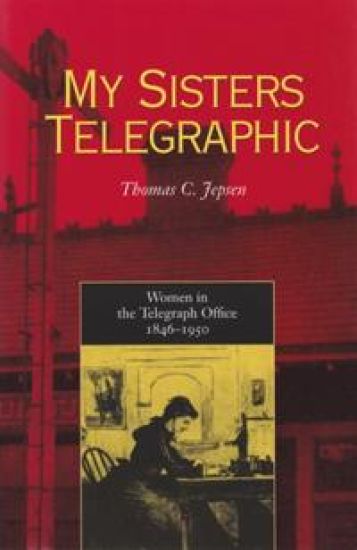
My Sisters Telegraphic

My Sisters Telegraphic

Thomas C. Jepsen

Ohio University Press
2000
sidottu
The role of the telegraph operator in the mid-nineteenth century was like that of today's software programmer/analyst, according to independent scholar Tom Jepsen, who notes that in the "cyberspace" of long ago, male operators were often surprised to learn that the "first-class man" on the other end of the wire was a woman. Like the computer, the telegraph caused a technological revolution. The telegraph soon worked synergistically with the era's other mass-scale technology, the railroad, to share facilities as well as provide communications to help trains run on time. The strategic nature of the telegraph in the Civil War opened opportunities for women, but tension arose as men began to return from military service. However, women telegraphers did not affect male employment or wage levels. Women kept their jobs after the war with support from industry—Western Union in particular—and because they defended and justified their role. "Although women were predominantly employed in lower-paying positions and in rural offices, women who persisted and made a career of the profession could work up to managerial or senior technical positions that, except for wage discrimination, were identical to those of their male counterparts," writes Jepsen. "Telegraphy as an occupation became gendered, in the sense that we understand today, only after the introduction of the teletype and the creation of a separate role for women teletype operators." My Sisters Telegraphic is a fresh introduction to this pivotal communications technology and its unsung women workers, long neglected by labor and social historians.