Kirjojen hintavertailu. Mukana 12 390 323 kirjaa ja 12 kauppaa.

Kirjailija

Thomas C. Schelling

Kirjat ja teokset yhdessä paikassa: 13 kirjaa, julkaisuja vuosilta 1977-2020, suosituimpien joukossa Micromotives and Macrobehavior. Vertaile teosten hintoja ja tarkista saatavuus suomalaisista kirjakaupoista.

Mukana myös kirjoitusasut: Thomas C Schelling

13 kirjaa

Kirjojen julkaisuhaarukka 1977-2020.

Micromotives and Macrobehavior

Micromotives and Macrobehavior

Thomas C. Schelling

WW Norton Co
1978
nidottu
Micromotives and Macrobehavior deals with all involve systems of behavior where a person reacting, responding, and adapting to his surroundings fails to perceive, or doesn't care, how his actions combine with the actions of others to produce unanticipated results.
Arms and Influence

Arms and Influence

Thomas C. Schelling

Yale University Press
2020
pokkari
“This is a brilliant and hardheaded book. It will frighten those who prefer not to dwell on the unthinkable and infuriate those who have taken refuge in stereotypes and moral attitudinizing.”—Gordon A. Craig, New York Times Book Review “A grim but carefully reasoned and coldly analytical book. . . . One of the most frightening previews which this reviewer has ever seen of the roads that lie just ahead in warfare.”—Los Angeles Times Originally published in 1966, this landmark book explores the ways in which military capabilities—real or imagined—are used, skillfully or clumsily, as bargaining power. Anne-Marie Slaughter’s new introduction to the work shows how Schelling’s framework—conceived of in a time of superpowers and mutually assured destruction—still applies to our multipolar world, where wars are fought as much online as on the ground. The Henry L. Stimson Lectures Series
Strategies of Commitment and Other Essays

Strategies of Commitment and Other Essays

Thomas C. Schelling

Harvard University Press
2007
nidottu
All of the essays in this new collection by Thomas Schelling convey his unique perspective on individuals and society. This perspective has several characteristics: it is strategic in that it assumes that an important part of people's behavior is motivated by the thought of influencing other people's expectations; it views the mind as being separable into two or more parts (rational/irrational; present-minded/future-minded); it is motivated by policy concerns--smoking and other addictions, global warming, segregation, nuclear war; and while it accepts many of the basic assumptions of economics--that people are forward-looking, rational decision makers, that resources are scarce, and that incentives are important--it is open to modifying them when appropriate, and open to the findings and insights of other social science disciplines.Schelling--a 2005 Nobel Prize winner-- has been one of the four or five most important social scientists of the past fifty years, and this collection shows why.
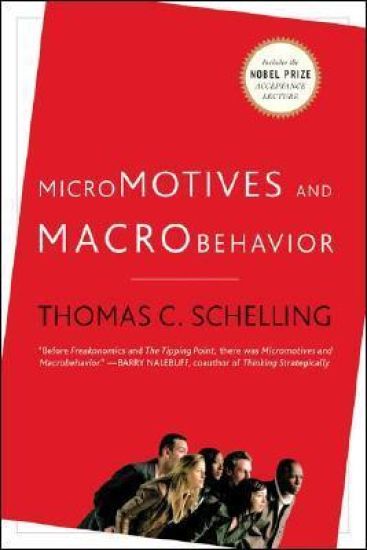
Micromotives and Macrobehavior

Micromotives and Macrobehavior

Thomas C. Schelling

WW Norton Co
2006
nidottu
"Schelling here offers an early analysis of 'tipping' in social situations involving a large number of individuals." —official citation for the 2005 Nobel Prize Micromotives and Macrobehavior was originally published over twenty-five years ago, yet the stories it tells feel just as fresh today. And the subject of these stories—how small and seemingly meaningless decisions and actions by individuals often lead to significant unintended consequences for a large group—is more important than ever. In one famous example, Thomas C. Schelling shows that a slight-but-not-malicious preference to have neighbors of the same race eventually leads to completely segregated populations. The updated edition of this landmark book contains a new preface and the author's Nobel Prize acceptance speech.
Surprise Attack

Surprise Attack

Ephraim Kam; Thomas C. Schelling

Harvard University Press
2004
nidottu
Ephraim Kam observes surprise attack through the eyes of its victim in order to understand the causes of the victim’s failure to anticipate the coming of war. Emphasizing the psychological aspect of warfare, Kam traces the behavior of the victim at various functional levels and from several points of view in order to examine the difficulties and mistakes that permit a nation to be taken by surprise. He argues that anticipation and prediction of a coming war are more complicated than any other issue of strategic estimation, involving such interdependent factors as analytical contradictions, judgmental biases, organizational obstacles, and political as well as military constraints.
Costs and Benefits of Greenhouse Gas Reduction
Little will be done in the near future to reduce greenhouse gas emissions - providing an opportunity to develop programmes for research, subsidization, and regulation. This text focuses on specific issues, such as global climate change, and the institutional arrangements required to deal with them.
Surprise Attack

Surprise Attack

Ephraim Kam; Thomas C Schelling

Harvard University Press
1988
sidottu
A new version of this book is now available. The striking thing about surprise attack is how frequently it succeeds--even in our own day, when improvements in communications and intelligence gathering should make it extremly difficult to sneak up on anyone. Ephraim Kam observes surprise attack through the eyes of its victim in order to understand the causes of the victim's failure to to anticipate the coming war. Kam analyzes eleven major surprise attacks that have been launched since the outbreak of World War II (by no means the only ones that occured), starting with the German invasion of Denmark and Norway in 1940 and ending with the Eyptian-Syrian attack on Isreal in 1973, in a systematic comparative effort to find the elements that successful sorties have in common. He tackles the problem on four levels: the individual analyst, the small group, the large organization, and the decision makers. Emphasizing the psychological aspects of warfare, Kam traces the behavior of the victim at various functional levels and from several points of view in order to examine the difficulties, mistakes, and "idees fixes" that permit a nation to be taken by surprise. He argues that anticipation and prediction of a coming war are more complicated than any other issue of strategic estimation, involving such interdependent factors as analytical contradictions, judgmental biases, organizational obstacles, and political as well as military constraints.
Choice and Consequence

Choice and Consequence

Thomas C. Schelling

Harvard University Press
1985
nidottu
Thomas Schelling is a political economist “conspicuous for wandering”—an errant economist. In Choice and Consequence, he ventures into the area where rationality is ambiguous in order to look at the tricks people use to try to quit smoking or lose weight. He explores topics as awesome as nuclear terrorism, as sordid as blackmail, as ineffable as daydreaming, as intimidating as euthanasia. He examines ethical issues wrapped up in economics, unwrapping the economics to disclose ethical issues that are misplaced or misidentified.With an ingenious, often startling approach, Schelling brings new perspectives to problems ranging from drug abuse, abortion, and the value people put on their lives to organized crime, airplane hijacking, and automobile safety. One chapter is a clear and elegant exposition of game theory as a framework for analyzing social problems. Another plays with the hypothesis that our minds are not only our problem-solving equipment but also the organ in which much of our consumption takes place.What binds together the different subjects is the author’s belief in the possibility of simultaneously being humane and analytical, of dealing with both the momentous and the familiar. Choice and Consequence was written for the curious, the puzzled, the worried, and all those who appreciate intellectual adventure.
The Strategy of Conflict

The Strategy of Conflict

Thomas C. Schelling

Harvard University Press
1981
nidottu
A series of closely interrelated essays on game theory, this book deals with an area in which progress has been least satisfactory—the situations where there is a common interest as well as conflict between adversaries: negotiations, war and threats of war, criminal deterrence, extortion, tacit bargaining. It proposes enlightening similarities between, for instance, maneuvering in limited war and in a traffic jam; deterring the Russians and one’s own children; the modern strategy of terror and the ancient institution of hostages.