Kirjojen hintavertailu. Mukana 12 595 353 kirjaa ja 12 kauppaa.

Kirjailija

Thomas D. Grant

Kirjat ja teokset yhdessä paikassa: 11 kirjaa, julkaisuja vuosilta 1999-2026, suosituimpien joukossa Admission to the United Nations. Vertaile teosten hintoja ja tarkista saatavuus suomalaisista kirjakaupoista.

Mukana myös kirjoitusasut: Thomas D Grant

11 kirjaa

Kirjojen julkaisuhaarukka 1999-2026.

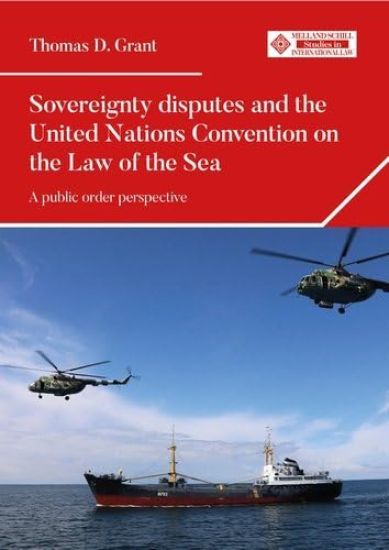
Sovereignty Disputes and the United Nations Convention on the Law of the Sea
Because maritime questions are often admixed with territorial sovereignty questions, parties sometimes seek to settle them together. Jurisdiction under the United Nations Convention on the Law of the Sea—UNCLOS—according to the received view does not encompass disputes concerning territorial sovereignty. In this book, international law scholar and practitioner Thomas D. Grant argues that the received view overstates the exclusion of sovereignty disputes. In Coastal State Rights, UNCLOS Annex VII arbitrators overstated the scope of the term ‘sovereignty dispute’ as well, an error of definition compounded when they ignored evidence probative as to whether a sovereignty dispute exists. Examining UNCLOS, its drafting history, and decades of decided cases, Sovereignty Disputes and the United Nations Convention on the Law of the Sea relates an important problem of international dispute settlement to the public order of which UNCLOS forms part.
On the path to AI

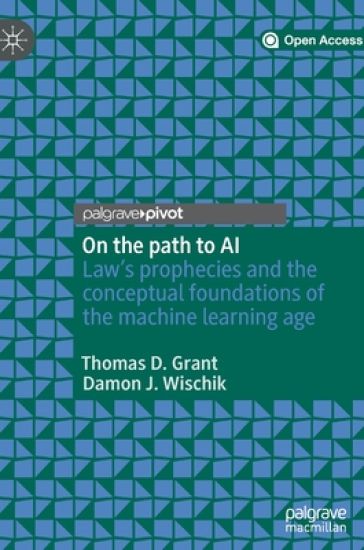
On the path to AI

Thomas D. Grant; Damon J. Wischik

Springer Nature Switzerland AG
2020
sidottu
This open access book explores machine learning and its impact on how we make sense of the world. It does so by bringing together two ‘revolutions’ in a surprising analogy: the revolution of machine learning, which has placed computing on the path to artificial intelligence, and the revolution in thinking about the law that was spurred by Oliver Wendell Holmes Jr in the last two decades of the 19th century. Holmes reconceived law as prophecy based on experience, prefiguring the buzzwords of the machine learning age—prediction based on datasets.On the path to AI introduces readers to the key concepts of machine learning, discusses the potential applications and limitations of predictions generated by machines using data, and informs current debates amongst scholars, lawyers and policy makers on how it should be used and regulated wisely. Technologists will also find useful lessons learned from the last 120 years of legal grappling with accountability, explainability, and biased data.
International Law and the Post-Soviet Space II

International Law and the Post-Soviet Space II

Thomas D Grant; Stephen M Schwebel

ibidem-Verlag, Jessica Haunschild u Christian Schon
2019
nidottu
This volume deals with legal issues concerning Russias annexation of Crimea and intervention in the Donbas, so-called frozen conflicts and hybrid warfare, the use of courts and tribunals to address armed aggression, and the implications of recent events for the security guarantees connected to nuclear non-proliferation. Continuing from the first volume, which contains Parts One and Two on Chechnya and the Baltic States, this book is comprised of Part Three --Ukraine and other successor States: Territorial Integrity and its Challengers in the Post-Soviet Space; Part Four -- Intervention and International Law; Part Five -- Legal Proceedings and Unlawful Claims; and Part Six -- Non-Proliferation after Budapest.
International Law and the Post-Soviet Space I

International Law and the Post-Soviet Space I

Thomas D Grant; Stephen M Schwebel

ibidem-Verlag, Jessica Haunschild u Christian Schon
2019
nidottu
The region that once comprised the Soviet Union has been the scene of crises with serious implications for international law. Some of these, like the separatist conflict in Chechnya, date to the time of the dissolution of the USSR. Others, like Russias forcible annexation of Crimea and intervention in Ukraines Donbas, erupted years later. The seizure of Estonia, Latvia, and Lithuania, which took place long before, would trouble Soviet-western relations for the Cold Wars duration and gained new relevance when the Baltic States re-emerged in the 1990s. The fate of Ukraine notwithstanding, the Budapest Memorandum of 1994 complicates future efforts at nuclear non-proliferation. Legal proceedings in connection with events in the post-Soviet space brought before the International Court of Justice and under investment treaties or the UN Convention on the Law of the Sea may be steps toward the resolution of recent crises -- or tests of the resiliency of modern international law.
International Law and the Post-Soviet Space II

International Law and the Post-Soviet Space II

Thomas D Grant; Stephen M Schwebel

ibidem-Verlag, Jessica Haunschild u Christian Schon
2019
sidottu
This volume deals with legal issues concerning Russias annexation of Crimea and intervention in the Donbas, so-called frozen conflicts and hybrid warfare, the use of courts and tribunals to address armed aggression, and the implications of recent events for the security guarantees connected to nuclear non-proliferation. Continuing from the first volume, which contains Parts One and Two on Chechnya and the Baltic States, this book is comprised of Part Three --Ukraine and other successor States: Territorial Integrity and its Challengers in the Post-Soviet Space; Part Four -- Intervention and International Law; Part Five -- Legal Proceedings and Unlawful Claims; and Part Six -- Non-Proliferation after Budapest.
International Law and the Post-Soviet Space I

International Law and the Post-Soviet Space I

Thomas D Grant; Stephen M Schwebel

ibidem-Verlag, Jessica Haunschild u Christian Schon
2019
sidottu
The region that once comprised the Soviet Union has been the scene of crises with serious implications for international law. Some of these, like the separatist conflict in Chechnya, date to the time of the dissolution of the USSR. Others, like Russias forcible annexation of Crimea and intervention in Ukraines Donbas, erupted years later. The seizure of Estonia, Latvia, and Lithuania, which took place long before, would trouble Soviet-western relations for the Cold Wars duration and gained new relevance when the Baltic States re-emerged in the 1990s. The fate of Ukraine notwithstanding, the Budapest Memorandum of 1994 complicates future efforts at nuclear non-proliferation. Legal proceedings in connection with events in the post-Soviet space brought before the International Court of Justice and under investment treaties or the UN Convention on the Law of the Sea may be steps toward the resolution of recent crises -- or tests of the resiliency of modern international law.
Biological Small Angle Scattering

Biological Small Angle Scattering

Eaton E. Lattman; Thomas D. Grant; Edward H. Snell

Oxford University Press
2018
sidottu
Small angle solution scattering (SAS) is increasingly being applied to biological problems. It is a complementary technique that, when applied in appropriate circumstances with carefully structured questions, can provide unique information not available from other techniques. While small angle solution scattering has been around for some time, a confluence of recent developments has dramatically enhanced its power. Intense third generation X-ray sources, low noise detectors, development of new algorithms and the computational power to take advantage of these have all matured, and use of free-electron x-ray laser sources is on the horizon. Whole new classes of experiments and analyses have been created as a result. These include the generation of molecular envelopes, the ability to do time-resolved studies, and the ability to account for structural changes using modelling based on the SAS data. The technical improvements have also reduced the amount of time and material needed to carry out an experiment. Beamtime at synchrotron sources is in demand, workshops on the subject are popular and researchers adopting the technique as part of their repertoire are growing. With these in mind, this book was written to guide structural biologists who may wish to adopt the technique, understand its strengths and weaknesses or just have a general interest in its potential.
Stormtroopers and Crisis in the Nazi Movement
Containing illustrations from archival material, this book scrutinizes two sets of hitherto understudied records:* SA morale reports in the US National Archive which show what Nazi leaders themselves knew about their radical paramilitary wing* police reports on the stormtroopers, from the former DDR state archive in Potsdam which show what Republican authorities knew.Stormtroopers and Crisis in the Nazi Movement casts fresh light on the crisis that beset Nazism during the final months of Germany's first republic.
Admission to the United Nations

Admission to the United Nations

Thomas D. Grant

BRILL
2009
sidottu
The United Nations began as an alliance during World War II. Eventually, however, the UN came to approximate a universal organization - i.e., open to and aspiring to include all States. This presents a legal question, for Article 4 of the Charter contains substantive criteria to limit admission of States to the UN and no formal amendment has touched that part of the Charter. This book gives an up-to-date account of admission to the UN, from the 1950s ‘logjam’ through on-going controversies like Kosovo and Taiwan. With reference to Charter law, the book considers how Article 4 came to accommodate universality and what the future of a universal organization in a world of politically diverse States might be.
Stormtroopers and Crisis in the Nazi Movement
Containing illustrations from archival material, this book scrutinizes two sets of hitherto understudied records:* SA morale reports in the US National Archive which show what Nazi leaders themselves knew about their radical paramilitary wing* police reports on the stormtroopers, from the former DDR state archive in Potsdam which show what Republican authorities knew.Stormtroopers and Crisis in the Nazi Movement casts fresh light on the crisis that beset Nazism during the final months of Germany's first republic.
The Recognition of States

The Recognition of States

Thomas D. Grant

Praeger Publishers Inc
1999
sidottu
Thomas D. Grant examines the Great Debate over state recognition, tracing its eclipse, and identifying trends in contemporary international law that may explain the lingering persistence of the terms of that debate. Although writers have generally accepted the declaratory view as more accurate than its old rival, the judicial sources often cited to support the declaratory view do not on scrutiny do so as decisively as commonly assumed. Contemporary doctrinal preference requires explanation. Declaratory doctrine, in its apparent diminution of the role state discretion plays in recognition, is in harmony, Grant asserts, with contemporary aspirations for international law. It may seem to many writers, he believes, that international governance functions better in a conceptual framework that reduces the power of states to legislate what entities are states. Grant proceeds from this analysis of the contemporary status of the old debate to ask what questions now take center stage. In place of doctrine, Grant argues, process is the chief issue concerning recognition today. Whether to recognize unilaterally or in a collective framework; whether to acknowledge legal rules or to let recognition be controlled by political calculus—as Grant points out, such questions concern how states recognize, not the theoretical nature of recognition. This is an important analysis for scholars and researchers of international law and relations and contemporary European politics.