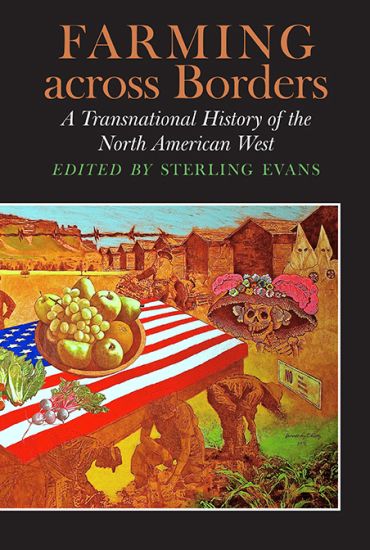
Farming Across Borders
Timothy P. Bowman; Kristin Hoganson; Laura Hooton; Josh MacFadyen; Todd Meyers; Peter S Morris; Andrew Dunlop; Alicia Marion Dewey; John Weber; Sonia Hernandez; Rosa E Cobos; Matt Caire-Perez; Paige Raibmon; Jason McCollom; Thomas D Isern; Suzzanne Kelley; Anthony Carlson; Stephen Mumme; Tisa Anders
Texas A M University Press
2017
sidottu
Farming across Borders uses agricultural history to connect the regional experiences of the American West, northern Mexico, western Canada, and the North American side of the Pacific Rim, now writ large into a broad history of the North American West. Case studies of commodity production and distribution, trans-border agricultural labor, and environmental change unite to reveal new perspectives on a historiography traditionally limited to a regional approach.Sterling Evans has curated nineteen essays to explore the contours of “big” agricultural history. Crops and commodities discussed include wheat, cattle, citrus, pecans, chiles, tomatoes, sugar beets, hops, henequen, and more. Toiling over such crops, of course, were the people of the North American West, and as such, the contributing authors investigate the role of agricultural labor, from braceros and Hutterites to women working in the sorghum fields and countless other groups in between.As Evans concludes, “society as a whole (no matter in what country) often ignores the role of agriculture in the past and the present.” Farming across Borders takes an important step toward cultivating awareness and understanding of the agricultural, economic, and environmental connections that loom over the North American West regardless of lines on a map. In the words of one essay, “we are tied together . . . in a hundred different ways.”