Kirjojen hintavertailu. Mukana 12 595 353 kirjaa ja 12 kauppaa.

Kirjailija

Thomas Docherty

Kirjat ja teokset yhdessä paikassa: 36 kirjaa, julkaisuja vuosilta 1992-2025, suosituimpien joukossa Kuutyttö. Vertaile teosten hintoja ja tarkista saatavuus suomalaisista kirjakaupoista.

36 kirjaa

Kirjojen julkaisuhaarukka 1992-2025.

John Donne, Undone (Routledge Revivals)
Contemporary criticism of Donne has tended to ignore the historical culture and ideology that conditioned his writings, reinforcing the traditionally accepted model of the poet as a humanist of ethical, cultural and political individualism. In this title, first published in 1986, Thomas Docherty challenges this with a more rigorously theoretical reading of Donne, particularly in relation to the specific culture of the late Renaissance in Europe. Docherty locates Donne’s poetry at the crux of the various scientific, legal, domestic and rhetorical discourses that surrounded and informed it. With a broadly post-structuralist approach, this reissue will benefit literature students with an interest in the wider study and context of John Donne’s work.
The Driftwood Ball

The Driftwood Ball

Thomas Docherty

Templar Publishing
2014
nidottu
Every year the badgers and the otters gather to dance at the Driftwood Ball. But the two groups never mix - they dance in completely different ways. That is, until otter Celia and badger George decide they want to do things differently... they want to dance together, in their own way. On the night of the ball, they show their friends and family what they've been secretly practising, and through their courage the two groups become friends, and the two star-crossed dancers win the Driftwood Cup.
The Driftwood Ball

The Driftwood Ball

Thomas Docherty

Templar Publishing
2014
sidottu
Every year the badgers and the otters gather to dance at the Driftwood Ball. But thetwo groups never mix - they dance in completely different ways. That is, until otterCelia and badger George decide they want to do things differently... they want todance together, in their own way. On the night of the ball, they show their friendsand family what they've been secretly practising, and through their courage the twogroups become friends, and the two star-crossed dancers win the Driftwood Cup.
Confessions

Confessions

Thomas Docherty

Bloomsbury Academic
2012
sidottu
This book explores what is at stake in our confessional culture. Thomas Docherty examines confessional writings from Augustine to Montaigne and from Sylvia Plath to Derrida, arguing that through all this work runs a philosophical substratum - the conditions under which it is possible to assert a confessional mode - that needs exploration and explication. Docherty outlines a philosophy of confession that has pertinence for a contemporary political culture based on the notion of 'transparency'. In a postmodern 'transparent society', the self coincides with its self-representations. Such a position is central to the idea of authenticity and truth-telling in confessional writing: it is the basis of saying, truthfully, 'here I take my stand'. The question is: what other consequences might there be of an assumption of the primacy of transparency? Two areas are examined in detail: the religious and the judicial. Docherty shows that despite the tendency to regard transparency as a general social and ethical good, our contemporary culture of transparency has engendered a society in which autonomy (or the very authority of the subject that proclaims 'I confess') is grounded in guilt, reparation and victimhood.
For the University

For the University

Thomas Docherty

Bloomsbury Academic
2011
nidottu
This book is available as open access through the Bloomsbury Open Access programme and is available on www.bloomsburycollections.com. For the University is a book both about and for the university in an age of mass and globalized education. Thomas Docherty analyses the current problems facing the university as an institution, and also offers some positive arguments for a revived and vibrant set of institutional arrangements and governing principles. The book considers the place of the university as an important global institution, now in a charged political and international public sphere. Docherty places current debates within their wider economic and political context, focusing on the relationship of the university to current and emerging models of democracy. The question of what the university will be -- rather than it is, was, or might be -- is at the heart of this book, and Docherty ably traces its history and present condition in order to offer us a vision for the future.
English Question

English Question

Thomas Docherty

Sussex Academic Press
2008
nidottu
To be or not to be free, that is the question, the English question, the question of what is academic English at the beginning of the 21st century. So argues Thomas Docherty in this new and important new study, a study that begins with the claim that the fundamental idea governing the institution of the University is a will to freedom. Tracing a history of the modern European University from Vico onwards and including Hume, Rousseau, Schiller, Hegel, Schopenhauer, Newman, Alain, Benda and Jaspers, the author argues the academy's will to freedom is grounded in study of the 'eloquence' that has shaped literate and humane values. He goes on to explore the current condition of English as a literary discipline, arguing that literary studies is (or should be) a search for the unknown; and that in only that search can the academy establish the real meaning -- or meanings -- of social, political and ethical freedom.
English Question

English Question

Thomas Docherty

Sussex Academic Press
2007
sidottu
To be or not to be free, that is the question, the English question, the question of what is academic English at the beginning of the 21st century. So argues Thomas Docherty in this new and important new study, a study that begins with the claim that the fundamental idea governing the institution of the University is a will to freedom. Tracing a history of the modern European University from Vico onwards and including Hume, Rousseau, Schiller, Hegel, Schopenhauer, Newman, Alain, Benda and Jaspers, the author argues the academy's will to freedom is grounded in study of the 'eloquence' that has shaped literate and humane values. He goes on to explore the current condition of English as a literary discipline, arguing that literary studies is (or should be) a search for the unknown; and that in only that search can the academy establish the real meaning -- or meanings -- of social, political and ethical freedom.
Fly, Pigeon, Fly!

Fly, Pigeon, Fly!

John Henderson; Julia Donaldson; Thomas Docherty

Little Tiger Press
2006
nidottu
When a boy finds a young pigeon, half starved, in a derelict warehouse in Glasgow, he names the pigeon Percy and takes him home. He looks after him and even teaches him to fly. Da says that Percy should be set free, but the boy wants him to stay for ever. This atmospheric book tells the story of an unusual friendship.
Aesthetic Democracy

Aesthetic Democracy

Thomas Docherty

Stanford University Press
2006
pokkari
Aesthetic Democracy argues that art and the aesthetic in general are the founding condition of the possibility of establishing social and political democracy. The book examines contemporary criticism and finds that it is historically shaped by colonialism, and that it sets up an opposition of east and west that shapes all contemporary cultural politics. The author argues for a way of outwitting this potentially dangerous struggle of east and west grounded in an aestheticism and a validation of sensory experience. Docherty proposes a new model of cultural critique, based on a revitalized and positively valorized notion of "hypocrisy," whose roots lie in Machiavelli, but whose contemporary strength lies in its potential for an ethical encounter with alterity as such.
Aesthetic Democracy

Aesthetic Democracy

Thomas Docherty

Stanford University Press
2006
sidottu
Aesthetic Democracy argues that art and the aesthetic in general are the founding condition of the possibility of establishing social and political democracy. The book examines contemporary criticism and finds that it is historically shaped by colonialism, and that it sets up an opposition of east and west that shapes all contemporary cultural politics. The author argues for a way of outwitting this potentially dangerous struggle of east and west grounded in an aestheticism and a validation of sensory experience. Docherty proposes a new model of cultural critique, based on a revitalized and positively valorized notion of "hypocrisy," whose roots lie in Machiavelli, but whose contemporary strength lies in its potential for an ethical encounter with alterity as such.
Criticism and Modernity

Criticism and Modernity

Thomas Docherty

Oxford University Press
1999
sidottu
Criticism and Modernity traces the conditions under which criticism emerges as a socio-cultural practice within the institutionalized forms of European modernity and democracy. It argues that criticism is born out of anxieties about national supremacy in the late seventeenth century, with the consequence that the emergent national cultures of the eighteenth century and since become sites for the regulation of the democratic subject through the academic form of arguments about the proper relations of aesthetics to ethics and politics. The central issue is that of legitimation: how can subjective aesthetic experiences regulate the norms of ethical justice? That question is posed not as an abstract philosophical issue, but rather as a question properly located within the struggles for national culture. The usual Germanic source of modern aesthetics and criticism is here placed in the broader European context, involving contests between England, France, Scotland, Ireland, and the emergent Germany and Italy. Writers addressed include Corneille, Dryden, Molière, Shaftesbury, Hutcheson, Hume, Rousseau, Kant, Schiller, Hegel, Schopenhauer; and, throughout, the legacy of these thinkers is found in the most recent contemporary theory, in work by Agamben, Badiou, Lyotard, MacIntyre, and others. A closing chapter considers the formation of the university across modern Europe, in Vico's Naples, Humboldt's Berlin, Newman's Dublin, Blair's Edinburgh, the France of Alain and Benda, the England of Leavis, as well as our contemporary institutional predicaments.
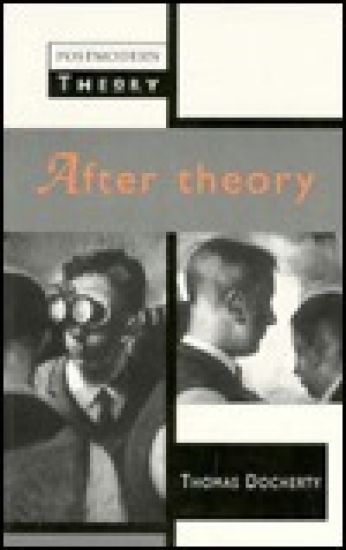
After Theory

After Theory

Thomas Docherty

Edinburgh University Press
1996
nidottu
This book proposes the necessity of a new critical attitude appropriate to a post-enlightenment social and political condition. Theory - the intellectual and his or her knowledge - has been institutionalised and tamed; the critic interested in praxis must find a new means of establishing an effective intellection. After Theory argues the demand for a post-theoretical or ana-theoretical attitude which will recondition and regenerate critique under the aegis of a philosophical and austere postmarxism. The 'waking' of theory advanced here ranges eclectically over twentieth-century practice in philosophy, literature, painting, music, dance, architecture, film and photography, breaking theory from its institutionalised bonds.
Alterities

Alterities

Thomas Docherty

Clarendon Press
1996
sidottu
Alterities marks an advance to a new stage of critical theory. Dealing with literature from Shakespeare and Donne to Calvino, with philosophy from the medieval to the contemporary, with cinema from popular to art-film, and with political theory from Marx to Lyotard, Baudrillard and Badiou, Thomas Docherty intervenes in all the major contemporary cultural debates to propose and practise a new criticism, whose theoretical foundations lie in postmodern ethics, ecopolitics, and an austere attention to the radical difficulties of art. Docherty's new book is a response to a growing realization that modern criticism - even in its apparently oppositional forms - remains caught up within the limitations of a philosophy of identity. Consequently, the tacit purpose of existing critique is the self-legitimation of the subject of criticism, a solace gained only through the refusal of the encounter with the objects of criticism: art and the culture of sociality. Alterities argues that we must attend to the difficulty of aesthetic practices. The contention is that it is only through an attention to the radical otherness of the world outside consciousness that we will be able to arrive at a historical and materialist criticism. In making this claim, Docherty rehabilitates the questions of why we bother about art, and proposes new modes of critical engagement with contemporary culture. Bound together by the cohesive drive of Docherty's intelligence and the coerciveness of the arguments he enlarges about alterity and historicity, Alterities is essential reading for those interested in postmodernist theory.