Kirjojen hintavertailu. Mukana 12 390 323 kirjaa ja 12 kauppaa.
Kirjailija
Thomas J. Courchene
Kirjat ja teokset yhdessä paikassa: 27 kirjaa, julkaisuja vuosilta 1993-2018, suosituimpien joukossa Room to Manouevre?. Vertaile teosten hintoja ja tarkista saatavuus suomalaisista kirjakaupoista.
Indigenous Nationals/Canadian Citizens begins with a detailed policy history from first contact to the Sesquicentennial with major emphasis on the evolution of Canadian policy initiatives relating to Indigenous peoples. This is followed by a focus on the
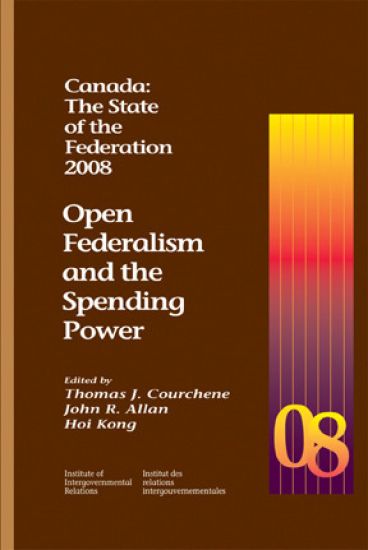
Whether considered from the perspective of constitutional law or that of political science, few, if any, areas of Canadian politics are more contested than the use of federal spending power. Initially presented at a conference sponsored by the Institute of Intergovernmental Relations and the Faculty of Law at Queen's University in January 2008, the papers in this book consider the topic of federal spending power from a variety of perspectives - legal scholars, political scientists, economists, past and present senior public servants, federal and provincial viewpoints, and critics and supporters are all represented in this comprehensive and accessible collection. Whether one believes that the federal spending power is a necessary safeguard for the protection and advancement of national interests in a decentralised federation or a threat to provincial autonomy from a powerful federal government, one will find reasoned support and criticism in these papers from a distinguished array of contributors. Contributors include Marc-Antoine Adam (Quebec Bar, Government of Quebec), Marc Chevrier (Université du Québec à Montréal), Thomas J. Courchene (Queen's University), Tom Kent (Queen's University), Hoi Kong (Queen's University), Andrée Lajoie (Université de Montréal), Harvey Lazar (Queen's University), Roderick A. Macdonald (McGill University and University of Toronto), Alain Noël (Université de Montréal), Andrew Petter (University of Victoria), and John Whyte (University of Saskatchewan).
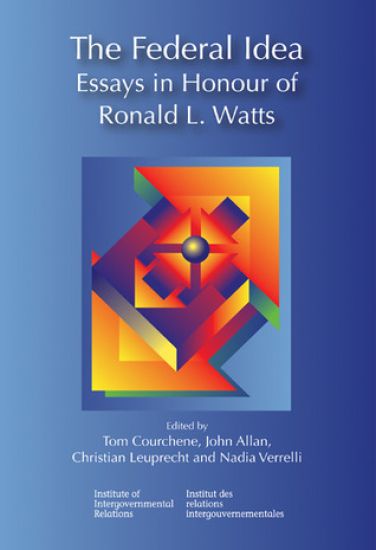
The first section, Celebrating Ron Watts, assesses Ronald Watts' academic contributions to the study of federalism (including comparative federalism) as well as his important role as an advisor to federations across the globe. The second section, The Federal Idea: Concepts, explores different perspectives on federalism, both constitutional and citizen-related, and assesses the successes and failures of the federal idea. The final section, The Federal Idea: Practice, addresses a range of policies and practices in individual federations. In addition to case studies, the contributors deal with such issues as fiscal federalism, intergovernmental relations, federalism in the European Union, Scottish devolution, and the differing approaches to upper chambers.
The first section, Celebrating Ron Watts, assesses Ronald Watts' academic contributions to the study of federalism (including comparative federalism) as well as his important role as an advisor to federations across the globe. The second section, The Federal Idea: Concepts, explores different perspectives on federalism, both constitutional and citizen-related, and assesses the successes and failures of the federal idea. The final section, The Federal Idea: Practice, addresses a range of policies and practices in individual federations. In addition to case studies, the contributors deal with such issues as fiscal federalism, intergovernmental relations, federalism in the European Union, Scottish devolution, and the differing approaches to upper chambers.
Initially prepared for an Institute of Intergovernmental Relations conference jointly sponsored by the Institute for Energy and Environmental Policy and Sustainable Prosperity, the papers presented here are by an outstanding group of those actively involved in conducting research and developing policy in this contested area. The issues are analyzed from legal, economic, and political perspectives, with particular attention paid to intergovernmental and international aspects.
Canada: The State of the Federation 2006/07 deals with transitions that have been initiated by a variety of factors and have profound implications. Scholars from several disciplines analyze the implications of these transitional forces, bringing historical, analytical, fiscal, and political perspectives to bear on issues arising from equalization and fiscal imbalance. Contributors examine the ramifications of recent major changes to equalization and show how these changes will have far-reaching and, in some cases, troubling implications. Further transitions arise in the area of federal-provincial relations as a result of Prime Minister Harper's commitment to "open federalism." In this context, contributors re-examine the role and use of federal spending power and explore whether the Canadian federation might be better served by a totally new approach to federalism. Finally, the implications of transitions affecting the role and place of cities in the Canadian federation are considered. Particular attention is given to the significance of the on-going information revolution, which privileges cities - most importantly "global city regions" - as the new, dynamic drivers of growth, innovation, and trade. Contributors include Marc-Antoine Adam (Queen's University), John R. Allan (Queen's University and University of Regina), Robin Boadway (Queen's University), Paul Boothe (University of Alberta), Thomas J. Courchene (Queen's University and Institute for Research on Public Policy), Gordon DiGiacomo (University of Ottawa), James P. Feehan (Memorial University), Anne Golden (The Conference Board of Canada), Paul A.R. Hobson (Acadia University), Christian Leuprecht (Royal Military College of Canada and Queen's University), L. Wade Locke (Memorial University), Janice MacKinnon (University of Saskatchewan), Al O'Brien (University of Alberta), Joe Ruggeri (University of New Brunswick), Anwar Shah (World Bank), Janice Gross Stein (University of Toronto), Garth Stevenson (Brock University), and Jean-François Tremblay (University of Ottawa).
Contributors include Douglas Gale (NYU) on regulation in the information era; David Smith (Federal Reserve Board) on the globalization of commercial banking; John Chant (Simon Fraser) on the internationalization of Canadian banking; Charles Goodhart (London School of Economics) on the economics of regulation; Ken Carow (Indiana University) on the banking-insurance nexus; Edwin Neave and Lewis Johnson (Queen's) on financial governance; and Charles Freedman (Bank of Canada), Tim O'Neill (Bank of Montreal) and Stephen Poloz (Export Development Canada) on the future of the Canadian financial sector.
Contributors include Douglas Gale (NYU) on regulation in the information era; David Smith (Federal Reserve Board) on the globalization of commercial banking; John Chant (Simon Fraser) on the internationalization of Canadian banking; Charles Goodhart (London School of Economics) on the economics of regulation; Ken Carow (Indiana University) on the banking-insurance nexus; Edwin Neave and Lewis Johnson (Queen's) on financial governance; and Charles Freedman (Bank of Canada), Tim O'Neill (Bank of Montreal) and Stephen Poloz (Export Development Canada) on the future of the Canadian financial sector.
The Art of the State includes contributions from Ron Daniels (University of Toronto) on corporate governance, Rick Harris (Simon Fraser University) on the new economic order, Pierre Marc Johnson (Heenan-Blaikie, Montreal law firm) on international governance and Canada, Michael Keating (European University Institute) on sub-national communities, Will Kymlicka (Queen's University) on new forms of citenzenship, B. Guy Peters (University of Pittsburg) on the changing nature of power and democracy, Christopher Pollitt (Erasmus University) on new forms of public services and Ronald Watts (Queen's University) on managing interdependence in a federal state. The publication also includes an introduction by conference co-chairs and editors Thomas J. Courchene and Donald J. Savoie.
What happens when the world changes in ways that make Canada's physical capital, natural resources, and geography - once the ultimate competitive advantages - less important than knowledge, information, technological know-how, and human capital? What happens to Canadians? In A State of Minds Thomas Courchene examines the political structures that link local, provincial, and federal governments and challenges many longstanding beliefs about how society should be organized and financed. While focusing on Canadian competitiveness in a global economy, Courchene shows us how an open federal state like Canada can achieve both economic prosperity and social justice. Always provocative, Courchene blends compelling analysis and reasoned insight with a prescription for change: To stay ahead of the competitive curve and protect the Canadian way of life, Canada must become a "state of minds."
Session I provides a wide-ranging survey of how North American integration impinges on a myriad of key policy areas and how this may influence Canada's room to manoeuvre. Session II focuses on the degree to which multinationals carry their home-country corporate culture and practices to their host-country environment. Session III addresses the telecomputational revolution and what it implies for Canadian policy in an information age. Session IV reflects on the on-going unbundling of post-war "embedded liberalism" and suggests alternative approaches in terms of which domestic regulatory sovereignty can be made consistent with the greater interplay of market forces ushered in by globalization. Session V articulates some principles and practices through which the Canadian tax system can be rendered consistent with domestic priorities on the one hand and challenges of economic integration and the increased information content of GDP on the other. In light of the introduction of the EURO as the common European Currency, session VI assesses the pros and cons of a Canada/US common currency. The final session grapples with the on-going Canadian policy challenge relating to the future evolution of the Canadian financial system. An integrative assessment of the conference proceedings rounds out this timely volume.
Session I provides a wide-ranging survey of how North American integration impinges on a myriad of key policy areas and how this may influence Canada's room to manoeuvre. Session II focuses on the degree to which multinationals carry their home-country corporate culture and practices to their host-country environment. Session III addresses the telecomputational revolution and what it implies for Canadian policy in an information age. Session IV reflects on the on-going unbundling of post-war "embedded liberalism" and suggests alternative approaches in terms of which domestic regulatory sovereignty can be made consistent with the greater interplay of market forces ushered in by globalization. Session V articulates some principles and practices through which the Canadian tax system can be rendered consistent with domestic priorities on the one hand and challenges of economic integration and the increased information content of GDP on the other. In light of the introduction of the EURO as the common European Currency, session VI assesses the pros and cons of a Canada/US common currency. The final session grapples with the on-going Canadian policy challenge relating to the future evolution of the Canadian financial system. An integrative assessment of the conference proceedings rounds out this timely volume.
When will the fiscal dividend appear and what is its likely magnitude? Should deficit targets be replaced by debt targets or debt/GDP targets? Should the fiscal dividend focus on tax cuts and increases in program expenditures? Should the Canadian government shift away from an annual deficit target to budget balance over the cycle to allow automatic stabilizers to play their important buffering role? And if so, what level of contingency reserve is necessary to ensure that cyclical budget balance can be met? Addressing these and other important questions, Fiscal Targets and Economic Growth provides valuable insights into labour force trends, productivity, long-term projections, automatic stabilizers, fiscal prudence, Optimal debt ratios, and investing the fiscal dividend.
When will the fiscal dividend appear and what is its likely magnitude? Should deficit targets be replaced by debt targets or debt/GDP targets? Should the fiscal dividend focus on tax cuts and increases in program expenditures? Should the Canadian government shift away from an annual deficit target to budget balance over the cycle to allow automatic stabilizers to play their important buffering role? And if so, what level of contingency reserve is necessary to ensure that cyclical budget balance can be met? Addressing these and other important questions, Fiscal Targets and Economic Growth provides valuable insights into labour force trends, productivity, long-term projections, automatic stabilizers, fiscal prudence, Optimal debt ratios, and investing the fiscal dividend.
In this collection of essays leading Canadian policy analysts focus on a range of issues and implications arising from the 1997 federal budget. Essays include a comparative assessment of the Paul Martin and Michael Wilson budgets, an assessment of the emerging fiscal dividend and an evaluation of alternative ways in which it can be spent, a comprehensive overview of the proposed child benefits package, an in-depth examination of new proposals for both the Canada Pension Plan/Quebec Pension Plan and employment insurance, and an empirical review of the fiscal stance as it relates to employment and the output gap. Essays also examine provincial budget issues, including a retrospective on the series of budgets tabled by retiring Alberta treasurer Jim Dinning and an overview of the deficit and deficit performance of the provinces over the last decade.
In this collection of essays leading Canadian policy analysts focus on a range of issues and implications arising from the 1997 federal budget. Essays include a comparative assessment of the Paul Martin and Michael Wilson budgets, an assessment of the emerging fiscal dividend and an evaluation of alternative ways in which it can be spent, a comprehensive overview of the proposed child benefits package, an in-depth examination of new proposals for both the Canada Pension Plan/Quebec Pension Plan and employment insurance, and an empirical review of the fiscal stance as it relates to employment and the output gap. Essays also examine provincial budget issues, including a retrospective on the series of budgets tabled by retiring Alberta treasurer Jim Dinning and an overview of the deficit and deficit performance of the provinces over the last decade.
John Chant (SFU) presents an insightful conceptual framework for financial policy in the millennium; Jeffrey MacIntosh (U of T) provides a comprehensive assessment of the pros and cons of a National Securities Commission; Maurice Levi (UBC) focuses on capital-market integration; Randall Morck (U of A) looks at international financial regulation; Harry Hassanwalia (Royal Bank) examines competition in Canadian financial markets; and Nick LePan (OSFI) and Charles Freedman (Bank of Canada) provide perspectives on regulation. Discussants for these papers are practitioners in the financial sector and Steve Poloz (Bank Credit Analysts Research Group) is the conference rapporteur.
Richard Cooper (Harvard) examines government, markets, and citizens in the millennium; Mark Zacher (UBC), Ronald McKinnon (Stanford), and Sylvia Ostry (U of T) provide three perspectives on the changing nature of supra-natural economic and political space; Paul Boothe (U of A) focuses on alternative ways to finance the shift toward a more decentralized federation; David Wolfe (U of T) reflects on the emergence of the region state; Keith Banting (Queen's) examines the evolution of the social contract; and Richard Simeon (U of T) discusses implications of the information revolution for sovereignty and democracy. Appended to each paper are comments of the assigned discussant and an edited version of the floor discussion. Robert Young (Western) is the volume rapporteur.