Kirjailija
Thomas J. Sargent
Kirjat ja teokset yhdessä paikassa: 15 kirjaa, julkaisuja vuosilta 1987-2025, suosituimpien joukossa Makroökonomik. Vertaile teosten hintoja ja tarkista saatavuus suomalaisista kirjakaupoista.
Mukana myös kirjoitusasut: Thomas J Sargent
15 kirjaa
Kirjojen julkaisuhaarukka 1987-2025.
Dynamic programming (DP) is a sub-field of optimization concerned with sequential decision making over time. The essential ideas of DP have been adopted in many applications, from robotics and AI to the sequencing of DNA. It is used around the world to control aircraft, route shipping, test products, recommend information on media platforms and solve major research problems. Dynamic Programming: Finite States treats the theory of dynamic programming and its applications in economics, finance, and operations research. It contains classical results on dynamic programming as well as extensions created by researchers and practitioners as they wrestle with formulating and solving dynamic models that can explain patterns observed in data. Adopting an abstract framework that provides great generality, this book facilitates rapid progress to the research frontier by combining rigorous theory with numerous applications, many solved exercises, and detailed open-source computer code.
It has become increasingly clear that economies can fruitfully be viewed as networks, consisting of millions of nodes (households, firms, banks, etc.) connected by business, social, and legal relationships. These relationships shape many outcomes that economists often measure. Over the past few years, research on production networks has flourished, as economists try to understand supply-side dynamics, default cascades, aggregate fluctuations, and many other phenomena. Economic Networks provides a brisk introduction to network analysis that is self-contained, rigorous, and illustrated with many figures, diagrams and listings with computer code. Network methods are put to work analyzing production networks, financial networks, and other related topics (including optimal transport, another highly active research field). Visualizations using recent data bring key ideas to life.
The substantially revised fourth edition of a widely used text, offering both an introduction to recursive methods and advanced material, mixing tools and sample applications.Recursive methods provide powerful ways to pose and solve problems in dynamic macroeconomics. Recursive Macroeconomic Theory offers both an introduction to recursive methods and more advanced material. Only practice in solving diverse problems fully conveys the advantages of the recursive approach, so the book provides many applications. This fourth edition features two new chapters and substantial revisions to other chapters that demonstrate the power of recursive methods.One new chapter applies the recursive approach to Ramsey taxation and sharply characterizes the time inconsistency of optimal policies. These insights are used in other chapters to simplify recursive formulations of Ramsey plans and credible government policies. The second new chapter explores the mechanics of matching models and identifies a common channel through which productivity shocks are magnified across a variety of matching models. Other chapters have been extended and refined. For example, there is new material on heterogeneous beliefs in both complete and incomplete markets models; and there is a deeper account of forces that shape aggregate labor supply elasticities in lifecycle models.The book is suitable for first- and second-year graduate courses in macroeconomics. Most chapters conclude with exercises; many exercises and examples use Matlab or Python computer programming languages.
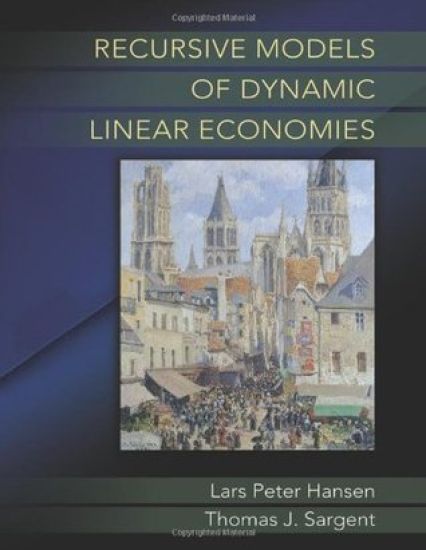
Recursive Models of Dynamic Linear Economies
Lars Peter Hansen; Thomas J. Sargent
Princeton University Press
2018
pokkari
A guide to the economic modeling of household preferences, from two leaders in the fieldA common set of mathematical tools underlies dynamic optimization, dynamic estimation, and filtering. In Recursive Models of Dynamic Linear Economies, Lars Peter Hansen and Thomas Sargent use these tools to create a class of econometrically tractable models of prices and quantities. They present examples from microeconomics, macroeconomics, and asset pricing. The models are cast in terms of a representative consumer. While Hansen and Sargent demonstrate the analytical benefits acquired when an analysis with a representative consumer is possible, they also characterize the restrictiveness of assumptions under which a representative household justifies a purely aggregative analysis.Hansen and Sargent unite economic theory with a workable econometrics while going beyond and beneath demand and supply curves for dynamic economies. They construct and apply competitive equilibria for a class of linear-quadratic-Gaussian dynamic economies with complete markets. Their book, based on the 2012 Gorman lectures, stresses heterogeneity, aggregation, and how a common structure unites what superficially appear to be diverse applications. An appendix describes MATLAB programs that apply to the book's calculations.
The standard theory of decision making under uncertainty advises the decision maker to form a statistical model linking outcomes to decisions and then to choose the optimal distribution of outcomes. This assumes that the decision maker trusts the model completely. But what should a decision maker do if the model cannot be trusted? Lars Hansen and Thomas Sargent, two leading macroeconomists, push the field forward as they set about answering this question. They adapt robust control techniques and apply them to economics. By using this theory to let decision makers acknowledge misspecification in economic modeling, the authors develop applications to a variety of problems in dynamic macroeconomics. Technical, rigorous, and self-contained, this book will be useful for macroeconomists who seek to improve the robustness of decision-making processes.
Uncertainty Within Economic Models
Lars Peter Hansen; Thomas J Sargent
World Scientific Publishing Co Pte Ltd
2014
sidottu
Written by Lars Peter Hansen (Nobel Laureate in Economics, 2013) and Thomas Sargent (Nobel Laureate in Economics, 2011), Uncertainty within Economic Models includes articles adapting and applying robust control theory to problems in economics and finance. This book extends rational expectations models by including agents who doubt their models and adopt precautionary decisions designed to protect themselves from adverse consequences of model misspecification. This behavior has consequences for what are ordinarily interpreted as market prices of risk, but big parts of which should actually be interpreted as market prices of model uncertainty. The chapters discuss ways of calibrating agents' fears of model misspecification in quantitative contexts.
Recursive Models of Dynamic Linear Economies
Lars Peter Hansen; Thomas J. Sargent
Princeton University Press
2013
sidottu
A common set of mathematical tools underlies dynamic optimization, dynamic estimation, and filtering. In Recursive Models of Dynamic Linear Economies, Lars Peter Hansen and Thomas Sargent use these tools to create a class of econometrically tractable models of prices and quantities. They present examples from microeconomics, macroeconomics, and asset pricing. The models are cast in terms of a representative consumer. While Hansen and Sargent demonstrate the analytical benefits acquired when an analysis with a representative consumer is possible, they also characterize the restrictiveness of assumptions under which a representative household justifies a purely aggregative analysis. Hansen and Sargent unite economic theory with a workable econometrics while going beyond and beneath demand and supply curves for dynamic economies. They construct and apply competitive equilibria for a class of linear-quadratic-Gaussian dynamic economies with complete markets. Their book, based on the 2012 Gorman lectures, stresses heterogeneity, aggregation, and how a common structure unites what superficially appear to be diverse applications. An appendix describes MATLAB programs that apply to the book's calculations.
This collection of essays uses the lens of rational expectations theory to examine how governments anticipate and plan for inflation, and provides insight into the pioneering research for which Thomas Sargent was awarded the 2011 Nobel Prize in economics. Rational expectations theory is based on the simple premise that people will use all the information available to them in making economic decisions, yet applying the theory to macroeconomics and econometrics is technically demanding. Here, Sargent engages with practical problems in economics in a less formal, noneconometric way, demonstrating how rational expectations can satisfactorily interpret a range of historical and contemporary events. He focuses on periods of actual or threatened depreciation in the value of a nation's currency. Drawing on historical attempts to counter inflation, from the French Revolution and the aftermath of World War I to the economic policies of Margaret Thatcher and Ronald Reagan, Sargent finds that there is no purely monetary cure for inflation; rather, monetary and fiscal policies must be coordinated. This fully expanded edition of Rational Expectations and Inflation includes Sargent's 2011 Nobel lecture, "United States Then, Europe Now." It also features new articles on the macroeconomics of the French Revolution and government budget deficits.
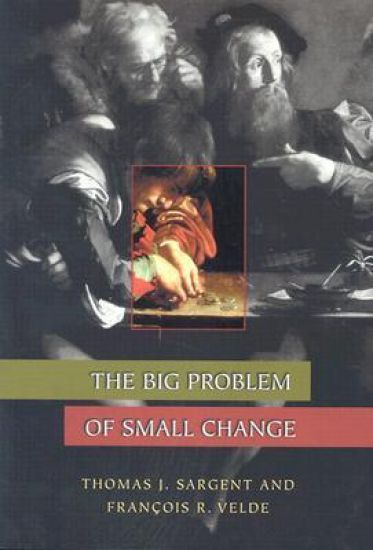
The Big Problem of Small Change
Thomas J. Sargent; François R. Velde
Princeton University Press
2003
pokkari
The Big Problem of Small Change offers the first credible and analytically sound explanation of how a problem that dogged monetary authorities for hundreds of years was finally solved. Two leading economists, Thomas Sargent and Francois Velde, examine the evolution of Western European economies through the lens of one of the classic problems of monetary history--the recurring scarcity and depreciation of small change. Through penetrating and clearly worded analysis, they tell the story of how monetary technologies, doctrines, and practices evolved from 1300 to 1850; of how the "standard formula" was devised to address an age-old dilemma without causing inflation. One big problem had long plagued commodity money (that is, money literally worth its weight in gold): governments were hard-pressed to provide a steady supply of small change because of its high costs of production. The ensuing shortages hampered trade and, paradoxically, resulted in inflation and depreciation of small change. After centuries of technological progress that limited counterfeiting, in the nineteenth century governments replaced the small change in use until then with fiat money (money not literally equal to the value claimed for it)--ensuring a secure flow of small change. But this was not all. By solving this problem, suggest Sargent and Velde, modern European states laid the intellectual and practical basis for the diverse forms of money that make the world go round today. This keenly argued, richly imaginative, and attractively illustrated study presents a comprehensive history and theory of small change. The authors skillfully convey the intuition that underlies their rigorous analysis. All those intrigued by monetary history will recognize this book for the standard that it is.
In the past fifteen years, inflation has been conquered by many advanced countries. History reveals, however, that it has been conquered before and returned. In The Conquest of American Inflation, Thomas J. Sargent presents a groundbreaking analysis of the rise and fall of U.S. inflation after 1960. He examines two broad explanations for the behavior of inflation and unemployment in this period: the natural-rate hypothesis joined to the Lucas critique and a more traditional econometric policy evaluation modified to include adaptive expectations and learning. His purpose is not only to determine which is the better account, but also to codify for the benefit of the next generation the economic forces that cause inflation. Sargent begins with an explanation of how American policymakers increased inflation in the early 1960s by following erroneous assumptions about the exploitability of the Phillips curve--the inverse relationship between inflation and unemployment. In subsequent chapters, he connects a sequence of ideas--self-confirming equilibria, least-squares and other adaptive or recursive learning algorithms, convergence of least-squares learners with self-confirming equilibria, and recurrent dynamics along escape routes from self-confirming equilibria. Sargent synthesizes results from macroeconomics, game theory, control theory, and other fields to extend both adaptive expectations and rational expectations theory, and he compellingly describes postwar inflation in terms of drifting coefficients. He interprets his results in favor of adaptive expectations as the relevant mechanism affecting inflation policy. Providing an original methodological link between theoretical and policy economics, this book will engender much debate and become an indispensable text for academics, graduate students, and professional economists.
Exercises in Dynamic Macroeconomic Theory
Rodolfo E. Manuelli; Thomas J. Sargent
Harvard University Press
1987
nidottu
This book is a companion volume to Dynamic Macroeconomic Theory by Thomas J. Sargent. It provides scrimmages in dynamic macroeconomic theory--precisely the kind of drills that people will need in order to learn the techniques of dynamic programming and its applications to economics. By doing these exercises, the reader can acquire the ability to put the theory to work in a variety of new situations, build technical skill, gain experience in fruitful ways of setting up problems, and learn to distinguish cases in which problems are well posed from cases in which they are not. The basic framework provided by variants of a dynamic general equilibrium model is used to analyze problems in macroeconomics and monetary economics. An equilibrium model provides a mapping from parameters of preferences, technologies, endowments, and "rules of the game" to a probability model for time series. The rigor of the logical connections between theory and observations that the mapping provides is an attractive feature of dynamic equilibrium, or "rational expectations," models. This book gives repeated and varied practice in constructing and interpreting this mapping.
The tasks of macroeconomics are to interpret observations on economic aggregates in terms of the motivations and constraints of economic agents and to predict the consequences of alternative hypothetical ways of administering government economic policy. General equilibrium models form a convenient context for analyzing such alternative government policies. In the past ten years, the strengths of general equilibrium models and the corresponding deficiencies of Keynesian and monetarist models of the 1960s have induced macroeconomists to begin applying general equilibrium models.This book describes some general equilibrium models that are dynamic, that have been built to help interpret time-series of observations of economic aggregates and to predict the consequences of alternative government interventions. The first part of the book describes dynamic programming, search theory, and real dynamic capital pricing models. Among the applications are stochastic optimal growth models, matching models, arbitrage pricing theories, and theories of interest rates, stock prices, and options. The remaining parts of the book are devoted to issues in monetary theory; currency-in-utility-function models, cash-in-advance models, Townsend turnpike models, and overlapping generations models are all used to study a set of common issues. By putting these models to work on concrete problems in exercises offered throughout the text, Thomas Sargent provides insights into the strengths and weaknesses of these models of money. An appendix on functional analysis shows the unity that underlies the mathematics used in disparate areas of rational expectations economics.This book on dynamic equilibrium macroeconomics is suitable for graduate-level courses; a companion book, Exercises in Dynamic Macroeconomic Theory, provides answers to the exercises and is also available from Harvard University Press.