Kirjojen hintavertailu. Mukana 12 595 353 kirjaa ja 12 kauppaa.

Kirjailija

Thomas J. Volgy

Kirjat ja teokset yhdessä paikassa: 5 kirjaa, julkaisuja vuosilta 1993-2023, suosituimpien joukossa Mapping the New World Order. Vertaile teosten hintoja ja tarkista saatavuus suomalaisista kirjakaupoista.

5 kirjaa

Kirjojen julkaisuhaarukka 1993-2023.

Regions, Power, and Conflict

Regions, Power, and Conflict

William R. Thompson; Thomas J. Volgy; Paul Bezerra; Jacob Cramer; Kelly Marie Gordell; Manjeet Pardesi; Karen Rasler; J. Patrick Rhamey Jr.; Kentaro Sakuwa; Rachel Van Nostrand; Leila Zakhirova

SPRINGER VERLAG, SINGAPORE
2023
nidottu
The three main levels of analysis in international relations have been the systemic, the national, and the individual. A fourth level that falls between the systemic and the national is the region. It is woefully underdeveloped in comparison to the attention afforded the other three. Yet regions tend to be distinctive theaters for international politics. Otherwise, we would not recognize that Middle Eastern interstate politics somehow does not resemble Latin American interstate politics or interstate politics in Southern Africa (although once the Middle East and Southern Africa may have seemed more similar in their mutual fixation with opposition to domestic policies in Israel and South Africa, respectively). This book, divided into three parts, first makes a case for studying regional politics even though it must also be appreciated that regional boundaries are also hazy and not always easy to pin down empirically. The second part examines power distributions within regions as an important entry point to studying regional similarities and differences. Two emphases are stressed. One is that regional power assessments need to be conditioned by controlling for weak states which are more common in some regions than they are in others. The other emphasis is on regional power hierarchies. Some regions have strong regional hierarchies while others do not. Regions with strong hierarchies operate much differently from those without them in the sense that the former are more pacific than the latter. The third part of the book focuses on regional differences in terms of conflict behavior, order preferences, rivalries, and rivalry termination.
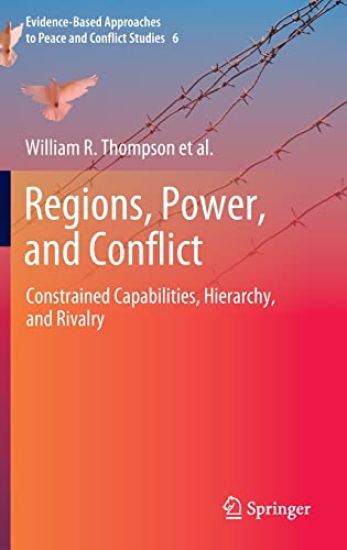
Regions, Power, and Conflict

Regions, Power, and Conflict

William R. Thompson; Thomas J. Volgy; Paul Bezerra; Jacob Cramer; Kelly Marie Gordell; Manjeet Pardesi; Karen Rasler; J. Patrick Rhamey Jr.; Kentaro Sakuwa; Rachel Van Nostrand; Leila Zakhirova

SPRINGER VERLAG, SINGAPORE
2022
sidottu
The three main levels of analysis in international relations have been the systemic, the national, and the individual. A fourth level that falls between the systemic and the national is the region. It is woefully underdeveloped in comparison to the attention afforded the other three. Yet regions tend to be distinctive theaters for international politics. Otherwise, we would not recognize that Middle Eastern interstate politics somehow does not resemble Latin American interstate politics or interstate politics in Southern Africa (although once the Middle East and Southern Africa may have seemed more similar in their mutual fixation with opposition to domestic policies in Israel and South Africa, respectively). This book, divided into three parts, first makes a case for studying regional politics even though it must also be appreciated that regional boundaries are also hazy and not always easy to pin down empirically. The second part examines power distributions within regions as an important entry point to studying regional similarities and differences. Two emphases are stressed. One is that regional power assessments need to be conditioned by controlling for weak states which are more common in some regions than they are in others. The other emphasis is on regional power hierarchies. Some regions have strong regional hierarchies while others do not. Regions with strong hierarchies operate much differently from those without them in the sense that the former are more pacific than the latter. The third part of the book focuses on regional differences in terms of conflict behavior, order preferences, rivalries, and rivalry termination.
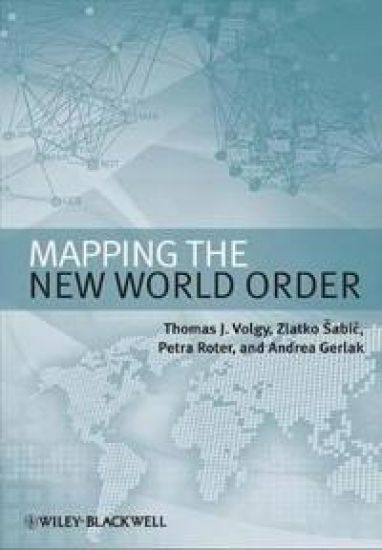
Mapping the New World Order

Mapping the New World Order

Thomas J. Volgy; Zlatko Šabic; Petra Roter; Andrea K. Gerlak

Wiley-Blackwell (an imprint of John Wiley Sons Ltd)
2009
nidottu
This groundbreaking study maps out and analyzes the development of a global intergovernmental (IGO) institutional architecture in the post World War II era. Systematically traces similarities and differences between the institutional architecture of the Cold War and post-Cold War erasExamines the range of reasons why states join IGOs, identifies patterns of participation within these organizations, and examines the effects of membership on statesConsiders the impact of the EU on other regional organizations and developments outside EuropeProvides a strong contribution to the study of international organization and IGO development combining both quantitative and qualitative methodologies
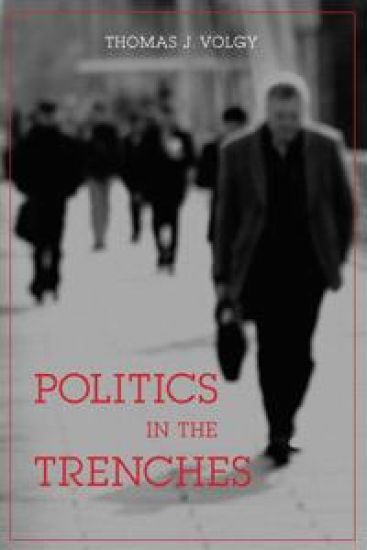
Politics in the Trenches

Politics in the Trenches

Thomas J. Volgy

University of Arizona Press
2001
nidottu
Ask most Americans what they think of politics and you'll likely get an earful. With suspicion and distrust of public servants running high, many citizens seem dispirited by the very process that has made the United States a showcase for democracy. Now ask Tom Volgy. This former mayor of a major western city, who is also a political scientist, contends that most elected officials are the very opposite of what the public thinks: honest, hardworking people whose real work goes unnoticed by most of their constituents and the media. Volgy has interviewed more than 300 elected officials mayors, city council members, legislators from all over the United States to offer a decidedly contrarian view of politics. He explores the lives and working conditions of elected officials at the local level the area of democracy closest to the public to show that officeholders are for the most part average citizens, not the slick lawyers or political pros we usually imagine them to be. Most are motivated by a sense of civic duty, and they often work for token salaries, yet once elected they give up their personal lives and fall prey to every conceivable brickbat of public and media outrage. In Politics in the Trenches, Volgy shows what really happens behind the scenes of government. He contrasts perception with reality regarding the rewards and perks of office. He examines the process of experimentation in the political laboratory and shows how the news media distort it. He provides a case study of homelessness to illustrate the system's constraints and limitations. And he offers a chapter on a typical week in office that will be an eye-opener for most readers. Although admittedly there are many flaws in the democratic political process, observes Volgy, all are correctable as long as citizens believe in the essential worth of the system itself. His book offers a fresh perspective on democratic governance and tackles tough issues such as campaign finance reform, urging citizens to understand the process before they condemn its players out of hand. More than that, this is a call to action, warning us that we could lose true democracy if we don't get involved.
The Forgotten Americans

The Forgotten Americans

John E. Schwarz; Thomas J. Volgy

WW Norton Co
1993
nidottu
Does the American Dream still exist when nearly 30 million Americans live in families in which workers find a paycheck and poverty in the same envelope? Just as Michael Harrington's The Other America shocked the nation with its disclosure of poverty in the 1960s, John E. Schwarz and Thomas J. Volgy's The Forgotten Americans exposes the breadth of poverty that exists today among responsible, hardworking Americans. At the end of the prosperous 1980s, the number of Americans living in working-poor families equaled the combined populations of the nation's 25 largest cities. Contrary to conventional wisdom, this situation is not largely confined to minorities, women, the undereducated or young adults. It is commonplace for workers from nearly all segments of society to be employed in low-paying jobs even during good economic times. The Forgotten Americans reveals the betrayal of the hopes and expectations of these industrious people through broad-based factual evidence and the real-life stories of individual families. Their hardship has been ignored at enormous cost to them and the country. Numerous problems at the forefront of national debate—welfare dependency, crime, and the inadequate performance of many American school children—are closely connected to the existence of working poverty on a large scale. Unless corrective action is taken, the country risks the creation of a deeply fractured society arising from the despair of millions of employed people who have discovered that practicing the work ethic yields little reward. The problem is staggering and often misunderstood by politicians, the media, and the public. Once Schwarz and Volgy have outlined the implications of this social and economic tragedy, they propose effective solutions that require simple changes to existing policies—solutions that are politically feasible and can be accomplished without new taxes.