Kirjojen hintavertailu. Mukana 12 390 323 kirjaa ja 12 kauppaa.

Kirjailija

Thomas K Shor

Kirjat ja teokset yhdessä paikassa: 9 kirjaa, julkaisuja vuosilta 2018-2022, suosituimpien joukossa The Baba Downstairs. Vertaile teosten hintoja ja tarkista saatavuus suomalaisista kirjakaupoista.

9 kirjaa

Kirjojen julkaisuhaarukka 2018-2022.

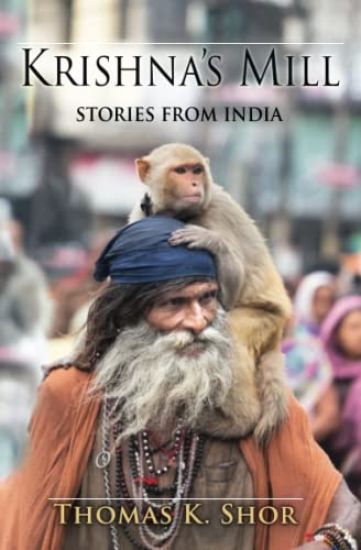
Krishna's Mill

Krishna's Mill

Thomas K Shor

City Lion Press
2022
pokkari
Short Stories from IndiaThe people you meet...A yogi in his Himalayan retreat who was once a millionaire Bombay cloth manufacturer, forced to return to keep his sons from killing each other over the empire he left behind.An American Buddhist, a "Defender of the Dharma," who confesses having defended his life, with death, and knows the feeling of a knife going into human flesh.A long-haired Indian artist and philosopher who sings ecstatically the poems of the English Romantics, reads Sanskrit and German philosophers in the original, and paints miniature paintings made entirely from tiny dots that are but two-dimensional slices of the world he sees within the 'Interior of the Dot.'And the places you go...From the exclusive Breach Candy Club on Bombay's Arabian Sea, to a zoo in Darjeeling where an ancient Siberian Tiger lays dying...and to a remote Himalayan village where it is said that in some dim antiquity the early inhabitants built their very own Tower of Babel made of clay pots, meant to reach Heaven.Is there really a temple complex and mountain in South India said to be underlaid by a vast network of tunnels so old their existence is clothed in legend and through which an entire population was said to disappear?
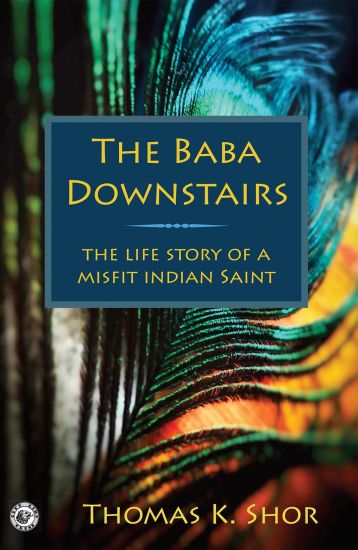
The Baba Downstairs

The Baba Downstairs

Thomas K Shor

City Lion Press
2022
sidottu
This book tells the true story of an Indian man named Vikram, whose strange fate it was to be born with a large birthmark identical to the birthmark of the holy man, or baba, who died immediately after blessing Vikram's mother to have a son. So from the very beginning, Vikram was raised as the old baba's reincarnation.At first Vikram goes along with it. He even believes it. He tries, in his childish way, to play the part. But when he probes his suspicions and discovers he possesses no special powers or insights, his course is set for rebellion. He becomes a wrestler, an engineer, embraces communism and atheism, and explores existentialism. He goes deaf, falls in love, and probes the darker side of human nature, always dogged by the stamp on his arm, his mind attuned to the deeper questions of life and the search for something foundational.Determined to do everything a baba is not supposed to do, he enters what he calls "the Inferno of the Passions," a course that leads him to the very threshold of death. Having spent much of his life trying to "kill the baba," to rid himself of this adjective that was imposed upon him at birth, in the end he himself is transformed with an illumination, an opening to the underlying oneness such as that experienced by the Indian mystics and the Taoist philosopher Lao Tzu.When Vikram moves in downstairs, the author's quiet writing routine in his home in a sprawling Himalayan village is disrupted. At their first meeting, this odd stranger, now quite old and near the end of his days, shoves a book of mystic philosophy that he himself wrote into the author's hands and begins his tale. The author listens, takes up his pen, and weaves the stories together into this fascinating narrative, at once entertaining and enlightening.
The Baba Downstairs

The Baba Downstairs

Thomas K Shor

City Lion Press
2022
pokkari
This book tells the true story of an Indian man named Vikram, whose strange fate it was to be born with a large birthmark identical to the birthmark of the holy man, or baba, who died immediately after blessing Vikram's mother to have a son. So from the very beginning, Vikram was raised as the old baba's reincarnation.At first Vikram goes along with it. He even believes it. He tries, in his childish way, to play the part. But when he probes his suspicions and discovers he possesses no special powers or insights, his course is set for rebellion. He becomes a wrestler, an engineer, embraces communism and atheism, and explores existentialism. He goes deaf, falls in love, and probes the darker side of human nature, always dogged by the stamp on his arm, his mind attuned to the deeper questions of life and the search for something foundational.Determined to do everything a baba is not supposed to do, he enters what he calls "the Inferno of the Passions," a course that leads him to the very threshold of death. Having spent much of his life trying to "kill the baba," to rid himself of this adjective that was imposed upon him at birth, in the end he himself is transformed with an illumination, an opening to the underlying oneness such as that experienced by the Indian mystics and the Taoist philosopher Lao Tzu.When Vikram moves in downstairs, the author's quiet writing routine in his home in a sprawling Himalayan village is disrupted. At their first meeting, this odd stranger, now quite old and near the end of his days, shoves a book of mystic philosophy that he himself wrote into the author's hands and begins his tale. The author listens, takes up his pen, and weaves the stories together into this fascinating narrative, at once entertaining and enlightening.
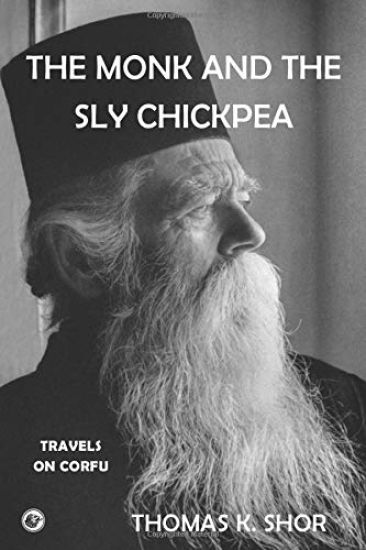
The Monk and the Sly Chickpea

The Monk and the Sly Chickpea

Thomas K Shor

City Lion Press
2019
pokkari
THE MONK AND THE SLY CHICKPEA tells the story of a journey the author and photographer Thomas K. Shor took in 1981 as a young man to the Greek island of Corfu. His journey starts in an idyllic coastal village in a house surrounded by lush fruit and olive trees.While many a young man's journey to Greece would feature a coastal village and even a strip of white beach, Thomas K. Shor's journey led him, with a certain inevitability, to the island's highest mountain, the wind-swept and craggy Mount Pantokrator, and to the ancient stone monastery that crowns its peak. It was there that he lived with the monastery's sole inhabitant of over forty years, the fiery-eyed Greek Orthodox monk Evthokimos Koskinas, a man of both the mountain and of God. From that stormy peak, often pounded by bolder-splitting lightning, sharing meals of chickpeas seasoned with the mountain's wild herbs drenched in olive oil, Shor comes to some startlingly profound insights for a young man of twenty-two.THE MONK AND THE SLY CHICKPEA, which is revised and has a new Postscript describing the author's return to Corfu and his encounters with the monk after twenty years, was originally published as Part I of the book WINDBLOWN CLOUDS by Escape Media Publishers, USA, in 2003.FROM THE REVIEW BY THE RENOWNED BRITISH POET KATHLEEN RAINE: In Thomas Shor's narrative the absorbing writing is the least of his gifts: he creates the imaginative adventure of his life as he lives it. He plunges into the story almost by accident, leaving a steamer bound for Athens by mistake at Corfu. But in Thomas Shor's life there are no mistakes, only opportunities, and before long we find him sharing the life of the last surviving monk at a monastery high on Mount Pantokrator, his meals of chick peas, garlic and olive oil, his toils, and the dense fogs and storms of the highest mountain on Corfu. The old monk wants him to become his successor, but life runs on, leading perhaps inevitably to the Indian sub-continent.Thomas Shor's life is a continual unfolding of those inner and outer worlds which his sense of wonder discovers continually. His story reminds us that we are, or could be, travelers in a world of marvels, of love, and encounters with men and women themselves on pilgrimages of the imagination. Did not the Emperor Haroun al-Rashid for a thousand and one nights hear in the city of Baghdad endless stories that make up the one story of the world? Once involved in Thomas Shor's adventure of life, one hopes only for more.Kathleen Raine (D.Litt., Cambridge; Commander of the Ordre des Arts et des Lettres, France; Commander of the British Empire; Winner--Queen's Gold Medal for Poetry, England, etc.)
Sculpture Garden of the Gods

Sculpture Garden of the Gods

Thomas K Shor

City Lion Press
2018
pokkari
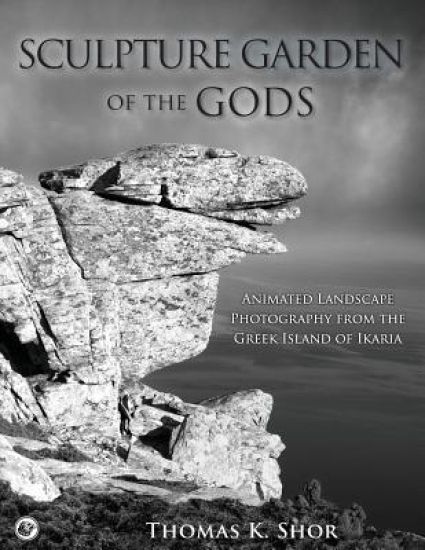
The Greek island of Ikaria has gained notoriety lately for being a so-called "Blue Zone," one of the select places on the planet where people live the longest. This otherwise obscure island was also known to the Ancients as the birthplace of the Greek god of ecstasy and wine, Dionysus, who was born upon the rocky ridge of mountain that runs down the center of the island. SCULPTURE GARDEN OF THE GODS, a book of black and white photographs, and prose, is the fruit of writer and photographer Thomas K. Shor's three winters upon this mountain--often blown by hurricane-force winds and engulfed in thick fog. Shor weaves the poetic force of his eye with that of his pen to take us on a journey to this otherworldly landscape, where lashing winds sculpt solid granite into forms that look like living beings with an uncanny regularity. It is a place of mystery and beauty, where the most enduring is dissolved by the most fleeting, where wisps of fog blown by a gale can cause an entire mountainside to disappear in an instant. It is a landscape that elicits a deep sense of wonder. Not only do great expanses of space open out on this mountain, but time opens out as well: Fresh cracks occur and are rounded by the years. Rocks balance for centuries before succumbing to a fissure. Stories are told in stone that are thousands of years old, forming a continuity from geologic times to our own. The rock formations are so strange and improbable--in seeming defiance of the logic that shapes landscapes--that one cannot help but wish one could go there with a geologist who could explain how it could have been left that way by nature, how such forms occur, how one huge granite boulder could have been left balancing so delicately upon another. Yet to have the eye of a geologist, to 'understand' the ravages of time that quite certainly led to this hauntingly beautiful and otherworldly landscape, would threaten the mystery of the place. SCULPTURE GARDEN OF THE GODS, with its 190 black-and-white photographs, takes us on a journey to this mythic yet very real landscape which gave birth to Dionysus, where the animating wind has been sculpting matter for untold millennia, giving breath to stone and bringing it to life.
Leopard in the City

Leopard in the City

Thomas K Shor

City Lion Press
2018
pokkari
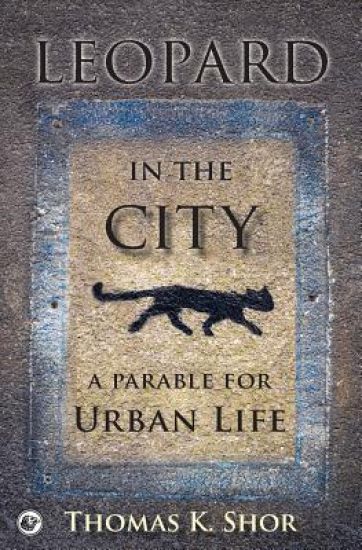
LEOPARD IN THE CITY is a fable for those longing to escape the urban tangle and return home to nature. Illustrated with over 45 black and white photographs, it tells the tale of a leopard, a real leopard of the jungle, who suddenly finds himself in the center of a modern Western metropolis, having to negotiate the rigid grid of streets. If seen, even by a single human being, he knows his fate would be sealed--either with a bullet through his heart or the sting of a tranquilizer gun, followed by a lifetime behind bars at the city zoo. And who can say which would be worse? In the zoo he would live out his days being gawked at as the famous mystery leopard from who-knows-where, the wild beast everybody read about in the newspapers that disrupted life in the city and then was caught. The longing for freedom leads him to the task of learning the ways of human beings, hoping that by understanding them he can discover a loophole, a way out. He figures out that long before human beings domesticated cats and dogs, they domesticated themselves. That's how they built their cities: by taming their own wild nature. They demand no less of whoever would live in their midst. Should he give up the dream of escape and follow the path of domestication as laid out by housecats, whose ancestors sacrificed their wild nature for security? Is it true, as the housecats would have it, that the way to salvation is captivity, to be free is to accept subjugation, and that safety is to be found not in liberty, but in confinement? Is it better to enjoy the comfortable fate of the housecat and live a privileged life of leisure with a secure place by the fire? What he needs--is a miracle. While the city in which these events unfold is imaginary and could be any modern metropolis, LEOPARD IN THE CITY is richly illustrated with photographs from the city of Vienna. And though the city is found on no map, can we say for certain that the leopard is also but a figment of someone's imagination? Who knows--he could be you or me.
Ganges Lament

Ganges Lament

Thomas K Shor

City Lion Press
2018
pokkari
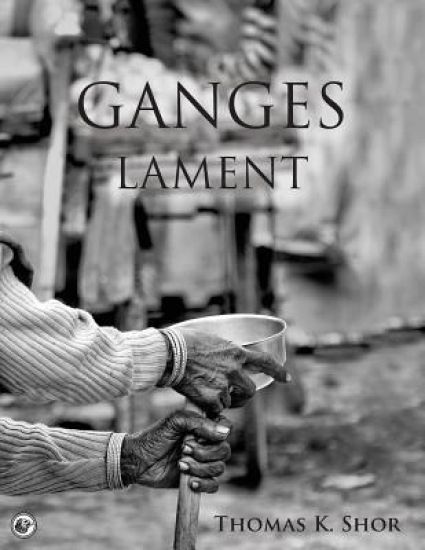
BLACK AND WHITE PHOTOGRAPHIC PORTRAITS FROM THE SACRED INDIAN CITY OF VARANASI THESE INTIMATE PORTRAITS from the alleys close to the Ganges River were taken in winter when the river mist rose into the alleys, often persisting throughout the day. These alleys are among the oldest continuously inhabited places on the planet. Varanasi is known as THE CITY OF LEARNING AND BURNING, referring both to the city's numerous schools, universities, ashrams, and pundits, as well as the many funeral pyres where faithful Hindus burn their dead by the river. Life and death are often juxtaposed in this chaotic and ancient city. While the photographs portray people from all walks of life--and from differing faiths, ages, and social standing--they are mostly of people that others tend to consider outcasts and shy away from: the poor, street-dwellers, beggars, rickshaw pullers, widows discarded by their families, mourners with their shaved heads. Though some of the portraits look as if they have been posed, none were. Most were taken quite spontaneously in the middle of the market's flow, often when the person was less than a pace away. A camera's shutter captures a sliver of time so thin that it is frozen. Yet in that thin slice of time something of our shared humanity, that which binds us together as human beings, can shine through. Sometimes it is the look of suffering in a photo that gives rise to that spark of compassion and shared humanity from the viewer; but it can as easily be a rickshaw driver's deep and thoughtful look that bridges the gap. The 114 photographs in Ganges Lament are in black-and-white, well suited to elicit the subtle emotions of those encountered, evoking the mood of the narrow passages of this ancient city in winter--with the gray, smoke-laden fog seeping up from the Ganges.