Kirjojen hintavertailu. Mukana 12 390 323 kirjaa ja 12 kauppaa.
Kirjailija
Thomas L. Krannawitter
Kirjat ja teokset yhdessä paikassa: 4 kirjaa, julkaisuja vuosilta 2005-2017, suosituimpien joukossa Vindicating Lincoln. Vertaile teosten hintoja ja tarkista saatavuus suomalaisista kirjakaupoista.
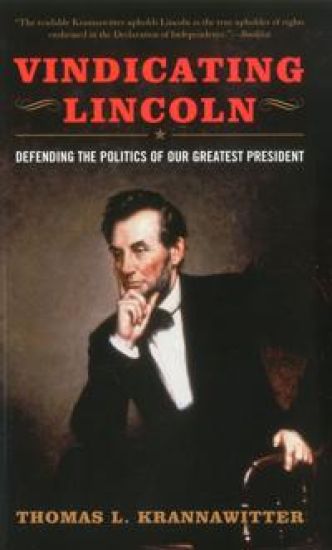
Was Abraham Lincoln a racist, as some critics would have us believe? Was he the father of big government, as some others maintain? Was the sixteenth president a traitor to the cause of free society and constitutional government? Are the political principles that guided him relevant today? In this provocative and timely book, Thomas L. Krannawitter sets out to defend the man many consider to be our greatest president from critics on both the left and the right. For although public opinion polls tend to rank Lincoln among the country's most venerated presidents, he is also, paradoxically, the president who is least understood. While Lincoln's name is frequently invoked in contemporary American politics, few Americans understand or agree with the moral and political principles for which Lincoln gave his last full measure of devotion. Many influential authors view Lincoln as an antiquated monument, a man of his age who knew only nineteenth-century prejudices and lacked twenty-first-century enlightenment. Other writers denounce Lincoln as a tyrant who trampled upon the Constitution and states' rights, and thereby inaugurated big government and the kind of politics feared by the Founding Fathers. Krannawitter argues that both views spring from a misunderstanding of Lincoln. Today, at precisely the moment when America is most in need of his moral and political understanding, we are more removed from Lincoln's thought than ever before. Vindicating Lincoln reintroduces us to Lincoln the statesman, the man who defended our greatest ideals of freedom and equality at the darkest moment in American history. Krannawitter shows us why it is in our interest not only to learn about Abraham Lincoln, but to learn from him—to understand that Lincoln's guiding principles were true not only for his time, but that they remain true for ours as well. On the eve of the bicentennial of his birth in 2009, Lincoln can offer moral and political guidance to us all.
A Nation Under God? raises the question of why the ACLU relentlessly attacks public expressions of mainstream religious faith. The answer, according to the book's argument, is that the work of the ACLU is informed by a larger political project-modern liberalism-to transform American government and society into an administrative-welfare state. Modern liberalism requires two decisive changes in American politics if it is to be successful: First, the government of limited powers mandated by the Constitution must become a government of unlimited powers and scope. Second, free, self-reliant, and independent citizens must become dependent on and understand themselves as subservient to government. The ACLU's drive to remove religion and morality from the public square advances both goals. Limited, constitutional government rests on the idea that rights come from God; the power of government should be limited commensurate to the limited purpose of legitimate government: to protect our natural, God-given rights. With God removed from the public square, it becomes much easier politically to argue that government is the source of rights, and that every expansion of government power is tantamount to an expansion of rights. Further, self-reliant citizens are not in need of and are unlikely to support large government welfare programs. But self-reliancy is largely a function of self-control and moral responsibility. Immoral and irresponsible citizens are incapable of providing for themselves and their families. Driving God and morality out of the public square serves to break down public morality, which in turn creates classes of citizens who are dependent on government assistance and regulation. Through endless litigation against public expressions of religion and morality and its distorted interpretations of the Establishment and Free Exercise Clauses, the ACLU reveals its real agenda and its real allegiance, which is not to the Constitution or Bill of Rights, but to a radical liberal ideology that seeks nothing less than the remaking of American government and society. This book is published in cooperation with The Claremont Institute.
A Nation Under God? raises the question of why the ACLU relentlessly attacks public expressions of mainstream religious faith. The answer, according to the book's argument, is that the work of the ACLU is informed by a larger political project-modern liberalism-to transform American government and society into an administrative-welfare state. Modern liberalism requires two decisive changes in American politics if it is to be successful: First, the government of limited powers mandated by the Constitution must become a government of unlimited powers and scope. Second, free, self-reliant, and independent citizens must become dependent on and understand themselves as subservient to government. The ACLU's drive to remove religion and morality from the public square advances both goals. Limited, constitutional government rests on the idea that rights come from God; the power of government should be limited commensurate to the limited purpose of legitimate government: to protect our natural, God-given rights. With God removed from the public square, it becomes much easier politically to argue that government is the source of rights, and that every expansion of government power is tantamount to an expansion of rights. Further, self-reliant citizens are not in need of and are unlikely to support large government welfare programs. But self-reliancy is largely a function of self-control and moral responsibility. Immoral and irresponsible citizens are incapable of providing for themselves and their families. Driving God and morality out of the public square serves to break down public morality, which in turn creates classes of citizens who are dependent on government assistance and regulation. Through endless litigation against public expressions of religion and morality and its distorted interpretations of the Establishment and Free Exercise Clauses, the ACLU reveals its real agenda and its real allegiance, which is not to the Constitution or Bill of Rights, but to a radical liberal ideology that seeks