Kirjojen hintavertailu. Mukana 12 314 220 kirjaa ja 12 kauppaa.

Kirjailija

Thomas Moynihan

Kirjat ja teokset yhdessä paikassa: 4 kirjaa, julkaisuja vuosilta 2019-2025, suosituimpien joukossa The History of Contingency and Future-Oriented Thought. Vertaile teosten hintoja ja tarkista saatavuus suomalaisista kirjakaupoista.

4 kirjaa

Kirjojen julkaisuhaarukka 2019-2025.

The History of Contingency and Future-Oriented Thought

The History of Contingency and Future-Oriented Thought

Thomas Moynihan

Cambridge University Press
2025
sidottu
The future is contingent. It can unfold differently, hinging on chance or choice within the present. This Element tells the story of how these twin concepts have developed across human history. Arcing from our earliest ancestors, through al-Ghazali, to S. J. Gould, the Element demonstrates how humans realised the future is an undecided, contingent place – at scales leading beyond the biographical, up to the planetary, and beyond. It pinpoints this realisation as an ongoing and unfinished intellectual revolution. Just as the telescope revealed Deep Space in the 1600s, and the geologists' hammer revealed Deep Time in the 1800s, contemporary developments in science are revealing what I call Deep Possibility. This is the realisation that there is far more possible than will ever be actual. It is this that makes history matter, and gives contingency its bite, insofar as it forces acknowledgement that not all outcomes will come to pass regardless.
The History of Contingency and Future-Oriented Thought

The History of Contingency and Future-Oriented Thought

Thomas Moynihan

Cambridge University Press
2025
nidottu
The future is contingent. It can unfold differently, hinging on chance or choice within the present. This Element tells the story of how these twin concepts have developed across human history. Arcing from our earliest ancestors, through al-Ghazali, to S. J. Gould, the Element demonstrates how humans realised the future is an undecided, contingent place – at scales leading beyond the biographical, up to the planetary, and beyond. It pinpoints this realisation as an ongoing and unfinished intellectual revolution. Just as the telescope revealed Deep Space in the 1600s, and the geologists' hammer revealed Deep Time in the 1800s, contemporary developments in science are revealing what I call Deep Possibility. This is the realisation that there is far more possible than will ever be actual. It is this that makes history matter, and gives contingency its bite, insofar as it forces acknowledgement that not all outcomes will come to pass regardless.
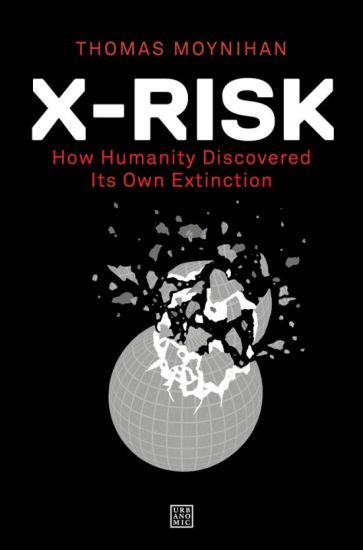
X-Risk

X-Risk

Thomas Moynihan

Urbanomic Media Ltd
2020
nidottu
How humanity came to contemplate its possible extinction.From forecasts of disastrous climate change to prophecies of evil AI superintelligences and the impending perils of genome editing, our species is increasingly concerned with the prospects of its own extinction. With humanity's future on this planet seeming more insecure by the day, in the twenty-first century, existential risk has become the object of a growing field of serious scientific inquiry. But, as Thomas Moynihan shows in X-Risk, this preoccupation is not exclusive to the post-atomic age of global warming and synthetic biology. Our growing concern with human extinction itself has a history. Tracing this untold story, Moynihan revisits the pioneers who first contemplated the possibility of human extinction and stages the historical drama of this momentous discovery. He shows how, far from being a secular reprise of religious prophecies of apocalypse, existential risk is a thoroughly modern idea, made possible by the burgeoning sciences and philosophical tumult of the Enlightenment era. In recollecting how we first came to care for our extinction, Moynihan reveals how today's attempts to measure and mitigate existential threats are the continuation of a project initiated over two centuries ago, which concerns the very vocation of the human as a rational, responsible, and future-oriented being.
Spinal Catastrophism

Spinal Catastrophism

Thomas Moynihan; Ian Hamilton Grant

Urbanomic Media Ltd
2019
pokkari
The historical continuity of spinal catastrophism, traced across multiform encounters between philosophy, psychology, biology, and geology.Drawing on cryptic intimations in the work of J. G. Ballard, Georges Bataille, William Burroughs, Andre Leroi-Gourhan, Elaine Morgan, and Friedrich Nietzsche, in the late twentieth century Daniel Barker formulated the axioms of spinal catastrophism: If human morphology, upright posture, and the possibility of language are the ramified accidents of natural history, then psychic ailments are ultimately afflictions of the spine, which itself is a scale model of biogenetic trauma, a portable map of the catastrophic events that shaped that atrocity exhibition of evolutionary traumata, the sick orthograde talking mammal.Tracing its provenance through the biological notions of phylogeny and "organic memory" that fueled early psychoanalysis, back into idealism, nature philosophy, and romanticism, and across multiform encounters between philosophy, psychology, biology, and geology, Thomas Moynihan reveals the historical continuity of spinal catastrophism. From psychoanalysis and myth to geology and neuroanatomy, from bioanalysis to chronopathy, from spinal colonies of proto-minds to the retroparasitism of the CNS, from "railway spine" to Elizabeth Taylor's lost gill-slits, this extravagantly comprehensive philosophical adventure uses the spinal cord as a guiding thread to rediscover forgotten pathways in modern thought. Moynihan demonstrates that, far from being an fanciful notion rendered obsolete by advances in biology, spinal catastrophism dramatizes fundamental philosophical problematics of time, identity, continuity, and the transcendental that remain central to any attempt to reconcile human experience with natural history.