Kirjojen hintavertailu. Mukana 12 289 852 kirjaa ja 12 kauppaa.

Kirjailija

Thomas Reid

Kirjat ja teokset yhdessä paikassa: 98 kirjaa, julkaisuja vuosilta 1983-2025, suosituimpien joukossa Essays On The Powers Of The Human Mind; Volume 1. Vertaile teosten hintoja ja tarkista saatavuus suomalaisista kirjakaupoista.

98 kirjaa

Kirjojen julkaisuhaarukka 1983-2025.

Essays on the intellectual Powers of Man
Essays on the intellectual Powers of Man is an unchanged, high-quality reprint of the original edition of 1785. Hansebooks is editor of the literature on different topic areas such as research and science, travel and expeditions, cooking and nutrition, medicine, and other genres. As a publisher we focus on the preservation of historical literature. Many works of historical writers and scientists are available today as antiques only. Hansebooks newly publishes these books and contributes to the preservation of literature which has become rare and historical knowledge for the future.
The Batman

The Batman

Thomas Reid

Lulu.com
2016
nidottu
A troubled Bruce Wayne goes through anger, love, and sadness. He learns to hide his anger and become something more than just a man, he becomes a symbol, he becomes the Batman.
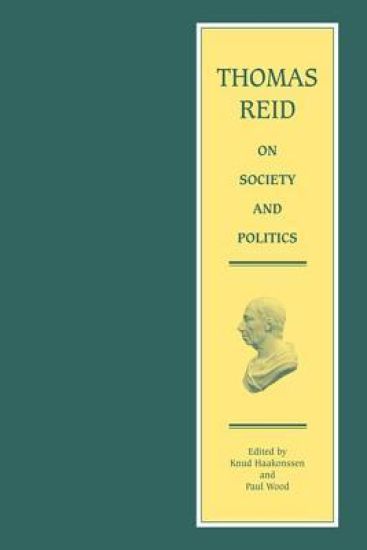
Thomas Reid on Society and Politics

Thomas Reid on Society and Politics

Thomas Reid

Edinburgh University Press
2015
sidottu
This book reveals this Enlightenment philosopher's acute comments on the Scottish political, social and economic scene. Thomas Reid might not have published much on politics, but his manuscripts reveal that he was deeply concerned with social, political and economic issues throughout his career. Published here for the first time, Reid's Glasgow lecture notes and his papers to learned societies in Aberdeen and Glasgow show that he was an acute commentator on contemporary politics and that his theoretical ideas framed solutions to some of the practical political and economic problems of his day. It explores Reid's eclectic system of political economy, which had considerable affinities with the work of Sir James Steuart. It provides an important contemporary template for comparison with Adam Smith, Reid's predecessor in the Glasgow chair of moral philosophy. It shows the continuing influence and transformation of long-standing paradigms within Anglo-Scottish thought. It includes a contextualising and critical introduction. All of the manuscripts are fully annotated with explanatory and textual notes.
Essays on the Intellectual Powers of Man

Essays on the Intellectual Powers of Man

Thomas Reid

Cambridge University Press
2011
pokkari
Thomas Reid (1710–1796) was a philosopher who founded the Scottish school of 'common sense'. Much of Reid's work is a critique of his contemporary, David Hume (1711–1776), whose empiricism he rejects. In this work, written after Reid's appointment to a professorship at the university of Glasgow, and published in 1785, he turns his attention to ideas about perception, memory, conception, abstraction, judgement, reasoning and taste. He examines the work of his predecessors and contemporaries, arguing that 'when we find philosophers maintaining that there is no heat in the fire, nor colour in the rainbow … we may be apt to think the whole to be only a dream of fanciful men, who have entangled themselves in cobwebs spun out of their own brain'. Written by one of the Scottish Enlightenment's most important thinkers, this work brings to life the intellectual debates of the time.
Spartan Band

Spartan Band

Thomas Reid

University of North Texas Press,U.S.
2010
nidottu
In ‘Spartan Band’ (coined from a chaplain’s eulogistic poem) author Thomas Reid traces the Civil War history of the 13th Texas Cavalry, a unit drawn from eleven counties in East Texas. The cavalry regiment organised in the spring of 1862 but was ordered to dismount once in Arkansas. The regiment gradually evolved into a tough, well-trained unit during action at Lake Providence, Fort De Russy, Mansfield, Pleasant Hill, and Jenkins' Ferry, as part of Maj. Gen. John G. Walker's Texas division in the Trans-Mississippi Department. Reid researched letters, documents, and diaries gleaned from more than one hundred descendants of the soldiers, answering many questions relating to their experiences and final resting places. He also includes detailed information on battle casualty figures, equipment issued to each company, slave ownership, wealth of officers, deaths due to disease, and the effects of conscription on the regiment’s composition.
Thomas Reid - Essays on the Active Powers of Man

Thomas Reid - Essays on the Active Powers of Man

Thomas Reid

Edinburgh University Press
2010
sidottu
The Essays on the Active Powers of Man (1788) was Thomas Reid's last major work. It was conceived as part of one large work, intended as a final synoptic statement of his philosophy. The first and larger part was published three years earlier as Essays on the Intellectual Powers of Man (edited as vol. 3 of the Edinburgh Edition of Thomas Reid). These two works are united by Reid's basic philosophy of common sense, which sets out native principles by which the mind operates in both its intellectual and active aspects. The Active Powers shows how these principles are involved in volition, action, and the ability to judge morally. Reid gives an original twist to a libertarian and realist tradition that was prominently represented in eighteenth-century British thought by such thinkers as Samuel Clarke and Richard Price.