Kirjojen hintavertailu. Mukana 12 595 353 kirjaa ja 12 kauppaa.

Kirjailija

Thomas S. Huang

Kirjat ja teokset yhdessä paikassa: 8 kirjaa, julkaisuja vuosilta 2003-2019, suosituimpien joukossa Deep Learning through Sparse and Low-Rank Modeling. Vertaile teosten hintoja ja tarkista saatavuus suomalaisista kirjakaupoista.

Mukana myös kirjoitusasut: Thomas S Huang

8 kirjaa

Kirjojen julkaisuhaarukka 2003-2019.

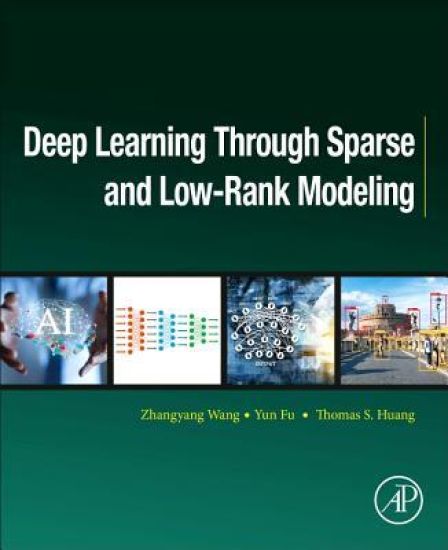
Deep Learning through Sparse and Low-Rank Modeling

Deep Learning through Sparse and Low-Rank Modeling

Zhangyang Wang; Yun Fu; Thomas S. Huang

Academic Press Inc
2019
nidottu
Deep Learning through Sparse Representation and Low-Rank Modeling bridges classical sparse and low rank models—those that emphasize problem-specific Interpretability—with recent deep network models that have enabled a larger learning capacity and better utilization of Big Data. It shows how the toolkit of deep learning is closely tied with the sparse/low rank methods and algorithms, providing a rich variety of theoretical and analytic tools to guide the design and interpretation of deep learning models. The development of the theory and models is supported by a wide variety of applications in computer vision, machine learning, signal processing, and data mining. This book will be highly useful for researchers, graduate students and practitioners working in the fields of computer vision, machine learning, signal processing, optimization and statistics.
Face Processing And Applications To Distance Learning

Face Processing And Applications To Distance Learning

Vuong Le; Usman Tariq; Hao Tang; Pooya Khorrami; Thomas S Huang

World Scientific Publishing Co Pte Ltd
2016
sidottu
This special compendium provides a concise and unified vision of facial image processing. It addresses a collection of state-of-the-art techniques, covering the most important areas for facial biometrics and behavior analysis. These techniques also converge to serve an emerging practical application of interactive distance learning.Readers will get a broad picture of the fundamental science of the field and technical details that make the research interesting. Moreover, the intellectual investigation motivated by the demand of real-life application will make this volume an inspiring read for current and prospective researchers and engineers in the fields of computer vision, machine learning and image processing.
Sparse Coding And Its Applications In Computer Vision

Sparse Coding And Its Applications In Computer Vision

Zhaowen Wang; Jianchao Yang; Haichao Zhang; Zhangyang Wang; Thomas S Huang; Ding Liu; Yingzhen Yang

World Scientific Publishing Co Pte Ltd
2015
sidottu
This book provides a broader introduction to the theories and applications of sparse coding techniques in computer vision research. It introduces sparse coding in the context of representation learning, illustrates the fundamental concepts, and summarizes the most active research directions. A variety of applications of sparse coding are discussed, ranging from low-level image processing tasks such as super-resolution and de-blurring to high-level semantic understanding tasks such as image recognition, clustering and fusion.The book is suitable to be used as an introductory overview to this field, with its theoretical part being both easy and precious enough for quick understanding. It is also of great value to experienced researchers as it offers new perspective to the underlying mechanism of sparse coding, and points out potential future directions for different applications.
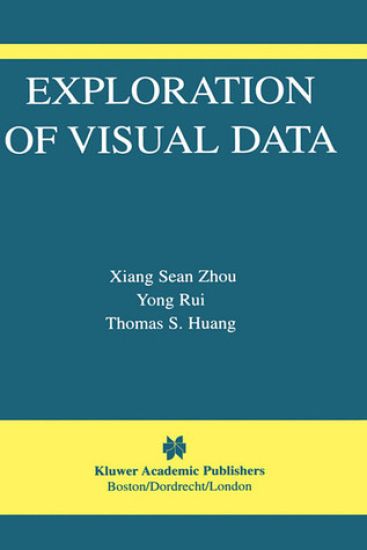
Exploration of Visual Data

Exploration of Visual Data

Sean Xiang Zhou; Thomas S. Huang

Springer-Verlag New York Inc.
2012
nidottu
Exploration of Visual Data presents latest research efforts in the area of content-based exploration of image and video data. The main objective is to bridge the semantic gap between high-level concepts in the human mind and low-level features extractable by the machines. The two key issues emphasized are "content-awareness" and "user-in-the-loop". The authors provide a comprehensive review on algorithms for visual feature extraction based on color, texture, shape, and structure, and techniques for incorporating such information to aid browsing, exploration, search, and streaming of image and video data. They also discuss issues related to the mixed use of textual and low-level visual features to facilitate more effective access of multimedia data. Exploration of Visual Data provides state-of-the-art materials on the topics of content-based description of visual data, content-based low-bitrate video streaming, and latest asymmetric and nonlinear relevance feedback algorithms, which to date are unpublished.
Motion and Structure from Image Sequences

Motion and Structure from Image Sequences

Juyang Weng; Thomas S. Huang; Narendra Ahuja

Springer-Verlag Berlin and Heidelberg GmbH Co. K
2011
nidottu
Motion and Structure from Image Sequences is invaluable reading for researchers, graduate students, and practicing engineers dealing with computer vision. It presents a balanced treatment of the theoretical and practical issues, including very recent results - some of which are published here for the first time. The topics covered in detail are: - image matching and optical flow computation - structure from stereo - structure from motion - motion estimation - integration of multiple views - motion modeling and prediction Aspects such as uniqueness of the solution, degeneracy conditions, error analysis, stability, optimality, and robustness are also investigated. These details together with the fact that the algorithms are accessible without necessarily studying the rest of the material, make this book particularly attractive to practitioners.
3D Face Processing

3D Face Processing

Zhen Wen; Thomas S. Huang

Springer-Verlag New York Inc.
2010
nidottu
3D Face Processing: Modeling, Analysis and Synthesis introduces the frontiers of 3D face processing techniques. It reviews existing 3D face processing techniques, including techniques for 3D face geometry modeling; 3D face motion modeling; and 3D face motion tracking and animation. Then it discusses a unified framework for face modeling, analysis and synthesis. In this framework, the authors present new methods for modeling complex natural facial motion, as well as face appearance variations due to illumination and subtle motion. Then the authors apply the framework to face tracking, expression recognition and face avatar for HCI interface. They conclude this book with comments on future work in the 3D face processing framework. 3D Face Processing: Modeling, Analysis and Synthesis will interest those working in face processing for intelligent human computer interaction and video surveillance. It contains a comprehensive survey on existing face processing techniques, which can serve as a reference for students and researchers. It also covers in-depth discussion on face motion analysis and synthesis algorithms, which will benefit more advanced graduate students and researchers.
3D Face Processing

3D Face Processing

Zhen Wen; Thomas S. Huang

Springer-Verlag New York Inc.
2004
sidottu
3D Face Processing: Modeling, Analysis and Synthesis introduces the frontiers of 3D face processing techniques. It reviews existing 3D face processing techniques, including techniques for 3D face geometry modeling; 3D face motion modeling; and 3D face motion tracking and animation. Then it discusses a unified framework for face modeling, analysis and synthesis. In this framework, the authors present new methods for modeling complex natural facial motion, as well as face appearance variations due to illumination and subtle motion. Then the authors apply the framework to face tracking, expression recognition and face avatar for HCI interface. They conclude this book with comments on future work in the 3D face processing framework. 3D Face Processing: Modeling, Analysis and Synthesis will interest those working in face processing for intelligent human computer interaction and video surveillance. It contains a comprehensive survey on existing face processing techniques, which can serve as a reference for students and researchers. It also covers in-depth discussion on face motion analysis and synthesis algorithms, which will benefit more advanced graduate students and researchers.
Exploration of Visual Data

Exploration of Visual Data

Sean Xiang Zhou; Thomas S. Huang

Springer-Verlag New York Inc.
2003
sidottu
Exploration of Visual Data presents latest research efforts in the area of content-based exploration of image and video data. The main objective is to bridge the semantic gap between high-level concepts in the human mind and low-level features extractable by the machines. The two key issues emphasized are "content-awareness" and "user-in-the-loop". The authors provide a comprehensive review on algorithms for visual feature extraction based on color, texture, shape, and structure, and techniques for incorporating such information to aid browsing, exploration, search, and streaming of image and video data. They also discuss issues related to the mixed use of textual and low-level visual features to facilitate more effective access of multimedia data. Exploration of Visual Data provides state-of-the-art materials on the topics of content-based description of visual data, content-based low-bitrate video streaming, and latest asymmetric and nonlinear relevance feedback algorithms, which to date are unpublished.