

Kirjailija
Thomas Ward
Kirjat ja teokset yhdessä paikassa: 32 kirjaa, julkaisuja vuosilta 1999-2026, suosituimpien joukossa Unitary Representations and Unitary Duals. Vertaile teosten hintoja ja tarkista saatavuus suomalaisista kirjakaupoista.
32 kirjaa
Kirjojen julkaisuhaarukka 1999-2026.

Unitary Representations and Unitary Duals
Manfred Einsiedler; Thomas Ward
Springer Nature Switzerland AG
2025
sidottu

This memoir chronicles the journey of an academic, tracing a path from primary school in Zambia to a career in higher education as a mathematician and educational leader. Set against the backdrop of the 20th century, the book explores how early influences and historical events shape an individual's life and professional trajectory. The author shares childhood experiences across three parts of Africa, providing an original perspective as a witness to the post-colonial period. Through personal reflections, the memoir delves into the emergence of ideas and collaborations in mathematics and how these shape career choices. It also offers candid observations on the major changes in British higher education since the 1980s. Intended for a general audience, this book provides a compelling read for anyone interested in the experience of becoming a mathematician, and higher education in general.

After Stoicism: Last Words of the Last Roman Philosopher
Thomas Ward
Word on Fire Academic
2024
sidottu
The Stoic philosophers of antiquity recognized something we often forget. Good fortune does not guarantee happiness, and bad fortune does not guarantee misery. Boethius was the last philosopher of ancient Rome and a Christian theologian. He was also an illustrious senator who suffered a spectacular reversal of fortune. Falsely accused of treason and sentenced to death, he spent several months in prison awaiting his execution. For consolation he turned to the Stoics he had spent his life studying. They helped him to remember that the good things he once enjoyed--wealth, power, fame--could not make him truly happy. Also, that the injustice he suffered need not make him miserable. But the Stoics were not the only philosophers Boethius sought for consolation. The Stoics had taught that the highest happiness we can hope for is tranquility--serene indifference despite all the trials of life. But for Boethius, tranquility was not enough. He reached for something beyond Stoicism. Something that promised true happiness, come what may. This book is a guide through Boethius's The Consolation of Philosophy. It shows how Boethius, in his darkest hour, took everything noble from Stoicism and fused it with a rational and religious conviction that there is a hope for happiness through and beyond the suffering of this life.

This memoir chronicles the journey of an academic, tracing a path from primary school in Zambia to a career in higher education as a mathematician and educational leader. Set against the backdrop of the 20th century, the book explores how early influences and historical events shape an individual's life and professional trajectory. The author shares childhood experiences across three parts of Africa, providing an original perspective as a witness to the post-colonial period. Through personal reflections, the memoir delves into the emergence of ideas and collaborations in mathematics and how these shape career choices. It also offers candid observations on the major changes in British higher education since the 1980s. Intended for a general audience, this book provides a compelling read for anyone interested in the experience of becoming a mathematician, and higher education in general.


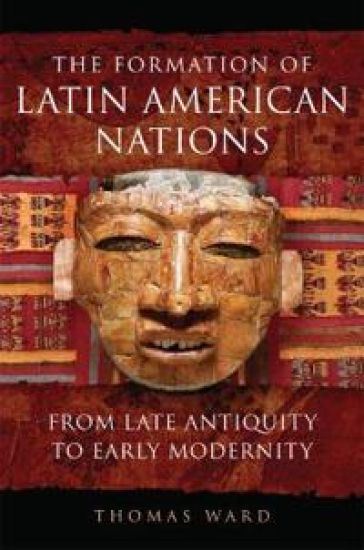
This pioneering work brings the pre-Columbian and colonial history of Latin America home: rather than starting out in Spain and following Columbus and the conquistadores as they “discover” New World peoples, The Formation of Latin American Nations begins with the Mesoamerican and South American nations as they were before the advent of European colonialism—and only then moves on to the sixteenth-century Spanish arrival and its impact. To form a clearer picture of precolonial Latin America, Thomas Ward reads between the lines in the “Chronicles of the Indies,” filling in the blanks with information derived from archaeology, anthropology, genetics, and common-sense logic. Although he finds fascinating points of comparison among the K’iche’ Maya in Central America, the polities (seÑorÍos) of Colombia, and the ChimÚ of the northern Peruvian coast, Ward focuses on two of the best-known peoples: the Nahua (Aztec) of Central Mexico and the Inka of the Andes. His study privileges indigenous-identified authors such as Diego MuÑoz Camargo, Fernando de Alva IxtlilxÓchitl, Inca Garcilaso de la Vega, and Felipe Guaman Poma de Ayala while it also consults Spanish chroniclers like HernÁn CortÉs, Bernal Diaz del Castillo, Pedro Cieza de LeÓn, and BartolomÉ de las Casas. The nation-forming processes that Ward theorizes feature two forms of cultural appropriation: the horizontal, in which nations appropriate people and customs from adjacent cultures, and the vertical, in which nations dig into their own past to fortify their concept of exceptionality. In defining these processes, Ward eschews the most common measure, race, instead opting for the Nahua altepetl, the Inka panaka, and the K’iche’ amaq’. His work thus approaches the nation both as the indigenous people conceptualized it and with terminology that would have been familiar to them before and after contact with the Spanish. The result is a truly decolonial account of the formation and organization of Latin American nations, one that puts the indigenous perspective at its center.

Coloniality and the Rise of Liberation Thinking during the Sixteenth Century
Thomas Ward
Arc Humanities Press
2021
sidottu

A Journey Through The Realm of Numbers
Menny Aka; Manfred Einsiedler; Thomas Ward
Springer Nature Switzerland AG
2020
nidottu
This book takes the reader on a journey from familiar high school mathematics to undergraduate algebra and number theory. The journey starts with the basic idea that new number systems arise from solving different equations, leading to (abstract) algebra. Along this journey, the reader will be exposed to important ideas of mathematics, and will learn a little about how mathematics is really done.Starting at an elementary level, the book gradually eases the reader into the complexities of higher mathematics; in particular, the formal structure of mathematical writing (definitions, theorems and proofs) is introduced in simple terms. The book covers a range of topics, from the very foundations (numbers, set theory) to basic abstract algebra (groups, rings, fields), driven throughout by the need to understand concrete equations and problems, such as determining which numbers are sums of squares. Some topics usually reserved for a more advanced audience, such as Eisenstein integers or quadratic reciprocity, are lucidly presented in an accessible way. The book also introduces the reader to open source software for computations, to enhance understanding of the material and nurture basic programming skills. For the more adventurous, a number of Outlooks included in the text offer a glimpse of possible mathematical excursions.This book supports readers in transition from high school to university mathematics, and will also benefit university students keen to explore the beginnings of algebraic number theory. It can be read either on its own or as a supporting text for first courses in algebra or number theory, and can also be used for a topics course on Diophantine equations.

Proceedings commemorative of the settlement of Newark,
Thomas Ward; William Burnet Kinney; Samuel H Congar
Hansebooks
2018
nidottu
This pioneering work brings the pre-Columbian and colonial history of Latin America home: rather than starting out in Spain and following Columbus and the conquistadores as they ""discover"" New World peoples, The Formation of Latin American Nations begins with the Mesoamerican and South American nations as they were before the advent of European colonialism - and only then moves on to the sixteenth-century Spanish arrival and its impact. To form a clearer picture of precolonial Latin America, Thomas Ward reads between the lines in the ""Chronicles of the Indies,"" filling in the blanks with information derived from archaeology, anthropology, genetics, and common-sense logic. Although he finds fascinating points of comparison among the K'iche' Maya in Central America, the polities (señoríos) of Colombia, and the Chimú of the northern Peruvian coast, Ward focuses on two of the best-known peoples: the Nahua (Aztec) of Central Mexico and the Inka of the Andes. His study privileges indigenous-identified authors such as Diego Muñoz Camargo, Fernando de Alva Ixtlilxóchitl, Inca Garcilaso de la Vega, and Felipe Guaman Poma de Ayala while it also consults Spanish chroniclers like Hernán Cortés, Bernal Diaz del Castillo, Pedro Cieza de León, and Bartolomé de las Casas. The nation-forming processes that Ward theorizes feature two forms of cultural appropriation: the horizontal, in which nations appropriate people and customs from adjacent cultures, and the vertical, in which nations dig into their own past to fortify their concept of exceptionality. In defining these processes, Ward eschews the most common measure, race, instead opting for the Nahua altepetl, the Inka panaka, and the K'iche' amaq'. His work thus approaches the nation both as the indigenous people conceptualized it and with terminology that would have been familiar to them before and after contact with the Spanish. The result is a truly decolonial account of the formation and organization of Latin American nations, one that puts the indigenous perspective at its center.

While there are differences between cultures in different places and times, colonial representations of indigenous peoples generally suggest they are not capable of literature nor are they worthy of being represented as nations. Colonial representations of indigenous people continue on into the independence era and can still be detected in our time. The thesis of this book is that there are various ways to decolonize the representation of Amerindian peoples. Each chapter has its own decolonial thesis which it then resolves. Chapter 1 proves that there is coloniality in contemporary scholarship and argues that word choices can be improved to decolonize the way we describe the first Americans. Chapter 2 argues that literature in Latin American begins before 1492 and shows the long arc of Mayan expression, taking the Popol Wuj as a case study. Chapter 3 demonstrates how colonialist discourse is reinforced by a dualist rhetorical ploy of ignorance and arrogance in a Renaissance historical chronicle, Agustin de Zárate's Historia del descubrimiento y conquista del Perú. Chapter 4 shows how by inverting the Renaissance dualist configuration of civilization and barbarian, the Nahua (Aztecs) who were formerly considered barbarian can be "civilized" within Spanish norms. This is done by modeling the categories of civilization discussed at length by the Friar Bartolomé de las Casas as a template that can serve to evaluate Nahua civil society as encapsulated by the historiography of Fernando de Alva Ixtlilxochitl, a possibility that would have been available to Spaniards during that time. Chapter 5 maintains that the colonialities of the pre-Independence era survive, but that Criollo-indigenous dialogue is capable of excavating their roots to extirpate them. By comparing the discussions of the hacienda system by the Peruvian essayist Manuel González Prada and by the Mayan-Quiché eye-witness to history Rigoberta Menchú, this books shows that there is common ground between their viewpoints despite the different genres in which their work appears and despite the different countries and the eight decades that separated them, suggesting a universality to the problem of the hacienda which can be dissected. This book models five different decolonizing methods to extricate from the continuities of coloniality both indigenous writing and the representation of indigenous peoples by learned elites.

Functional Analysis, Spectral Theory, and Applications
Manfred Einsiedler; Thomas Ward
Springer International Publishing AG
2018
nidottu
This textbook provides a careful treatment of functional analysis and some of its applications in analysis, number theory, and ergodic theory.In addition to discussing core material in functional analysis, the authors cover more recent and advanced topics, including Weyl’s law for eigenfunctions of the Laplace operator, amenability and property (T), the measurable functional calculus, spectral theory for unbounded operators, and an account of Tao’s approach to the prime number theorem using Banach algebras. The book further contains numerous examples and exercises, making it suitable for both lecture courses and self-study.Functional Analysis, Spectral Theory, and Applications is aimed at postgraduate and advanced undergraduate students with some background in analysis and algebra, but will also appeal to everyone with an interest in seeing how functional analysis can be applied to other parts of mathematics.

Functional Analysis, Spectral Theory, and Applications
Manfred Einsiedler; Thomas Ward
Springer International Publishing AG
2017
sidottu
This textbook provides a careful treatment of functional analysis and some of its applications in analysis, number theory, and ergodic theory.In addition to discussing core material in functional analysis, the authors cover more recent and advanced topics, including Weyl’s law for eigenfunctions of the Laplace operator, amenability and property (T), the measurable functional calculus, spectral theory for unbounded operators, and an account of Tao’s approach to the prime number theorem using Banach algebras. The book further contains numerous examples and exercises, making it suitable for both lecture courses and self-study.Functional Analysis, Spectral Theory, and Applications is aimed at postgraduate and advanced undergraduate students with some background in analysis and algebra, but will also appeal to everyone with an interest in seeing how functional analysis can be applied to other parts of mathematics.

While there are differences between cultures in different places and times, colonial representations of indigenous peoples generally suggest they are not capable of literature nor are they worthy of being represented as nations. Colonial representations of indigenous people continue on into the independence era and can still be detected in our time. The thesis of this book is that there are various ways to decolonize the representation of Amerindian peoples. Each chapter has its own decolonial thesis which it then resolves. Chapter 1 proves that there is coloniality in contemporary scholarship and argues that word choices can be improved to decolonize the way we describe the first Americans. Chapter 2 argues that literature in Latin American begins before 1492 and shows the long arc of Mayan expression, taking the Popol Wuj as a case study. Chapter 3 demonstrates how colonialist discourse is reinforced by a dualist rhetorical ploy of ignorance and arrogance in a Renaissance historical chronicle, Agustin de Zárate's Historia del descubrimiento y conquista del Perú. Chapter 4 shows how by inverting the Renaissance dualist configuration of civilization and barbarian, the Nahua (Aztecs) who were formerly considered barbarian can be "civilized" within Spanish norms. This is done by modeling the categories of civilization discussed at length by the Friar Bartolomé de las Casas as a template that can serve to evaluate Nahua civil society as encapsulated by the historiography of Fernando de Alva Ixtlilxochitl, a possibility that would have been available to Spaniards during that time. Chapter 5 maintains that the colonialities of the pre-Independence era survive, but that Criollo-indigenous dialogue is capable of excavating their roots to extirpate them. By comparing the discussions of the hacienda system by the Peruvian essayist Manuel González Prada and by the Mayan-Quiché eye-witness to history Rigoberta Menchú, this books shows that there is common ground between their viewpoints despite the different genres in which their work appears and despite the different countries and the eight decades that separated them, suggesting a universality to the problem of the hacienda which can be dissected. This book models five different decolonizing methods to extricate from the continuities of coloniality both indigenous writing and the representation of indigenous peoples by learned elites.

Flora, Or, The Gipsy's Frolic, A Pastoral Opera in Three Acts
Thomas Ward
Createspace Independent Publishing Platform
2016
nidottu

Errata to the Protestant Bible, or, The Truth of Their English Translations Examined
Thomas Ward
Sagwan Press
2015
sidottu


This text is a rigorous introduction to ergodic theory, developing the machinery of conditional measures and expectations, mixing, and recurrence. Beginning by developing the basics of ergodic theory and progressing to describe some recent applications to number theory, this book goes beyond the standard texts in this topic. Applications include Weyl's polynomial equidistribution theorem, the ergodic proof of Szemeredi's theorem, the connection between the continued fraction map and the modular surface, and a proof of the equidistribution of horocycle orbits. Ergodic Theory with a view towards Number Theory will appeal to mathematicians with some standard background in measure theory and functional analysis. No background in ergodic theory or Lie theory is assumed, and a number of exercises and hints to problems are included, making this the perfect companion for graduate students and researchers in ergodic theory, homogenous dynamics or number theory.