Kirjojen hintavertailu. Mukana 12 595 353 kirjaa ja 12 kauppaa.

Kirjailija

Thorsten Pöschel

Kirjat ja teokset yhdessä paikassa: 5 kirjaa, julkaisuja vuosilta 2004-2019, suosituimpien joukossa Computational Granular Dynamics. Vertaile teosten hintoja ja tarkista saatavuus suomalaisista kirjakaupoista.

5 kirjaa

Kirjojen julkaisuhaarukka 2004-2019.

Computational Granular Dynamics

Computational Granular Dynamics

Thorsten Pöschel; T. Schwager

Springer-Verlag Berlin and Heidelberg GmbH Co. K
2010
nidottu
Please note: The link 'www.springeronline.com/3-540-21485-2' mentioned in the Preface of this book has become obsolete over time and the referenced images, code, etc, will not be accessible to the purchaser. Computer simulations not only belong to the most important methods for the theoretical investigation of granular materials, but provide the tools that have enabled much of the expanding research by physicists and engineers. The present book is intended to serve as an introduction to the application of numerical methods to systems of granular particles. Accordingly emphasis is on a general understanding of the subject rather than on the presentation of latest advances in numerical algorithms. Although a basic knowledge of C++ is needed for the understanding of the numerical methods and algorithms in the book, it avoids usage of elegant but complicated algorithms to remain accessible for those who prefer to use a different programming language. While the book focuses more on models than on the physics of granular material, many applications to real systems are presented.
Computational Granular Dynamics

Computational Granular Dynamics

Thorsten Pöschel; T. Schwager

Springer-Verlag Berlin and Heidelberg GmbH Co. K
2005
sidottu
Please note: The link 'www.springeronline.com/3-540-21485-2' mentioned in the Preface of this book has become obsolete over time and the referenced images, code, etc, will not be accessible to the purchaser. Computer simulations not only belong to the most important methods for the theoretical investigation of granular materials, but provide the tools that have enabled much of the expanding research by physicists and engineers. The present book is intended to serve as an introduction to the application of numerical methods to systems of granular particles. Accordingly emphasis is on a general understanding of the subject rather than on the presentation of latest advances in numerical algorithms. Although a basic knowledge of C++ is needed for the understanding of the numerical methods and algorithms in the book, it avoids usage of elegant but complicated algorithms to remain accessible for those who prefer to use a different programming language. While the book focuses more on models than on the physics of granular material, many applications to real systems are presented.
Lectures on Quantum Statistics

Lectures on Quantum Statistics

Werner Ebeling; Thorsten Pöschel

Springer Nature Switzerland AG
2019
nidottu
Most of the matter in our universe is in a gaseous or plasma state. Yet, most textbooks on quantum statistics focus on examples from and applications in condensed matter systems, due to the prevalence of solids and liquids in our day-to-day lives. In an attempt to remedy that oversight, this book consciously focuses on teaching the subject matter in the context of (dilute) gases and plasmas, while aiming primarily at graduate students and young researchers in the field of quantum gases and plasmas for some of the more advanced topics. The majority of the material is based on a two-semester course held jointly by the authors over many years, and has benefited from extensive feedback provided by countless students and co-workers. The book also includes many historical remarks on the roots of quantum statistics: firstly because students appreciate and are strongly motivated by looking back at the history of a given field of research, and secondly because the spirit permeating this book has been deeply influenced by meetings and discussions with several pioneers of quantum statistics over the past few decades.
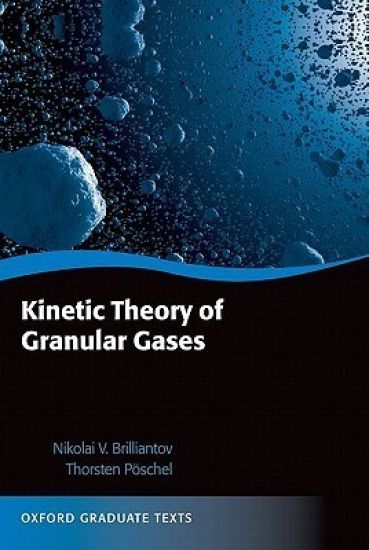
Kinetic Theory of Granular Gases

Kinetic Theory of Granular Gases

Nikolai V. Brilliantov; Thorsten Pöschel

Oxford University Press
2010
nidottu
"Kinetic Theory of Granular Gases" provides an introduction to the rapidly developing theory of dissipative gas dynamics - a theory which has mainly evolved over the last decade. The book is aimed at readers from the advanced undergraduate level upwards and leads on to the present state of research. Throughout, special emphasis is put on a microscopically consistent description of pairwise particle collisions which leads to an impact-velocity-dependent coefficient of restitution. The description of the many-particle system, based on the Boltzmann equation, starts with the derivation of the velocity distribution function, followed by the investigation of self-diffusion and Brownian motion. Using hydrodynamical methods, transport processes and self-organized structure formation are studied. An appendix gives a brief introduction to event-driven molecular dynamics. A second appendix describes a novel mathematical technique for derivation of kinetic properties, which allows for the application of computer algebra. The text is self-contained, requiring no mathematical or physical knowledge beyond that of standard physics undergraduate level. The material is adequate for a one-semester course and contains chapter summaries as well as exercises with detailed solutions. The molecular dynamics and computer-algebra programs can be downloaded from a companion web page.
Kinetic Theory of Granular Gases

Kinetic Theory of Granular Gases

Nikolai V. Brilliantov; Thorsten Pöschel

Oxford University Press
2004
sidottu
"Kinetic Theory of Granular Gases" provides an introduction to the rapidly developing theory of dissipative gas dynamics - a theory which has mainly evolved over the last decade. The book is aimed at readers from the advanced undergraduate level upwards and leads on to the present state of research. Throughout, special emphasis is put on a microscopically consistent description of pairwise particle collisions which leads to an impact-velocity-dependent coefficient of restitution. The description of the many-particle system, based on the Boltzmann equation, starts with the derivation of the velocity distribution function, followed by the investigation of self-diffusion and Brownian motion. Using hydrodynamical methods, transport processes and self-organized structure formation are studied. An appendix gives a brief introduction to event-driven molecular dynamics. A second appendix describes a novel mathematical technique for derivation of kinetic properties, which allows for the application of computer algebra. The text is self-contained, requiring no mathematical or physical knowledge beyond that of standard physics undergraduate level. The material is adequate for a one-semester course and contains chapter summaries as well as exercises with detailed solutions. The molecular dynamics and computer-algebra programs can be downloaded from a companion web page.