Kirjojen hintavertailu. Mukana 12 367 459 kirjaa ja 12 kauppaa.
Kirjailija
Tijana T. Ivancevic
Kirjat ja teokset yhdessä paikassa: 22 kirjaa, julkaisuja vuosilta 2005-2016, suosituimpien joukossa Geometrical Dynamics of Complex Systems. Vertaile teosten hintoja ja tarkista saatavuus suomalaisista kirjakaupoista.
Complex Nonlinearity: Chaos, Phase Transitions, Topology Change and Path Integrals is a book about prediction & control of general nonlinear and chaotic dynamics of high-dimensional complex systems of various physical and non-physical nature and their underpinning geometro-topological change. The book starts with a textbook-like expose on nonlinear dynamics, attractors and chaos, both temporal and spatio-temporal, including modern techniques of chaos–control. Chapter 2 turns to the edge of chaos, in the form of phase transitions (equilibrium and non-equilibrium, oscillatory, fractal and noise-induced), as well as the related field of synergetics. While the natural stage for linear dynamics comprises of flat, Euclidean geometry (with the corresponding calculation tools from linear algebra and analysis), the natural stage for nonlinear dynamics is curved, Riemannian geometry (with the corresponding tools from nonlinear, tensor algebra and analysis). The extreme nonlinearity – chaos – corresponds to the topology change of this curved geometrical stage, usually called configuration manifold. Chapter 3 elaborates on geometry and topology change in relation with complex nonlinearity and chaos. Chapter 4 develops general nonlinear dynamics, continuous and discrete, deterministic and stochastic, in the unique form of path integrals and their action-amplitude formalism. This most natural framework for representing both phase transitions and topology change starts with Feynman’s sum over histories, to be quickly generalized into the sum over geometries and topologies. The last Chapter puts all the previously developed techniques together and presents the unified form of complex nonlinearity. Here we have chaos, phase transitions, geometrical dynamics and topology change, all working together in the form of path integrals. The objective of this book is to provide a serious reader with a serious scientific tool that willenable them to actually perform a competitive research in modern complex nonlinearity. It includes a comprehensive bibliography on the subject and a detailed index. Target readership includes all researchers and students of complex nonlinear systems (in physics, mathematics, engineering, chemistry, biology, psychology, sociology, economics, medicine, etc.), working both in industry/clinics and academia.
Quantum Neural Computation is a graduate–level monographic textbook. It presents a comprehensive introduction, both non-technical and technical, into modern quantum neural computation, the science behind the fiction movie Stealth. Classical computing systems perform classical computations (i.e., Boolean operations, such as AND, OR, NOT gates) using devices that can be described classically (e.g., MOSFETs). On the other hand, quantum computing systems perform classical computations using quantum devices (quantum dots), that is devices that can be described only using quantum mechanics. Any information transfer between such computing systems involves a state measurement. This book describes this information transfer at the edge of classical and quantum chaos and turbulence, where mysterious quantum-mechanical linearity meets even more mysterious brain’s nonlinear complexity, in order to perform a super–high–speed and error–free computations. This monograph describes a crossroad between quantum field theory, brain science and computational intelligence.
The book “Paradigm Shift for Future Tennis” starts with revelations that make obvious the limitations of today’s tennis, which does not use the laws of modern Biomechanics and Neurophysiology. The second part of the book includes a new approach to the quantum mind of a champion. It will reveal the secret weapon of Roger Federer and the blueprint of a future tennis champion. This book will expose the new tennis shot emerging from the field of sports science. It is a real weapon, which can generate a ball-speed similar to that of the first serve: the Power High-Forehand. Its aim is to generate maximal possible racket-head speed while players do not wait for the ball to bounce. This is both a tactical and psychological basis for the future tennis game. This aggressive interceptive psychology will shape the minds of future tennis champions. High racket-head speed can be achieved using the stretch-reflex, without big loops and swings. Weapons of a future tennis game will comprise of whip-like tennis serves and ground strokes, based on the stretch–reflex, and using the whole body in a fluid and integrated manner, thus manifesting a superb combination of speed and strength. Restructure your brain and apply the power of state of the art biomechanical, mathematical, medical, neural, cognitive, and quantum computational intelligence to understand the tennis of today and the future!
New Trends in Control Theory is a graduate-level monographic textbook. It is a contemporary overview of modern trends in control theory. The introductory chapter gives the geometrical and quantum background, which is a necessary minimum for comprehensive reading of the book. The second chapter gives the basics of classical control theory, both linear and nonlinear. The third chapter shows the key role that Euclidean group of rigid motions plays in modern robotics and biomechanics. The fourth chapter gives an overview of modern quantum control, from both theoretical and measurement perspectives. The fifth chapter presents modern control and synchronization methods in complex systems and human crowds. The appendix provides the rest of the background material complementary to the introductory chapter.The book is designed as a one-semester course for engineers, applied mathematicians, computer scientists and physicists, both in industry and academia. It includes a most relevant bibliography on the subject and detailed index.
The book “Paradigm Shift for Future Tennis” starts with revelations that make obvious the limitations of today’s tennis, which does not use the laws of modern Biomechanics and Neurophysiology. The second part of the book includes a new approach to the quantum mind of a champion. It will reveal the secret weapon of Roger Federer and the blueprint of a future tennis champion. This book will expose the new tennis shot emerging from the field of sports science. It is a real weapon, which can generate a ball-speed similar to that of the first serve: the Power High-Forehand. Its aim is to generate maximal possible racket-head speed while players do not wait for the ball to bounce. This is both a tactical and psychological basis for the future tennis game. This aggressive interceptive psychology will shape the minds of future tennis champions. High racket-head speed can be achieved using the stretch-reflex, without big loops and swings. Weapons of a future tennis game will comprise of whip-like tennis serves and ground strokes, based on the stretch–reflex, and using the whole body in a fluid and integrated manner, thus manifesting a superb combination of speed and strength. Restructure your brain and apply the power of state of the art biomechanical, mathematical, medical, neural, cognitive, and quantum computational intelligence to understand the tennis of today and the future!
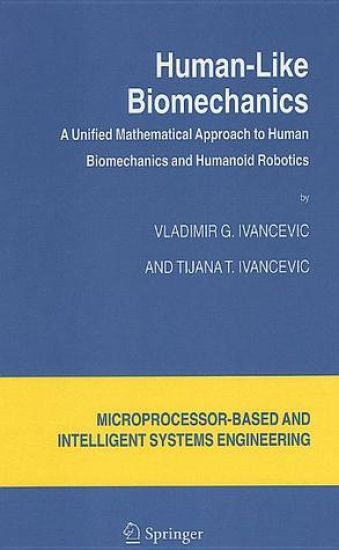
Human-Like Biomechanics is a comprehensive introduction into modern geometrical methods to be used as a unified research approach in two apparently separate and rapidly growing fields: mathematical biomechanics and humanoid robotics. The book contains six Chapters and an Appendix. The first Chapter is an Introduction, giving a brief review of mathematical techniques to be used in the text. The second Chapter develops geometrical basis of human-like biomechanics, while the third Chapter develops its mechanical basis, mainly from generalized Lagrangian and Hamiltonian perspective. The fourth Chapter develops topology of human-like biomechanics, while the fifth Chapter reviews related nonlinear control techniques. The sixth Chapter develops covariant biophysics of electro-muscular stimulation. The Appendix consists of two parts: classical muscular mechanics and modern path integral methods, which are both used frequently in the main text. The whole book is based on the authors’ own research papers in human-like biomechanics.
Computational Mind: A Complex Dynamics Perspective is a graduate–level monographic textbook in the field of Computational Intelligence. It presents a modern dynamical theory of the computational mind, combining cognitive psychology, artificial and computational intelligence, and chaos theory with quantum consciousness and computation. The book introduces to human and computational mind, comparing and contrasting main themes of cognitive psychology, artificial and computational intelligence. It presents brain/mind dynamics from the chaos theory perspective, including sections on chaos in human EEG, basics of nonlinear dynamics and chaos, techniques of chaos control, synchronization in chaotic systems and complexity in humanoid robots. This book presents modern theory of quantum computational mind, including sections on Dirac–Feynman quantum dynamics, quantum consciousness, and quantum computation using Josephson junctions. The book is designed as a one–semester course for computer scientists, engineers, physicists and applied mathematicians, both in industry and academia. It includes a strong bibliography on the subject and detailed index.
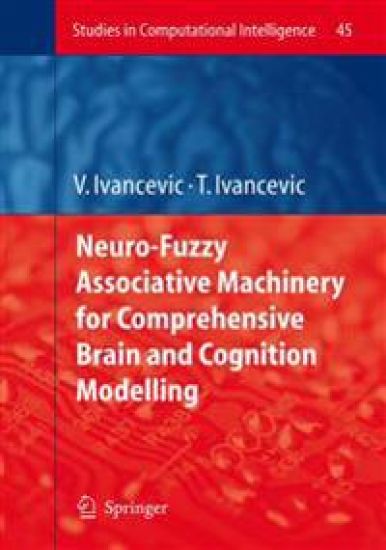
Neuro–Fuzzy Associative Machinery for Comprehensive Brain and Cognition Modelling" is a graduate–level monographic textbook. It represents a comprehensive introduction into both conceptual and rigorous brain and cognition modelling. It is devoted to understanding, prediction and control of the fundamental mechanisms of brain functioning. The reader will be provided with a scientific tool enabling him to perform a competitive research in brain and cognition modelling.
If we try to describe real world in mathematical terms, we will see that real life is very often a high–dimensional chaos. Sometimes, by ‘pushing hard’, we manage to make order out of it; yet sometimes, we need simply to accept our life as it is. To be able to still live successfully, we need tounderstand, predict, and ultimately control this high–dimensional chaotic dynamics of life. This is the main theme of the present book. In our previous book, Geometrical - namics of Complex Systems, Vol. 31 in Springer book series Microprocessor– Based and Intelligent Systems Engineering, we developed the most powerful mathematical machinery to deal with high–dimensional nonlinear dynamics. In the present text, we consider the extreme cases of nonlinear dynamics, the high–dimensional chaotic and other attractor systems. Although they might look as examples of complete disorder – they still represent control systems, with their inputs, outputs, states, feedbacks, and stability. Today, we can see a number of nice books devoted to nonlinear dyn- ics and chaos theory (see our reference list). However, all these books are only undergraduate, introductory texts, that are concerned exclusively with oversimpli?ed low–dimensional chaos, thus providing only an inspiration for the readers to actually throw themselves into the real–life chaotic dynamics.
What are motor abilities of Olympic champions? What are essential psyc- logical characteristics of Mark Spitz, Carl Lewis and Roger Federer? How to discover and maximally develop motor intelligence? How to develop - domitable will power of Olympic champions? What are the secrets of sel- tion for the future Olympic champions? Does for every sport exist a unique model of an Olympic champion? This book gives a modern scienti?c answers to the above questions. Its purpose is to give you the answer to everything you ever wanted to ask about sport champions, but didn’t know who or how to ask. In particular, the purpose of this book is to give you the answer to eve- thing you ever wanted to ask about advanced tennis, but didn’t know who or how to ask. Its aim is to dispel classical myths of a “biomechanically sound” serve, forehand, and backhand, as well as provide methods for developing superior tennis weapons,a lightning–fast game,and unrivaled mental speed and strength – essential qualities of a future tennis champion.
Quantum Neural Computation is a graduate–level monographic textbook. It presents a comprehensive introduction, both non-technical and technical, into modern quantum neural computation, the science behind the fiction movie Stealth. Classical computing systems perform classical computations (i.e., Boolean operations, such as AND, OR, NOT gates) using devices that can be described classically (e.g., MOSFETs). On the other hand, quantum computing systems perform classical computations using quantum devices (quantum dots), that is devices that can be described only using quantum mechanics. Any information transfer between such computing systems involves a state measurement. This book describes this information transfer at the edge of classical and quantum chaos and turbulence, where mysterious quantum-mechanical linearity meets even more mysterious brain’s nonlinear complexity, in order to perform a super–high–speed and error–free computations. This monograph describes a crossroad between quantum field theory, brain science and computational intelligence.
What are motor abilities of Olympic champions? What are essential psyc- logical characteristics of Mark Spitz, Carl Lewis and Roger Federer? How to discover and maximally develop motor intelligence? How to develop - domitable will power of Olympic champions? What are the secrets of sel- tion for the future Olympic champions? Does for every sport exist a unique model of an Olympic champion? This book gives a modern scienti?c answers to the above questions. Its purpose is to give you the answer to everything you ever wanted to ask about sport champions, but didn’t know who or how to ask. In particular, the purpose of this book is to give you the answer to eve- thing you ever wanted to ask about advanced tennis, but didn’t know who or how to ask. Its aim is to dispel classical myths of a “biomechanically sound” serve, forehand, and backhand, as well as provide methods for developing superior tennis weapons,a lightning–fast game,and unrivaled mental speed and strength – essential qualities of a future tennis champion.
This is a unique 21st-century monograph that reveals a basic, yet deep understanding of the universe, as well as the human mind and body — all from the perspective of quantum mechanics and quantum field theory.This book starts with both non-mathematical and mathematical preliminaries. It presents the basics of both non-relativistic and relativistic quantum mechanics, and introduces Feynman path integrals and their application to quantum fields and string theory, as well as some non-quantum applications. It then describes the quantum universe in the form of loop quantum gravity and quantum cosmology. Lastly, the book turns to the human body and mind, applying quantum theory to electro-muscular stimulation and consciousness.It can be used as a graduate (or advanced undergraduate) textbook for a two-semester course in quantum physics and its modern applications. Some parts of the book can also be used by engineers, biologists, psychologists and computer scientists, as well as applied mathematicians, both in industry and academia.
Complex Nonlinearity: Chaos, Phase Transitions, Topology Change and Path Integrals is a book about prediction & control of general nonlinear and chaotic dynamics of high-dimensional complex systems of various physical and non-physical nature and their underpinning geometro-topological change. The book starts with a textbook-like expose on nonlinear dynamics, attractors and chaos, both temporal and spatio-temporal, including modern techniques of chaos–control. Chapter 2 turns to the edge of chaos, in the form of phase transitions (equilibrium and non-equilibrium, oscillatory, fractal and noise-induced), as well as the related field of synergetics. While the natural stage for linear dynamics comprises of flat, Euclidean geometry (with the corresponding calculation tools from linear algebra and analysis), the natural stage for nonlinear dynamics is curved, Riemannian geometry (with the corresponding tools from nonlinear, tensor algebra and analysis). The extreme nonlinearity – chaos – corresponds to the topology change of this curved geometrical stage, usually called configuration manifold. Chapter 3 elaborates on geometry and topology change in relation with complex nonlinearity and chaos. Chapter 4 develops general nonlinear dynamics, continuous and discrete, deterministic and stochastic, in the unique form of path integrals and their action-amplitude formalism. This most natural framework for representing both phase transitions and topology change starts with Feynman’s sum over histories, to be quickly generalized into the sum over geometries and topologies. The last Chapter puts all the previously developed techniques together and presents the unified form of complex nonlinearity. Here we have chaos, phase transitions, geometrical dynamics and topology change, all working together in the form of path integrals. The objective of this book is to provide a serious reader with a serious scientific tool that willenable them to actually perform a competitive research in modern complex nonlinearity. It includes a comprehensive bibliography on the subject and a detailed index. Target readership includes all researchers and students of complex nonlinear systems (in physics, mathematics, engineering, chemistry, biology, psychology, sociology, economics, medicine, etc.), working both in industry/clinics and academia.
Computational Mind: A Complex Dynamics Perspective is a graduate–level monographic textbook in the field of Computational Intelligence. It presents a modern dynamical theory of the computational mind, combining cognitive psychology, artificial and computational intelligence, and chaos theory with quantum consciousness and computation. The book introduces to human and computational mind, comparing and contrasting main themes of cognitive psychology, artificial and computational intelligence. It presents brain/mind dynamics from the chaos theory perspective, including sections on chaos in human EEG, basics of nonlinear dynamics and chaos, techniques of chaos control, synchronization in chaotic systems and complexity in humanoid robots. This book presents modern theory of quantum computational mind, including sections on Dirac–Feynman quantum dynamics, quantum consciousness, and quantum computation using Josephson junctions. The book is designed as a one–semester course for computer scientists, engineers, physicists and applied mathematicians, both in industry and academia. It includes a strong bibliography on the subject and detailed index.
This graduate-level monographic textbook treats applied differential geometry from a modern scientific perspective. Co-authored by the originator of the world's leading human motion simulator — “Human Biodynamics Engine”, a complex, 264-DOF bio-mechanical system, modeled by differential-geometric tools — this is the first book that combines modern differential geometry with a wide spectrum of applications, from modern mechanics and physics, via nonlinear control, to biology and human sciences. The book is designed for a two-semester course, which gives mathematicians a variety of applications for their theory and physicists, as well as other scientists and engineers, a strong theory underlying their models.
Neuro–Fuzzy Associative Machinery for Comprehensive Brain and Cognition Modelling" is a graduate–level monographic textbook. It represents a comprehensive introduction into both conceptual and rigorous brain and cognition modelling. It is devoted to understanding, prediction and control of the fundamental mechanisms of brain functioning. The reader will be provided with a scientific tool enabling him to perform a competitive research in brain and cognition modelling.
If we try to describe real world in mathematical terms, we will see that real life is very often a high–dimensional chaos. Sometimes, by ‘pushing hard’, we manage to make order out of it; yet sometimes, we need simply to accept our life as it is. To be able to still live successfully, we need tounderstand, predict, and ultimately control this high–dimensional chaotic dynamics of life. This is the main theme of the present book. In our previous book, Geometrical - namics of Complex Systems, Vol. 31 in Springer book series Microprocessor– Based and Intelligent Systems Engineering, we developed the most powerful mathematical machinery to deal with high–dimensional nonlinear dynamics. In the present text, we consider the extreme cases of nonlinear dynamics, the high–dimensional chaotic and other attractor systems. Although they might look as examples of complete disorder – they still represent control systems, with their inputs, outputs, states, feedbacks, and stability. Today, we can see a number of nice books devoted to nonlinear dyn- ics and chaos theory (see our reference list). However, all these books are only undergraduate, introductory texts, that are concerned exclusively with oversimpli?ed low–dimensional chaos, thus providing only an inspiration for the readers to actually throw themselves into the real–life chaotic dynamics.
Human-Like Biomechanics is a comprehensive introduction into modern geometrical methods to be used as a unified research approach in two apparently separate and rapidly growing fields: mathematical biomechanics and humanoid robotics. The book contains six Chapters and an Appendix. The first Chapter is an Introduction, giving a brief review of mathematical techniques to be used in the text. The second Chapter develops geometrical basis of human-like biomechanics, while the third Chapter develops its mechanical basis, mainly from generalized Lagrangian and Hamiltonian perspective. The fourth Chapter develops topology of human-like biomechanics, while the fifth Chapter reviews related nonlinear control techniques. The sixth Chapter develops covariant biophysics of electro-muscular stimulation. The Appendix consists of two parts: classical muscular mechanics and modern path integral methods, which are both used frequently in the main text. The whole book is based on the authors’ own research papers in human-like biomechanics.