Kirjojen hintavertailu. Mukana 12 142 703 kirjaa ja 12 kauppaa.

Kirjailija

Tim Chartier

Kirjat ja teokset yhdessä paikassa: 3 kirjaa, julkaisuja vuosilta 2015-2024, suosituimpien joukossa When Life Is Linear: From Computer Graphics to Bracketology. Vertaile teosten hintoja ja tarkista saatavuus suomalaisista kirjakaupoista.

3 kirjaa

Kirjojen julkaisuhaarukka 2015-2024.

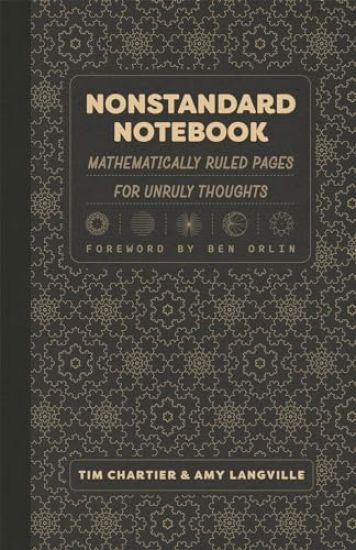
Nonstandard Notebook

Nonstandard Notebook

Tim Chartier; Amy Langville; Ben Orlin

THE UNIVERSITY OF CHICAGO PRESS
2024
nidottu
A revolutionary notebook that challenges us to play outside (and with) the lines. A standard notebook displays page after page of horizontal lines. But what if we break the pattern? What if the ruled pages grew unruly? In this Nonstandard Notebook, lines twist, fragment, curve, and crisscross in beautiful formations. Each sheet is a distinctive work of imagination, asking us to draw, doodle, and journal in the same spirit. Page after page, as we journey from lines to parabolas to waves, deep questions arise—about form, art, and mathematics. How do we harness the infinite? Why do patterns permeate nature? What are the limitations and possibilities of human vision? Nonstandard Notebook explores these questions and more through its provocative and inspirational images, each displayed with the mathematics that generated it. We see how straight lines can form fractal crenellations, how circles can disrupt and unify, and how waves and scaling can form complex landscapes (or even famous faces). Created by mathematicians, educators, and math popularizers Tim Chartier and Amy Langville, and with a foreword from Ben Orlin (bestselling author of Math with Bad Drawings), Nonstandard Notebook shows that rules—both the rules of mathematics and the rules of a notebook—do not mark the end of creativity, but the beginning.
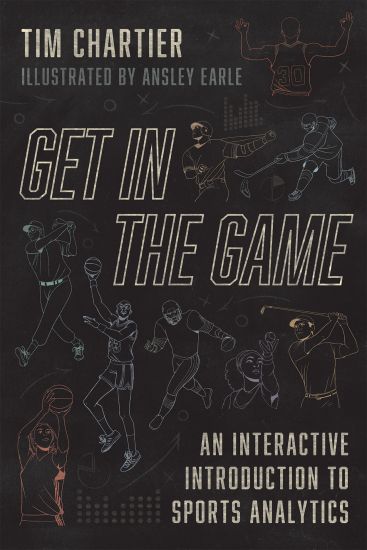
Get in the Game

Get in the Game

Tim Chartier

THE UNIVERSITY OF CHICAGO PRESS
2022
nidottu
An award-winning math popularizer, who has advised the US Olympic Committee, NFL, and NBA, offers sports fans a new way to understand truly improbable feats in their favorite games. In 2013, NBA point guard Steph Curry wowed crowds when he sunk 11 out of 13 three-pointers for a game total of 54 points—only seven other players, including Michael Jordan and Kobe Bryant, had scored more in a game at Madison Square Garden. Four years later, the University of Connecticut women’s basketball team won its hundredth straight game, defeating South Carolina 66–55. And in 2010, one forecaster—an octopus named Paul—correctly predicted the outcome of all of Germany’s matches in the FIFA World Cup. These are surprising events—but are they truly improbable? In Get in the Game, mathematician and sports analytics expert Tim Chartier helps us answer that question—condensing complex mathematics down to coin tosses and dice throws to give readers both an introduction to statistics and a new way to enjoy sporting events. With these accessible tools, Chartier leads us through modeling experiments that develop our intuitive sense of the improbable. For example, to see how likely you are to beat Curry’s three-pointer feat, consider his 45.3 percent three-point shooting average in 2012–13. Take a coin and assume heads is making the shot (slightly better than Curry at a fifty percent chance). Can you imagine getting heads eleven out of thirteen times? With engaging exercises and fun, comic book–style illustrations by Ansley Earle, Chartier’s book encourages all readers—including those who have never encountered formal statistics or data simulations, or even heard of sports analytics, but who enjoy watching sports—to get in the game.
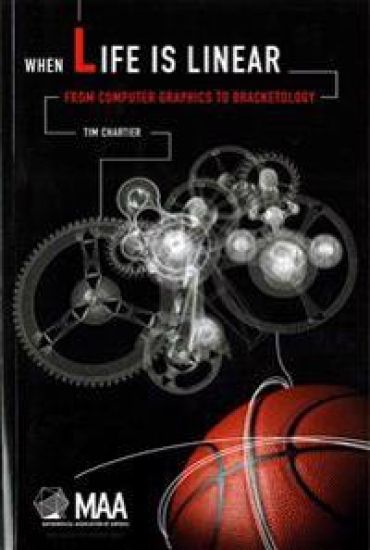
When Life Is Linear: From Computer Graphics to Bracketology

When Life Is Linear: From Computer Graphics to Bracketology

Tim Chartier

Mathematical Association of America (MAA)
2015
nidottu
From simulating complex phenomenon on supercomputers to storing information for modern 3D printing, the mathematics of data is a huge part of our world. A major tool to manipulate and study such data is linear algebra. This book introduces concepts of matrix algebra with an emphasis on applications, particularly in the fields of computer graphics and data mining. Readers will learn to make an image transparent, compress an image, and rotate a 3D wireframe model. In data mining, readers will use linear algebra to read zip codes on envelopes and encrypt sensitive information. The book details methods behind web search, utilized by such companies as Google, and algorithms for sports ranking, which have been applied to creating brackets for March Madness and predict outcomes in FIFA World Cup football. With a strong visual approach, the book can serve as a resource on its own or as a supplement to a course on linear algebra.