Kirjojen hintavertailu. Mukana 12 595 353 kirjaa ja 12 kauppaa.

Kirjailija

Tim Dean

Kirjat ja teokset yhdessä paikassa: 10 kirjaa, julkaisuja vuosilta 2000-2022, suosituimpien joukossa How We Became Human. Vertaile teosten hintoja ja tarkista saatavuus suomalaisista kirjakaupoista.

10 kirjaa

Kirjojen julkaisuhaarukka 2000-2022.

Hatred of Sex

Hatred of Sex

Oliver Davis; Tim Dean

University of Nebraska Press
2022
pokkari
Hatred of Sex links Jacques Rancière’s political philosophy of the constitutive disorder of democracy with Jean Laplanche’s identification of a fundamental perturbation at the heart of human sexuality. Sex is hated as well as desired, Oliver Davis and Tim Dean contend, because sexual intensity impedes coherent selfhood and undermines identity, rendering us all a little more deplorable than we might wish. Davis and Dean explore the consequences of this conflicted dynamic across a range of fields and institutions, including queer studies, attachment theory, the #MeToo movement, and “traumatology,” demonstrating how hatred of sex has been optimized and exploited by neoliberalism. Advancing strong claims about sex, pleasure, power, intersectionality, therapy, and governance, Davis and Dean shed new light on enduring questions of equality at a historical moment when democracy appears ever more precarious.

Raw

Raw

Tim Dean

University of Regina Press
2019
nidottu
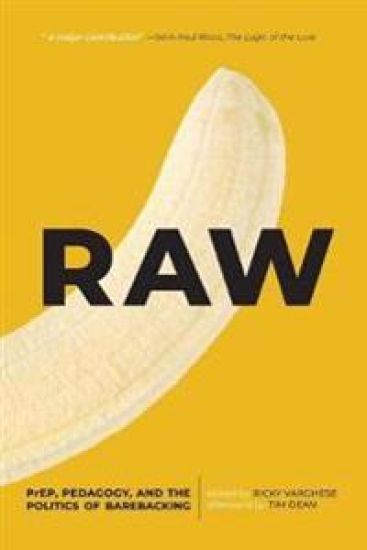
Marking the tenth anniversary of Tim Dean's Unlimited Intimacy, Raw returns to the question of sex without condoms, or barebacking, a timely topic in the age of PrEP, a drug that virtually eliminates the transmission of HIV. "Essential reading for anyone interested in the politics of sex, sexuality and sexual representation in the 21st century." —John Mercer, author of Gay Pornography "Finally, queer theory returns to a topic it has had surprisingly little to say about: sex! Underpinning these essays is a thrilling wager: that desire demands discourse but resists rationalization." —Damon R. Young, author of Making Sex Public and Other Cinematic Fantasies "A major contribution to research. It opens up the discourse on barebacking to a varity of perspectives and theoretical arguments, and makes clear that the topic remains relevant." —John Paul Ricco, author of The Decision Between Us "Raw provides an account of the state of queer-theoretical scholarship on bareback today, and makes a pluralising and distinctive contribution to that body of work, significantly broadening this field of scholarship." —Oliver Davis, editor of Bareback Sex and Queer Theory across Three National Contexts (France, UK, US) Contributors: Jonathan A. Allan (Brandon University), Tim Dean (University of Illinois at Urbana-Champaign), Elliot Evans (University of Birmingham), Christien Garcia (University of Cambridge), Octavio R. Gonzales (Wellesley College), Adam J. Greteman (School of the Art Institute of Chicago), Frank G. Karioris (University of Pittsburgh & American University of Central Asia), Gareth Longstaff (Newcastle University), Paul Morris (San Francisco), Susanna Paasonen (University of Turku), Diego Semerene (Oxford Brookes University), Evangelos Tziallas (Concordia University), Ricky Varghese (Toronto), Rinaldo Walcott (University of Toronto)
RAW

RAW

Tim Dean

Zed Books Ltd
2019
nidottu
RAW addresses the question of sex without condoms, or barebacking, in the age of PrEP, a drug that virtually eliminates the transmission of HIV. Writing out of the history of the AIDS crisis, the authors in RAW expand the study of barebacking into new areas, such as its appearance within lesbian, heterosexual, and BDSM communities and its implications for teaching critical sexology.
Unlimited Intimacy

Unlimited Intimacy

Tim Dean

University of Chicago Press
2009
nidottu
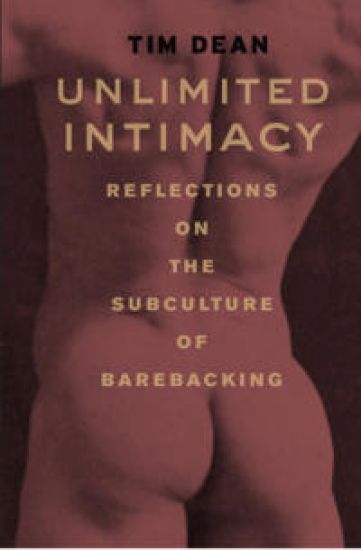
Barebacking - when gay men deliberately abandon condoms and embrace unprotected sex - has incited a great deal of shock, outrage, anger, and even disgust, but very little contemplation. Purposely flying in the face of decades of safe-sex campaigning and HIV/AIDS awareness initiatives, barebacking is unquestionably radical behavior, behavior that most people would rather condemn than understand. Thus the time is ripe for "Unlimited Intimacy", Tim Dean's riveting investigation into barebacking and the distinctive subculture that has grown around it. Audacious and undeniably provocative, Dean's profoundly reflective account is neither a manifesto nor an apology; instead, it is a searching analysis that tests the very limits of the study of sex in the twenty-first century. Dean's extensive research into the subculture provides a tour of the scene's bars, sex clubs, and Web sites; offers an explicit but sophisticated analysis of its pornography; and, documents his own personal experiences in the culture. But ultimately, it is HIV that animates the controversy around barebacking, and "Unlimited Intimacy" explores how barebackers think about transmitting the virus - especially the idea that deliberately sharing it establishes a new network of kinship among the infected. According to Dean, intimacy makes us vulnerable, exposes us to emotional risk, and forces us to drop our psychological barriers. As a committed experiment in intimacy without limits - one that makes those metaphors of intimacy quite literal - barebacking thus says a great deal about how intimacy works. Written with a fierce intelligence and uncompromising nerve, "Unlimited Intimacy" will prove to be a milestone in our understanding of sexual behavior.
Unlimited Intimacy

Unlimited Intimacy

Tim Dean

University of Chicago Press
2009
sidottu
Barebacking - when gay men deliberately abandon condoms and embrace unprotected sex - has incited a great deal of shock, outrage, anger, and even disgust, but very little contemplation. Purposely flying in the face of decades of safe-sex campaigning and HIV/AIDS awareness initiatives, barebacking is unquestionably radical behavior, behavior that most people would rather condemn than understand. Thus the time is ripe for "Unlimited Intimacy", Tim Dean's riveting investigation into barebacking and the distinctive subculture that has grown around it. Audacious and undeniably provocative, Dean's profoundly reflective account is neither a manifesto nor an apology; instead, it is a searching analysis that tests the very limits of the study of sex in the twenty-first century. Dean's extensive research into the subculture provides a tour of the scene's bars, sex clubs, and Web sites; offers an explicit but sophisticated analysis of its pornography; and, documents his own personal experiences in the culture. But ultimately, it is HIV that animates the controversy around barebacking, and "Unlimited Intimacy" explores how barebackers think about transmitting the virus - especially the idea that deliberately sharing it establishes a new network of kinship among the infected. According to Dean, intimacy makes us vulnerable, exposes us to emotional risk, and forces us to drop our psychological barriers. As a committed experiment in intimacy without limits - one that makes those metaphors of intimacy quite literal - barebacking thus says a great deal about how intimacy works. Written with a fierce intelligence and uncompromising nerve, "Unlimited Intimacy" will prove to be a milestone in our understanding of sexual behavior.
A Time for the Humanities

A Time for the Humanities

Tim Dean; Ewa Plonowska Ziarek

Fordham University Press
2008
sidottu
This book brings together an international roster of renowned scholars from disciplines including philosophy, political theory, intellectual history, and literary studies to address the conceptual foundations of the humanities and the question of their future. What notions of the future, of the human, and of finitude underlie recurring anxieties about the humanities in our current geopolitical situation? How can we think about the unpredictable and unthought dimensions of praxis implicit in the very notion of futurity? The essays here argue that the uncertainty of the future represents both an opportunity for critical engagement and a matrix for invention. Broadly conceived, the notion of invention, or cultural poiesis, questions the key assumptions and tasks of a whole range of practices in the humanities, beginning with critique, artistic practices, and intellectual inquiry, and ending with technology, emancipatory politics, and ethics. The essays discuss a wide range of key figures (e.g., Deleuze, Freud, Lacan, Foucault, Kristeva, Irigaray), problems (e.g., becoming, kinship and the foreign, "disposable populations" within a global political economy, queerness and the death drive, the parapoetic, electronic textuality, invention and accountability, political and social reform in Latin America), disciplines and methodologies (philosophy, art and art history, visuality, political theory, criticism and critique, psychoanalysis, gender analysis, architecture, literature, art). The volume should be required reading for all who feel a deep commitment to the humanities, its practices, and its future.
A Time for the Humanities

A Time for the Humanities

Tim Dean; Ewa Plonowska Ziarek

Fordham University Press
2008
pokkari
This book brings together an international roster of renowned scholars from disciplines including philosophy, political theory, intellectual history, and literary studies to address the conceptual foundations of the humanities and the question of their future. What notions of the future, of the human, and of finitude underlie recurring anxieties about the humanities in our current geopolitical situation? How can we think about the unpredictable and unthought dimensions of praxis implicit in the very notion of futurity? The essays here argue that the uncertainty of the future represents both an opportunity for critical engagement and a matrix for invention. Broadly conceived, the notion of invention, or cultural poiesis, questions the key assumptions and tasks of a whole range of practices in the humanities, beginning with critique, artistic practices, and intellectual inquiry, and ending with technology, emancipatory politics, and ethics. The essays discuss a wide range of key figures (e.g., Deleuze, Freud, Lacan, Foucault, Kristeva, Irigaray), problems (e.g., becoming, kinship and the foreign, "disposable populations" within a global political economy, queerness and the death drive, the parapoetic, electronic textuality, invention and accountability, political and social reform in Latin America), disciplines and methodologies (philosophy, art and art history, visuality, political theory, criticism and critique, psychoanalysis, gender analysis, architecture, literature, art). The volume should be required reading for all who feel a deep commitment to the humanities, its practices, and its future.
Beyond Sexuality

Beyond Sexuality

Tim Dean

University of Chicago Press
2000
sidottu
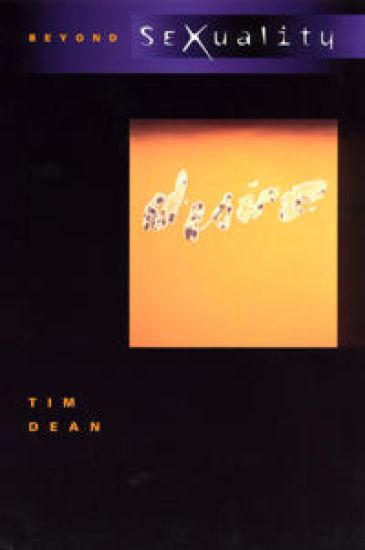
Combining psychoanalytic emphasis on the unconscious with a respect for the historical variability of sexual identities, this work of queer theory makes the case for vewing erotic desire as fundamentally impersonal. Dean develops a reading of Jacques Lacan that - rather than straightening out this notoriously difficult French psychoanalyst - brings out the queer tensions and productive incoherencies in his account of desire. Dean shows that Lacanian unconscious "deheterosexualizes" desire, and along the way he reveals how psychoanalytic thinkers as well as queer theorists have failed to exploit the full potential of this conception of desire. The book elaborates this by investigating social fantasies about homosexuality and AIDS, including gay men's own fantasies about sex and promiscuity, in an attempt to illuminate the challenges facing safe-sex education.
Beyond Sexuality

Beyond Sexuality

Tim Dean

University of Chicago Press
2000
nidottu
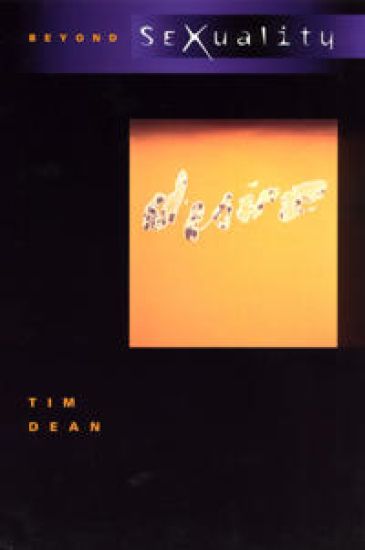
Combining psychoanalytic emphasis on the unconscious with a respect for the historical variability of sexual identities, this work of queer theory makes the case for vewing erotic desire as fundamentally impersonal. Dean develops a reading of Jacques Lacan that - rather than straightening out this notoriously difficult French psychoanalyst - brings out the queer tensions and productive incoherencies in his account of desire. Dean shows that Lacanian unconscious "deheterosexualizes" desire, and along the way he reveals how psychoanalytic thinkers as well as queer theorists have failed to exploit the full potential of this conception of desire. The book elaborates this by investigating social fantasies about homosexuality and AIDS, including gay men's own fantasies about sex and promiscuity, in an attempt to illuminate the challenges facing safe-sex education.