Kirjojen hintavertailu. Mukana 12 263 975 kirjaa ja 12 kauppaa.

Kirjailija

Tim Ingold

Kirjat ja teokset yhdessä paikassa: 39 kirjaa, julkaisuja vuosilta 1976-2025, suosituimpien joukossa Llevando la vida. Vertaile teosten hintoja ja tarkista saatavuus suomalaisista kirjakaupoista.

39 kirjaa

Kirjojen julkaisuhaarukka 1976-2025.

Anthropology

Anthropology

Tim Ingold

Polity Press
2018
sidottu
Humanity is at a crossroads. We face mounting inequality, escalating political violence, warring fundamentalisms and an environmental crisis of planetary proportions. How can we fashion a world that has room for everyone, for generations to come? What are the possibilities, in such a world, of collective human life? These are urgent questions, and no discipline is better placed to address them than anthropology. It does so by bringing to bear the wisdom and experience of people everywhere, whatever their backgrounds and walks of life.In this passionately argued book, Tim Ingold relates how a field of study once committed to ideals of progress collapsed amidst the ruins of war and colonialism, only to be reborn as a discipline of hope, destined to take centre stage in debating the most pressing intellectual, ethical and political issues of our time. He shows why anthropology matters to us all.Introducing Polity’s Why It Matters series: In these short and lively books, world-leading thinkers make the case for the importance of their subjects and aim to inspire a new generation of students.
Anthropology

Anthropology

Tim Ingold

Polity Press
2018
nidottu
Humanity is at a crossroads. We face mounting inequality, escalating political violence, warring fundamentalisms and an environmental crisis of planetary proportions. How can we fashion a world that has room for everyone, for generations to come? What are the possibilities, in such a world, of collective human life? These are urgent questions, and no discipline is better placed to address them than anthropology. It does so by bringing to bear the wisdom and experience of people everywhere, whatever their backgrounds and walks of life.In this passionately argued book, Tim Ingold relates how a field of study once committed to ideals of progress collapsed amidst the ruins of war and colonialism, only to be reborn as a discipline of hope, destined to take centre stage in debating the most pressing intellectual, ethical and political issues of our time. He shows why anthropology matters to us all.Introducing Polity’s Why It Matters series: In these short and lively books, world-leading thinkers make the case for the importance of their subjects and aim to inspire a new generation of students.
Tomás Saraceno: Aerocene

Tomás Saraceno: Aerocene

Hans Ulrich Obrist; Eva Horn; Timothy Morton; Tim Ingold

Skira
2018
sidottu
The book is an in-depth survey of the Aerocene project. The Aerocene project consists of a series of airborne sculptures made by Tom s Saraceno that will achieve the longest emissions-free journey around the world, becoming buoyant only by the heat of the Sun and infrared radiation from the surface of the Earth.
Anthropology and/as Education

Anthropology and/as Education

Tim Ingold

Routledge
2017
sidottu
There is more to education than teaching and learning, and more to anthropology than making studies of other people’s lives. Here Tim Ingold argues that both anthropology and education are ways of studying, and of leading life, with others. In this provocative book, he goes beyond an exploration of the interface between the disciplines of anthropology and education to claim their fundamental equivalence.Taking inspiration from the writings of John Dewey, Ingold presents his argument in four close-knit chapters. Education, he contends, is not the transmission of authorised knowledge from one generation to the next but a way of attending to things, opening up paths of growth and discovery. What does this mean for the ways we think about study and the school, teaching and learning, and the freedoms they exemplify? And how does it bear on the practices of participation and observation, on ways of study in the field and in the school, on art and science, research and teaching, and the university?Written in an engaging and accessible style, this book is intended as much for educationalists as for anthropologists. It will appeal to all who are seeking alternatives to mainstream agendas in social and educational policy, including educators and students in philosophy, the social sciences, educational psychology, environmentalism and arts practice.
Anthropology and/as Education

Anthropology and/as Education

Tim Ingold

Routledge
2017
nidottu
There is more to education than teaching and learning, and more to anthropology than making studies of other people’s lives. Here Tim Ingold argues that both anthropology and education are ways of studying, and of leading life, with others. In this provocative book, he goes beyond an exploration of the interface between the disciplines of anthropology and education to claim their fundamental equivalence.Taking inspiration from the writings of John Dewey, Ingold presents his argument in four close-knit chapters. Education, he contends, is not the transmission of authorised knowledge from one generation to the next but a way of attending to things, opening up paths of growth and discovery. What does this mean for the ways we think about study and the school, teaching and learning, and the freedoms they exemplify? And how does it bear on the practices of participation and observation, on ways of study in the field and in the school, on art and science, research and teaching, and the university?Written in an engaging and accessible style, this book is intended as much for educationalists as for anthropologists. It will appeal to all who are seeking alternatives to mainstream agendas in social and educational policy, including educators and students in philosophy, the social sciences, educational psychology, environmentalism and arts practice.
The Invention of Culture

The Invention of Culture

Roy Wagner; Tim Ingold

University of Chicago Press
2016
nidottu
In anthropology, a field that is known for its critical edge and intellectual agility, few books manage to maintain both historical value and contemporary relevance. Roy Wagner's The Invention of Culture, originally published in 1981, is one. Wagner breaks new ground by arguing that culture arises from the dialectic between the individual and the social world. Rooting his analysis in the relationship between invention and convention, innovation and control, meaning and context, he builds a theory that insists on the importance of creativity, placing people-as-inventors at the heart of the process that creates culture. In an elegant twist, he shows that those very processes ultimately produce the discipline of anthropology itself. This new edition, with a foreword by Tim Ingold, puts the book in context of current debates and makes an unimpeachable case for its status as a classic in the field.
Evolution and Social Life

Evolution and Social Life

Tim Ingold

Routledge
2016
sidottu
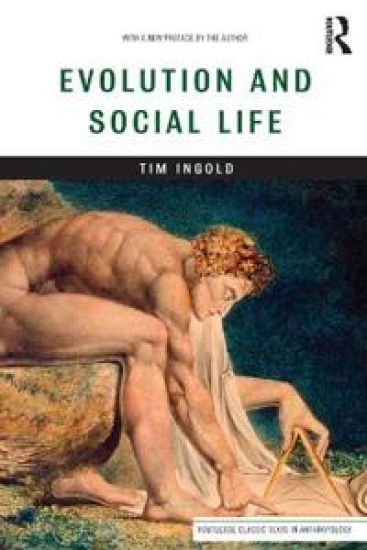
Evolution is among the most central and most contested of ideas in the history of anthropology. This book charts the fortunes of the idea from the mid-nineteenth century to recent times. By comparing biological, historical, and anthropological approaches to the study of human culture and social life, it lays the foundation for their effective synthesis. Far ahead of its time when first published, the book anticipates debates at the forefront of contemporary thinking. Revisiting the work after almost thirty years, Tim Ingold offers a substantial new preface that describes how the book came to be written, how it was received and its bearing on later developments. Unique in scope and breadth of theoretical vision, Evolution and Social Life cuts across the boundaries of natural science and the humanities to provide a major contribution both to the history of anthropological and social thought, and to contemporary debate on the relationship between human nature, culture, and social life.
Evolution and Social Life

Evolution and Social Life

Tim Ingold

Routledge
2016
nidottu
Evolution is among the most central and most contested of ideas in the history of anthropology. This book charts the fortunes of the idea from the mid-nineteenth century to recent times. By comparing biological, historical, and anthropological approaches to the study of human culture and social life, it lays the foundation for their effective synthesis. Far ahead of its time when first published, the book anticipates debates at the forefront of contemporary thinking. Revisiting the work after almost thirty years, Tim Ingold offers a substantial new preface that describes how the book came to be written, how it was received and its bearing on later developments. Unique in scope and breadth of theoretical vision, Evolution and Social Life cuts across the boundaries of natural science and the humanities to provide a major contribution both to the history of anthropological and social thought, and to contemporary debate on the relationship between human nature, culture, and social life.
Lines

Lines

Tim Ingold

Routledge
2016
nidottu
What do walking, weaving, observing, storytelling, singing, drawing and writing have in common? The answer is that they all proceed along lines. In this extraordinary book Tim Ingold imagines a world in which everyone and everything consists of interwoven or interconnected lines and lays the foundations for a completely new discipline: the anthropological archaeology of the line.Ingold’s argument leads us through the music of Ancient Greece and contemporary Japan, Siberian labyrinths and Roman roads, Chinese calligraphy and the printed alphabet, weaving a path between antiquity and the present. Drawing on a multitude of disciplines including archaeology, classical studies, art history, linguistics, psychology, musicology, philosophy and many others, and including more than seventy illustrations, this book takes us on an exhilarating intellectual journey that will change the way we look at the world and how we go about in it.This Routledge Classics edition includes a new preface by the author.
The Life of Lines

The Life of Lines

Tim Ingold

Routledge
2015
sidottu
To live, every being must put out a line, and in life these lines tangle with one another. This book is a study of the life of lines. Following on from Tim Ingold's groundbreaking work Lines: A Brief History, it offers a wholly original series of meditations on life, ground, weather, walking, imagination and what it means to be human. In the first part, Ingold argues that a world of life is woven from knots, and not built from blocks as commonly thought. He shows how the principle of knotting underwrites both the way things join with one another, in walls, buildings and bodies, and the composition of the ground and the knowledge we find there. In the second part, Ingold argues that to study living lines, we must also study the weather. To complement a linealogy that asks what is common to walking, weaving, observing, singing, storytelling and writing, he develops a meteorology that seeks the common denominator of breath, time, mood, sound, memory, colour and the sky. This denominator is the atmosphere. In the third part, Ingold carries the line into the domain of human life. He shows that for life to continue, the things we do must be framed within the lives we undergo. In continually answering to one another, these lives enact a principle of correspondence that is fundamentally social. This compelling volume brings our thinking about the material world refreshingly back to life. While anchored in anthropology, the book ranges widely over an interdisciplinary terrain that includes philosophy, geography, sociology, art and architecture.
The Life of Lines

The Life of Lines

Tim Ingold

Routledge
2015
nidottu
To live, every being must put out a line, and in life these lines tangle with one another. This book is a study of the life of lines. Following on from Tim Ingold's groundbreaking work Lines: A Brief History, it offers a wholly original series of meditations on life, ground, weather, walking, imagination and what it means to be human. In the first part, Ingold argues that a world of life is woven from knots, and not built from blocks as commonly thought. He shows how the principle of knotting underwrites both the way things join with one another, in walls, buildings and bodies, and the composition of the ground and the knowledge we find there. In the second part, Ingold argues that to study living lines, we must also study the weather. To complement a linealogy that asks what is common to walking, weaving, observing, singing, storytelling and writing, he develops a meteorology that seeks the common denominator of breath, time, mood, sound, memory, colour and the sky. This denominator is the atmosphere. In the third part, Ingold carries the line into the domain of human life. He shows that for life to continue, the things we do must be framed within the lives we undergo. In continually answering to one another, these lives enact a principle of correspondence that is fundamentally social. This compelling volume brings our thinking about the material world refreshingly back to life. While anchored in anthropology, the book ranges widely over an interdisciplinary terrain that includes philosophy, geography, sociology, art and architecture.
Making

Making

Tim Ingold

Routledge
2013
sidottu
Making creates knowledge, builds environments and transforms lives. Anthropology, archaeology, art and architecture are all ways of making, and all are dedicated to exploring the conditions and potentials of human life. In this exciting book, Tim Ingold ties the four disciplines together in a way that has never been attempted before. In a radical departure from conventional studies that treat art and architecture as compendia of objects for analysis, Ingold proposes an anthropology and archaeology not of but with art and architecture. He advocates a way of thinking through making in which sentient practitioners and active materials continually answer to, or ‘correspond’, with one another in the generation of form. Making offers a series of profound reflections on what it means to create things, on materials and form, the meaning of design, landscape perception, animate life, personal knowledge and the work of the hand. It draws on examples and experiments ranging from prehistoric stone tool-making to the building of medieval cathedrals, from round mounds to monuments, from flying kites to winding string, from drawing to writing. The book will appeal to students and practitioners alike, with interests in social and cultural anthropology, archaeology, architecture, art and design, visual studies and material culture.
Making

Making

Tim Ingold

Routledge
2013
nidottu
Making creates knowledge, builds environments and transforms lives. Anthropology, archaeology, art and architecture are all ways of making, and all are dedicated to exploring the conditions and potentials of human life. In this exciting book, Tim Ingold ties the four disciplines together in a way that has never been attempted before. In a radical departure from conventional studies that treat art and architecture as compendia of objects for analysis, Ingold proposes an anthropology and archaeology not of but with art and architecture. He advocates a way of thinking through making in which sentient practitioners and active materials continually answer to, or ‘correspond’, with one another in the generation of form. Making offers a series of profound reflections on what it means to create things, on materials and form, the meaning of design, landscape perception, animate life, personal knowledge and the work of the hand. It draws on examples and experiments ranging from prehistoric stone tool-making to the building of medieval cathedrals, from round mounds to monuments, from flying kites to winding string, from drawing to writing. The book will appeal to students and practitioners alike, with interests in social and cultural anthropology, archaeology, architecture, art and design, visual studies and material culture.
Comp Ency Anthropology

Comp Ency Anthropology

Tim Ingold

Routledge
1997
nidottu
This comprehensive survey of contemporary thought in biological, social and cultural anthropology sets the foundation for their future development and integration. The principal rationale behind the Encyclopedia is to overcome the division and fragmentation within the approaches of the humanities and natural sciences to anthropology. It emphasizes interconnections between perspectives and sub-disciplines, producing a complete perspective on what it means to be human. The work consists of three parts--Humanity, Culture, and Social Life--and 40 major contributions. Part One emphasizes human beings as members of a species, how that species differs from others, how it has evolved, and how human populations have adapted to and in turn transformed their environments. Part Two deals with the origin and structure of human culture, and on the role of culture in action, perception, and cognition. Part Three examines the various aspects of the relationships and processes that are carried on by persons and groups in the course of social life. Useful features such as cross-references within the text, full biographical references, suggestions for further reading and carefully illustrated line drawings make this an indispensable resource for all students of anthropology or sociology.
Tools, Language and Cognition in Human Evolution

Tools, Language and Cognition in Human Evolution

Kathleen R. Gibson; Tim Ingold

Cambridge University Press
1995
pokkari
The question addressed by this volume is how human beings have evolved as creatures who can make and use more complex tools, communicate in more complex ways and engage in more complex forms of social life than any other species in the animal kingdom. Leading researchers from fields as diverse as biological and social anthropology, archaeology, linguistics, psychology, neurology and ethology have come together to present a unique interdisciplinary study of this central question in human evolution. The topics explored include the parallels between speech, manual gesture and other modes of communication; comparisons of the tool-using skills and imitative abilities of humans and non-human primates and the neurological links between the cognitive processes involved in language. This important volume will be essential reading for all those interested in human evolution, be they philosophers, humanists or scientists.
Hunters, Pastoralists and Ranchers

Hunters, Pastoralists and Ranchers

Tim Ingold

Cambridge University Press
1988
pokkari
Throughout the northern circumpolar tundras and forests, and over many millennia, human populations have based their livelihood wholly or in part upon the exploitation of a single animal species–the reindeer. Yet some are hunters, others pastoralists, while today traditional pastoral economies are being replaced by a commercially oriented ranch industry. In this book, drawing on ethnographic material from North America and Eurasia, Tim Ingold explains the causes and mechanisms of transformations between hunting, pastoralism and ranching, each based on the same animal in the same environment, and each viewed in terms of a particular conjunction of social and ecological relations of production. In developing a workable synthesis between ecological and economic approaches in anthropology, Ingold introduces theoretically rigorous concepts for the analysis of specialized animal-based economies, which cast the problem of 'domestication' in an entirely new light.
The Skolt Lapps Today

The Skolt Lapps Today

Tim Ingold

Cambridge University Press
1976
pokkari
On the conclusion of the Second World War, Finland was obliged to cede its northeasternmost territory of Petsamo to the Soviet Union. Amongst those who lost their homes were around four hundred representatives of the original native population of the territory, the Skolt Lapps. The Skolts were subsequently resettled in two 'reservations' marked out in the wilderness of Finland's present northeastern borderlands. The contemporary organization of the Skolt community in the larger of these reservations, the Sevettijärvi area, is the subject of this 1976 study. The first part of the book the ecological imbalance created by technological innovation and commercial penetration; the second analyses the the activities and relationships built up on the fixes template of the resettlement plan; and the third explores the business of 'leap-frog' politics, which links the community into the machinery of modern government and the forum of debate on the future of native minorities.